30 July 1661: John Ray encounters the effigy of a tragic Inuit in his canoe at Hull Trinity House
John Ray and William Derham. 1760. Select Remains of the Learned John Ray, With His Life. London: George Scott. Get it:
.Unedited excerpt
If an excerpt is used in the book, it will be shorter, edited and, where applicable, translated.
[There are] two rooms above stairs, one very fair, where the brethren of the society meet, in which hang many tables of orders for the society’s government; another large chamber where they make sails: In the middle whereof hangeth the effigies of a native of Greenland, with a coat of skins upon him, sitting in a very small boat or canoe, covered with skins. He hath, in his right hand, a pair of wooden oars, wherewith he rows his boat; in his left a dart, with which he strikes fish. On his forehead a thing like a trencher, which serves as a bongrace [OED: A projecting brim or shade attached to the front of a bonnet or headdress, protecting the wearer’s face from the sun], to fence his eyes from the sun, and it may be too, from the dashing of the water. Behind him lies a bladder or skin-bag, in which we suppose he bestowed the fish be caught. (Some told us it was a bladder full of oil, with which he used to allure the fish to him). The boat iş covered over with the same it is made of, excepting one hole wherein he sits, just fitted to his body; so, that when he sits in it, his legs, and lower part, are under cover or deck; the boat is thus contrived, that when it shall be plunged by a wave, it may rise again, no water getting into it, This was the same individual canoe that was taken, with all its furniture or remex, anno 1613, in the sea, by Andrew Barker of Hull. The Greenlander taken, refused to eat, and died with hunger and sullenness, in the space of three days.


Comment
Comment
Here’s an image:
In 1613 Andrew Barker, an Elder Brother of Hull’s Trinity House & the captain of the Heartsease, took aboard an Inuit in a kayak off Greenland. The Inuit died 3 days later, but the 12-ft skin-covered kayak & its contents were brought home to Hull & are displayed in Trinity House. pic.twitter.com/7HsFqlTpj5— Former Lord Mayor of Kingston Upon Hull (@LordHull) July 16, 2020
Capt. Henry Watson, of the ship True-love, having brought a native of Davis’s Straits to Hull, he has exhibited his canoe, in the Old Dock, where he displayed his wonderful art in the management of that boat, so peculiar to his country, and his dexterity with the harpoon and lance (Phillips 1816).
Something to say? Get in touch
Tags
Tags are assigned inclusively on the basis of an entry’s original text and any comment. You may find this confusing if you only read an entry excerpt.
- Canoe (2) W/G ·
- Davis Strait (3) W/G ·
- Greenland (6) W/G ·
- Greenlandic Inuit (1) W/G ·
- Hull Trinity House (4) W/G ·
- International trade (17) W/G ·
- 📌Kingston upon Hull (74) W/G ·
- 📌Port of Hull (19) W/G ·
- Ray, John (1627-1705) (6), one of the earliest of the English parson-naturalists W/G ·
- Whaling in the United Kingdom (11) W/G ·
- Whaling (10) W/G ·
Comment
Comment
Here’s an image:
In 1613 Andrew Barker, an Elder Brother of Hull’s Trinity House & the captain of the Heartsease, took aboard an Inuit in a kayak off Greenland. The Inuit died 3 days later, but the 12-ft skin-covered kayak & its contents were brought home to Hull & are displayed in Trinity House. pic.twitter.com/7HsFqlTpj5— Former Lord Mayor of Kingston Upon Hull (@LordHull) July 16, 2020
Capt. Henry Watson, of the ship True-love, having brought a native of Davis’s Straits to Hull, he has exhibited his canoe, in the Old Dock, where he displayed his wonderful art in the management of that boat, so peculiar to his country, and his dexterity with the harpoon and lance (Phillips 1816).
Something to say? Get in touch
Similar
 3 July 1837: The Swan, a Hull whaler, returns from the dead (the ice of the Davis Strait) bearing three whales
 19 February 1866: The Diana, Hull’s first steam-assisted whaler and its last of any nature, leaves on its fateful voyage to the Arctic
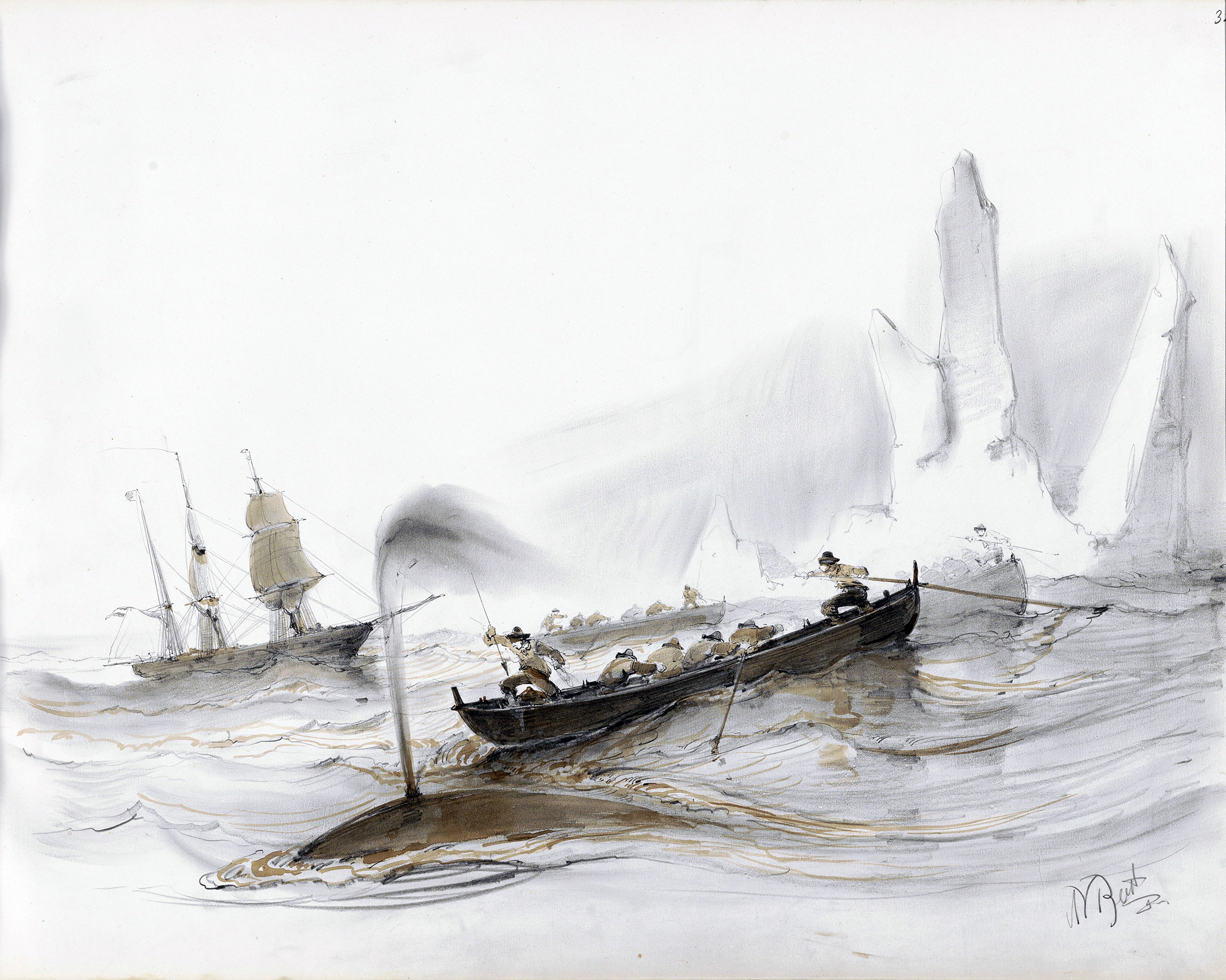 30 June 1866: The crew of the Diana of Hull kill and process two right whales – a small fortune – in Melville Bay, off northwestern Greenland
Comment
Comment
Something to say? Get in touch
Search
Subscribe/buy
Donate
Music & books
Place-People-Play: Childcare (and the Kazookestra) on the Headingley/Weetwood borders next to Meanwood Park.
Music from and about Yorkshire by Leeds's Singing Organ-Grinder.
 RSS feed
 Bluesky
 Extwitter