17 December 1688: Mass mobilisation in Leeds on rumours of an imminent Celtic counteroffensive against the Glorious Revolution
Thomas Brooke. 1889. Extracts from the Journal of Castilion Morris. Yorkshire Archaeological and Topographical Journal, Vol. 10. London: Yorkshire Archaeological and Topographical Association. Get it:
.Unedited excerpt
If an excerpt is used in the book, it will be shorter, edited and, where applicable, translated.
On Saturday, 15th December, 1688, an express was sent from York to Leeds with account that a party of Irish and Scots, lately disbanded, had burnt several towns, particularly Birmingham and Northampton, and were coming northward, whereupon strict watch and ward, horse and foot, of the most substantial householders in great numbers was kept in Leeds and all the country, the Papists were secured, particularly Mr Charles Killingbeck of Allerton Grange (hid in a neighbouring tenement), by Mr Nevile of Holbeck, captain of the guard that night. It was thought convenient this Sunday to send notes to be read in all the chapels to give notice to all masters of families with servants and all that were able to bear arms to come to Leeds by 10 o’clock the next morning, and to bring along with them scythes, forks or such weapons as they could procure, and accordingly I sent notes to the churches and chapels.
The next morning, being Monday 17th December, was an appearance of most of the parishioners of all ranks, the better sort (about 500) well accoutred with good horses, sword and pistols, the foot with swords, pikes, muskets, and others with scythes set lengthway upon shafts (a very dangerous weapon), at least 300, the rest of the foot or rabble with clubs, staves, etc., were computed to 5000, but most say six thousand men horse and foot in the … (illegible) … where we met, where we formed ourselves into a kind of body. Sir John Kay was colonel, Sir Michael Wentworth lieutenant-colonel, Mr. Nevile of Chevet major; and some troops of horse were framed the officers were:
| Captains. Gervase Nevile, Esq. Jasper Blythman, Esq. Dr Francis Wheatley. Robert Barnes, Gent. | Lieutenants. Alderman William Sawer. Alderman Thomas Potter. John Preston. |
| Cornets. John Skinner, Gent. Castilion Morris, Gent. John Jackson, Gent. | Quarter-Masters. Alderman Michael Idle. Jeremiah Barstow. |
The foot were framed into companies that I cannot enumerate.
About 8 of the clock on Monday night a great cry and shout was made by several men in the street, crying, “Arms, arms, arms, horse, horse, horse, foot, foot, foot,” by the noise of which I was awakened (being then gone to bed by reason I had been up the night before on the watch with Mr. Mayor), and hearing this noise increase called for a candle, got on my boots, left my wife in tears and children asleep, could procure no certain intelligence in the street, all was in such confusion, only a general cry that the enemy was at hand and that Beeston was fired. I then went through the crowd, which was very great going down the street towards the bridge, armed with swords, pistols, scythes, forks and other weapons. I rode to the bridge, etc., where I met some returning, who satisfied me it was a false alarm, with which the consternation of the town was allayed, but I was scarce fallen asleep when on a sudden, about one or two of the clock, I was awakened again with the like cry of “arms.” This was occasioned by Mr. Watson, a young merchant (formerly apprentice with Mr Richard Green), who was come in all haste from Mr Green of Hightown with information that news came to them there that Halifax was on fire and that Huddersfield was burnt, which occasioned another very great consternation in the town, for which some more ground, Halifax beacon being really fired by the inhabitants to give the country notice of the supposed danger, from whence the general alarm that passed through the whole country arose.
I will not presume to say, but the surmise was that the gentry who had appeared in several parts for the Prince of Orange had done it either with a design to draw the people in general to appear in arms as they had done, that all might be in the same circumstances with them, or else to see in how short a time and with what posture the kingdom would appear to defend themselves against Popery, and not a little probable to terrify that party.
[Then follows the story of Murgetroid the tailor and Mrs Skinner and her 3 servants, who left a great deal of plate in the midst of the room, 100 bag under the table, and fled with the children upon the servants’ backs to the woods near Kirkstall.]


Comment
Comment
Something to say? Get in touch
Tags
Tags are assigned inclusively on the basis of an entry’s original text and any comment. You may find this confusing if you only read an entry excerpt.
- Beacon (3) W/G ·
- Beeston, Leeds (6) W/G ·
- Birmingham (8) W/G ·
- Catholic Church (57) W/G ·
- Glorious Revolution (7) W/G ·
- 📌Halifax (43) W/G ·
- Hightown, West Yorkshire (1) W/G ·
- 📌Holbeck (10) W/G ·
- 📌Huddersfield (32) W/G ·
- Irish Catholics (10) W/G ·
- James II (20) W/G ·
- 📌Kirkstall (9) W/G ·
- 📌Leeds (249) W/G ·
- Military of Scotland (4) W/G ·
- Militia (5) W/G ·
- Northampton (2) W/G ·
- Scythe (3) W/G ·
- West Riding of Yorkshire (150) W/G ·
- William III (9) W/G ·
Comment
Comment
Something to say? Get in touch
Similar
 23 January 1643: Thomas Fairfax, the Rider of the White Horse, captures Leeds from the Beast with the help of Psalm 68
 12 December 1641: John Sugden causes panic in Bradford and Pudsey with news of the imminent advent of genocidal Irish Catholics
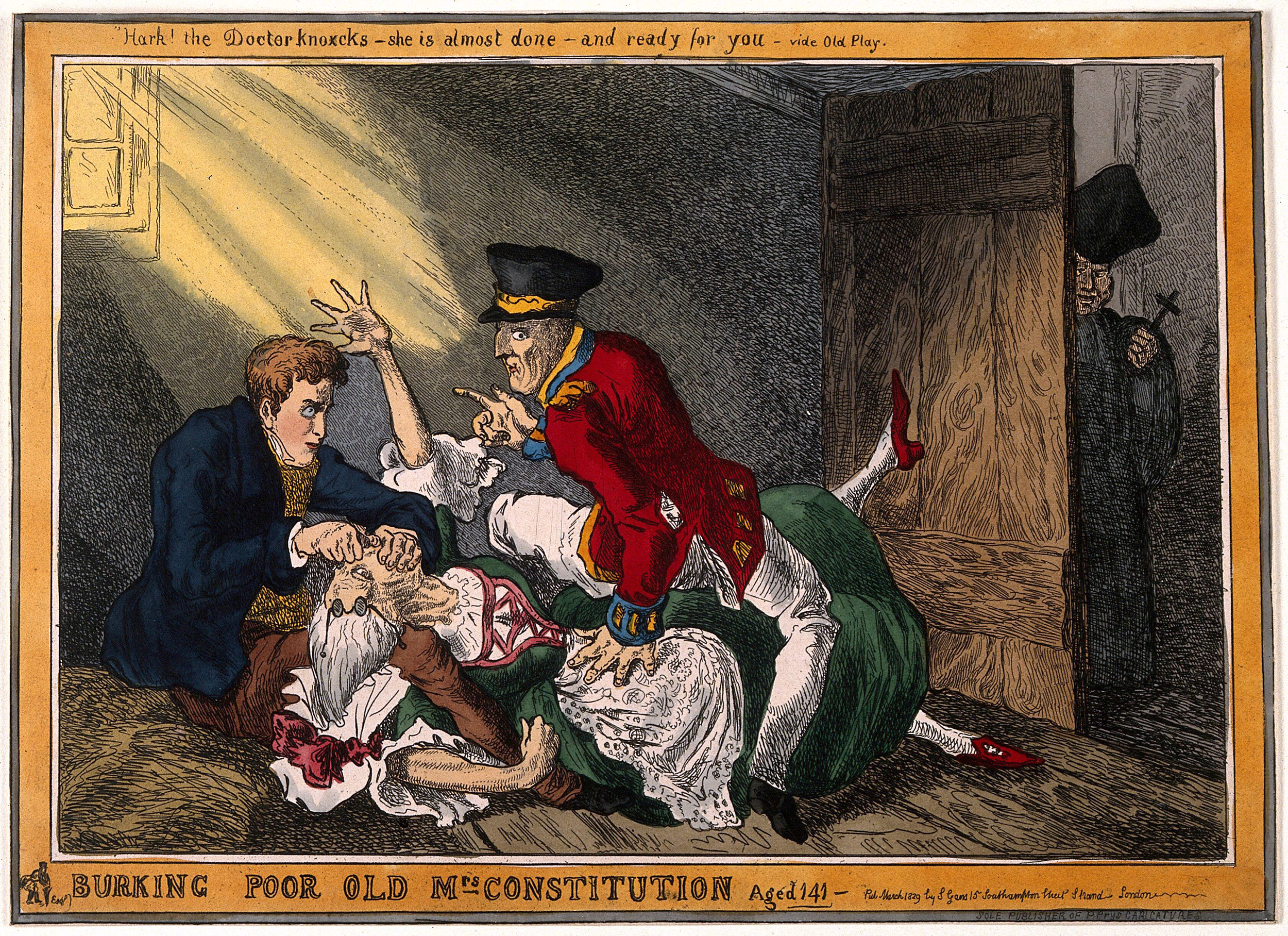 5 March 1829: Henry Burton of Hotham tells a rowdy public meeting at Beverley to petition parliament against Catholic emancipation and preserve “the Protestant constitution”
Comment
Comment
Rules is rules, but while the attack begins after midnight (12 April), archival research shows that the mob gathered before midnight (Luddite Bicentenary 2012/04/11), and so I’ve gone with 11 April.
From a report of the great trial in 1813:
Two greater outrages never were witnessed in a civilized country, than the attack made on the 11th of April upon the mill of Mr. Cartwright … and the burning of Messrs. Wroe and Duncuft’s manufactory at West Houghton in Lancashire, on the 24th of the same month. (Howell 1823)
Kevin Binfield quotes from a letter to Huddersfield magistrate Joseph Radcliffe from Colonel Thomas Norton describing the behaviour of Luddites hanged at York Castle during the first
two weeks of 1812:
You know how the three Murderers died, and the five Men for Rawfold’s Mill died precisely the same. The Chaplain told them it was his Duty to entreat them to confess. They were silent. He then told them he should take their Silence as confessions. They were still Silent on that Subject, but spoke Generally of their Sins. Thus in Fact tacitly allowing their Guilt as to the Offence they died for, but not doing so in Words…. Nor was one Word said by their People. (Binfield 2004)
There are great similarities with the assault on Robert Moore’s mill in Charlotte Brontë’s Shirley (Brontë 1857), in which Shirley is to a considerable degree based on local landowner Anne Lister, more recently mythologised as “the first modern lesbian” and “Gentleman Jack”:
All Stilbro’ Moor, alight and aglow with bonfires, would not have stopped them, nor would Calder or Aire thundering in flood. Yet one sound made them pause. Scarce had they set foot on the solid opposite bank when a shot split the air from the north. One second elapsed. Further off burst a like note in the south. Within the space of three minutes similar signals boomed in the east and west.
“I thought we were dead at the first explosion,” observed Shirley, drawing a long breath. “I felt myself hit in the temples, and I concluded your heart was pierced; but the reiterated voice was an explanation. Those are signals—it is their way—the attack must be near. We should have had wings. Our feet have not borne us swiftly enough.”
A portion of the copse was now to clear. When they emerged from it the mill lay just below them. They could look down upon the buildings, the yard; they could see the road beyond. And the first glance in that direction told Shirley she was right in her conjecture. They were already too late to give warning. It had taken more time than they calculated on to overcome the various obstacles which embarrassed the short cut across the fields.
The road, which should have been white, was dark with a moving mass. The rioters were assembled in front of the closed yard gates, and a single figure stood within, apparently addressing them. The mill itself was perfectly black and still. There was neither life, light, nor motion around it.
“Surely he is prepared. Surely that is not Moore meeting them alone?” whispered Shirley.
“It is. We must go to him. I will go to him.”
“That you will not.”
“Why did I come, then? I came only for him. I shall join him.”
“Fortunately it is out of your power. There is no entrance to the yard.”
“There is a small entrance at the back, besides the gates in front. It opens by a secret method which I know. I will try it.”
“Not with my leave.”
Miss Keeldar clasped her round the waist with both arms and held her back. “Not one step shall you stir,” she went on authoritatively. “At this moment Moore would be both shocked and embarrassed if he saw either you or me. Men never want women near them in time of real danger.”
“I would not trouble—I would help him,” was the reply.
“How?—by inspiring him with heroism? Pooh! these are not the days of chivalry. It is not a tilt at a tournament we are going to behold, but a struggle about money, and food, and life.”
“It is natural that I should be at his side.”
“As queen of his heart? His mill is his lady-love, Cary! Backed by his factory and his frames, he has all the encouragement he wants or can know. It is not for love or beauty, but for ledger and broadcloth, he is going to break a spear. Don’t be sentimental; Robert is not so.”
“I could help him; I will seek him.”
“Off then—I let you go—seek Moore. You’ll not find him.”
She loosened her hold. Caroline sped like levelled shaft from bent bow; after her rang a jesting, gibing laugh. “Look well there is no mistake!” was the warning given.
But there was a mistake. Miss Helstone paused, hesitated, gazed. The figure had suddenly retreated from the gate, and was running back hastily to the mill.
“Make haste, Lina!” cried Shirley; “meet him before he enters.”
Caroline slowly returned. “It is not Robert,” she said. “It has neither his height, form, nor bearing.”
“I saw it was not Robert when I let you go. How could you imagine it? It is a shabby little figure of a private soldier; they had posted him as sentinel. He is safe in the mill now. I saw the door open and admit him. My mind grows easier. Robert is prepared. Our warning would have been superfluous; and now I am thankful we came too late to give it. It has saved us the trouble of a scene. How fine to have entered the counting-house toute éperdue, and to have found oneself in presence of Messrs. Armitage and Ramsden smoking, Malone swaggering, your uncle sneering, Mr. Sykes sipping a cordial, and Moore himself in his cold man-of-business vein! I am glad we missed it all.”
“I wonder if there are many in the mill, Shirley!”
“Plenty to defend it. The soldiers we have twice seen to-day were going there, no doubt, and the group we noticed surrounding your cousin in the fields will be with him.”
“What are they doing now, Shirley? What is that noise?”
“Hatchets and crowbars against the yard gates. They are forcing them. Are you afraid?”
“No; but my heart throbs fast. I have a difficulty in standing. I will sit down. Do you feel unmoved?”
“Hardly that; but I am glad I came. We shall see what transpires with our own eyes. We are here on the spot, and none know it. Instead of amazing the curate, the clothier, and the corn-dealer with a romantic rush on the stage, we stand alone with the friendly night, its mute stars, and these whispering trees, whose report our friends will not come to gather.”
“Shirley, Shirley, the gates are down! That crash was like the felling of great trees. Now they are pouring through. They will break down the mill doors as they have broken the gate. What can Robert do against so many? Would to God I were a little nearer him—could hear him speak—could speak to him! With my will—my longing to serve him—I could not be a useless burden in his way; I could be turned to some account.”
“They come on!” cried Shirley. “How steadily they march in! There is discipline in their ranks. I will not say there is courage—hundreds against tens are no proof of that quality—but” (she dropped her voice) “there is suffering and desperation enough amongst them. These goads will urge them forwards.”
“Forwards against Robert; and they hate him. Shirley, is there much danger they will win the day?”
“We shall see. Moore and Helstone are of ‘earth’s first blood’—no bunglers—no cravens——”
A crash—smash—shiver—stopped their whispers. A simultaneously hurled volley of stones had saluted the broad front of the mill, with all its windows; and now every pane of every lattice lay in shattered and pounded fragments. A yell followed this demonstration—a rioters’ yell—a north-of-England, a Yorkshire, a West-Riding, a West-Riding-clothing-district-of-Yorkshire rioters’ yell.
You never heard that sound, perhaps, reader? So much the better for your ears—perhaps for your heart, since, if it rends the air in hate to yourself, or to the men or principles you approve, the interests to which you wish well, wrath wakens to the cry of hate; the lion shakes his mane, and rises to the howl of the hyena; caste stands up, ireful against caste; and the indignant, wronged spirit of the middle rank bears down in zeal and scorn on the famished and furious mass of the operative class. It is difficult to be tolerant, difficult to be just, in such moments.
Caroline rose; Shirley put her arm round her: they stood together as still as the straight stems of two trees. That yell was a long one, and when it ceased the night was yet full of the swaying and murmuring of a crowd.
“What next?” was the question of the listeners. Nothing came yet. The mill remained mute as a mausoleum.
“He cannot be alone!” whispered Caroline.
“I would stake all I have that he is as little alone as he is alarmed,” responded Shirley.
Shots were discharged by the rioters. Had the defenders waited for this signal? It seemed so. The hitherto inert and passive mill woke; fire flashed from its empty window-frames; a volley of musketry pealed sharp through the Hollow.
“Moore speaks at last!” said Shirley, “and he seems to have the gift of tongues. That was not a single voice.”
“He has been forbearing. No one can accuse him of rashness,” alleged Caroline. “Their discharge preceded his. They broke his gates and his windows. They fired at his garrison before he repelled them.”
What was going on now? It seemed difficult, in the darkness, to distinguish; but something terrible, a still-renewing tumult, was obvious—fierce attacks, desperate repulses. The mill-yard, the mill itself, was full of battle movement. There was scarcely any cessation now of the discharge of firearms; and there was struggling, rushing, trampling, and shouting between. The aim of the assailants seemed to be to enter the mill, that of the defenders to beat them off. They heard the rebel leader cry, “To the back, lads!” They heard a voice retort, “Come round; we will meet you.”
“To the counting-house!” was the order again.
“Welcome! we shall have you there!” was the response. And accordingly the fiercest blaze that had yet glowed, the loudest rattle that had yet been heard, burst from the counting-house front when the mass of rioters rushed up to it.
The voice that had spoken was Moore’s own voice. They could tell by its tones that his soul was now warm with the conflict; they could guess that the fighting animal was roused in every one of those men there struggling together, and was for the time quite paramount above the rational human being.
Both the girls felt their faces glow and their pulses throb; both knew they would do no good by rushing down into the mêlée. They desired neither to deal nor to receive blows; but they could not have run away—Caroline no more than Shirley; they could not have fainted; they could not have taken their eyes from the dim, terrible scene—from the mass of cloud, of smoke, the musket-lightning—for the world.
“How and when would it end?” was the demand throbbing in their throbbing pulses. “Would a juncture arise in which they could be useful?” was what they waited to see; for though Shirley put off their too-late arrival with a jest, and was ever ready to satirize her own or any other person’s enthusiasm, she would have given a farm of her best land for a chance of rendering good service.
The chance was not vouchsafed her; the looked-for juncture never came. It was not likely. Moore had expected this attack for days, perhaps weeks; he was prepared for it at every point. He had fortified and garrisoned his mill, which in itself was a strong building. He was a cool, brave man; he stood to the defence with unflinching firmness. Those who were with him caught his spirit, and copied his demeanour. The rioters had never been so met before. At other mills they had attacked they had found no resistance; an organized, resolute defence was what they never dreamed of encountering. When their leaders saw the steady fire kept up from the mill, witnessed the composure and determination of its owner, heard themselves coolly defied and invited on to death, and beheld their men falling wounded round them, they felt that nothing was to be done here. In haste they mustered their forces, drew them away from the building. A roll was called over, in which the men answered to figures instead of names. They dispersed wide over the fields, leaving silence and ruin behind them. The attack, from its commencement to its termination, had not occupied an hour.
Day was by this time approaching; the west was dim, the east beginning to gleam. It would have seemed that the girls who had watched this conflict would now wish to hasten to the victors, on whose side all their interest had been enlisted; but they only very cautiously approached the now battered mill, and when suddenly a number of soldiers and gentlemen appeared at the great door opening into the yard, they quickly stepped aside into a shed, the deposit of old iron and timber, whence they could see without being seen.
It was no cheering spectacle. These premises were now a mere blot of desolation on the fresh front of the summer dawn. All the copse up the Hollow was shady and dewy, the hill at its head was green; but just here, in the centre of the sweet glen, Discord, broken loose in the night from control, had beaten the ground with his stamping hoofs, and left it waste and pulverized. The mill yawned all ruinous with unglazed frames; the yard was thickly bestrewn with stones and brickbats; and close under the mill, with the glittering fragments of the shattered windows, muskets and other weapons lay here and there. More than one deep crimson stain was visible on the gravel, a human body lay quiet on its face near the gates, and five or six wounded men writhed and moaned in the bloody dust.
Miss Keeldar’s countenance changed at this view. It was the after-taste of the battle, death and pain replacing excitement and exertion. It was the blackness the bright fire leaves when its blaze is sunk, its warmth failed, and its glow faded.
“This is what I wished to prevent,” she said, in a voice whose cadence betrayed the altered impulse of her heart.
“But you could not prevent it; you did your best—it was in vain,” said Caroline comfortingly. “Don’t grieve, Shirley.”
“I am sorry for those poor fellows,” was the answer, while the spark in her glance dissolved to dew. “Are any within the mill hurt, I wonder? Is that your uncle?”
“It is, and there is Mr. Malone; and, O Shirley, there is Robert!”
“Well” (resuming her former tone), “don’t squeeze your fingers quite into my hand. I see. There is nothing wonderful in that. We knew he, at least, was here, whoever might be absent.”
“He is coming here towards us, Shirley!”
“Towards the pump, that is to say, for the purpose of washing his hands and his forehead, which has got a scratch, I perceive.”
“He bleeds, Shirley. Don’t hold me. I must go.”
“Not a step.”
“He is hurt, Shirley!”
“Fiddlestick!”
“But I must go to him. I wish to go so much. I cannot bear to be restrained.”
“What for?”
“To speak to him, to ask how he is, and what I can do for him.”
“To tease and annoy him; to make a spectacle of yourself and him before those soldiers, Mr. Malone, your uncle, et cetera. Would he like it, think you? Would you like to remember it a week hence?”
“Am I always to be curbed and kept down?” demanded Caroline, a little passionately.
“For his sake, yes; and still more for your own. I tell you, if you showed yourself now you would repent it an hour hence, and so would Robert.”
“You think he would not like it, Shirley?”
“Far less than he would like our stopping him to say good-night, which you were so sore about.”
“But that was all play; there was no danger.”
“And this is serious work; he must be unmolested.”
“I only wish to go to him because he is my cousin—you understand?”
“I quite understand. But now, watch him. He has bathed his forehead, and the blood has ceased trickling. His hurt is really a mere graze; I can see it from hence. He is going to look after the wounded men.”
Accordingly Mr. Moore and Mr. Helstone went round the yard, examining each prostrate form. They then gave directions to have the wounded taken up and carried into the mill. This duty being performed, Joe Scott was ordered to saddle his master’s horse and Mr. Helstone’s pony, and the two gentlemen rode away full gallop, to seek surgical aid in different directions.
Caroline was not yet pacified.
“Shirley, Shirley, I should have liked to speak one word to him before he went,” she murmured, while the tears gathered glittering in her eyes.
“Why do you cry, Lina?” asked Miss Keeldar a little sternly. “You ought to be glad instead of sorry. Robert has escaped any serious harm; he is victorious; he has been cool and brave in combat; he is now considerate in triumph. Is this a time—are these causes for weeping?”
“You do not know what I have in my heart,” pleaded the other—”what pain, what distraction—nor whence it arises. I can understand that you should exult in Robert’s greatness and goodness; so do I, in one sense, but in another I feel so miserable. I am too far removed from him. I used to be nearer. Let me alone, Shirley. Do let me cry a few minutes; it relieves me.”
Miss Keeldar, feeling her tremble in every limb, ceased to expostulate with her. She went out of the shed, and left her to weep in peace. It was the best plan. In a few minutes Caroline rejoined her, much calmer. She said, with her natural, docile, gentle manner, “Come, Shirley, we will go home now. I promise not to try to see Robert again till he asks for me. I never will try to push myself on him. I thank you for restraining me just now.”
“I did it with a good intention,” returned Miss Keeldar.
“Now, dear Lina,” she continued, “let us turn our faces to the cool morning breeze, and walk very quietly back to the rectory. We will steal in as we stole out. None shall know where we have been or what we have seen to-night; neither taunt nor misconstruction can consequently molest us. To-morrow we will see Robert, and be of good cheer; but I will say no more, lest I should begin to cry too. I seem hard towards you, but I am not so.”
The attack on Cartwright’s also features in Sykes’s novel, Ben o’ Bill’s (Sykes 1898).
Something to say? Get in touch
Search
Subscribe/buy
Donate
Music & books
Place-People-Play: Childcare (and the Kazookestra) on the Headingley/Weetwood borders next to Meanwood Park.
Music from and about Yorkshire by Leeds's Singing Organ-Grinder.
 RSS feed
 Bluesky
 Extwitter