8 December 1770: The Rev Henry Venn’s heart and lungs require removal from polluted Huddersfield to Cambridgeshire
John Venn. 1904. Annals of a Clerical Family. London: Macmillan. Get it:
.Unedited excerpt
If an excerpt is used in the book, it will be shorter, edited and, where applicable, translated.
It is a happy circumstance for me, since even you and all my dear friends in Yorkshire seem determined to place my removal to a lucrative motive, that the living I am going to will not suffer any such construction, nor will my circumstances be at all materially mended by it. But this does not in the least affect me, because I plainly perceive, every time I preach, how much I am hurt, and the very last time I preached in Bath chapel I had such a palpitation of heart (a thing I never had before) as soon as I sat down in the chair, as made me ready to faint away. This and many other symptoms I feel, but, because I am cheerful and ride about, my Yorkshire friends, through their affection for me, make little of the matter; and as Mrs. Jones expressed it, she said if she were one of the Huddersfield congregation she had sooner see me drop down dead than leave the place. I feel very sensibly what a total change in my condition this event will bring about; and if I seem to consult flesh and blood, there are many more comforts in Huddersfield than at Yelling. Do not you believe I enjoy the Word of God, the House of God, the Table of God, and the Ministers of God? and where are they to be enjoyed in that degree they are at Huddersfield? What is a little church with at most a hundred people? What is a small solitary village? What is the Lord’s Table, with perhaps twenty communicants, with what I have for near twenty years been used to? Only renew my strength and make me in any degree capable of the labour of my much-loved post, and I will be bound to strive rather than leave it.
[A later letter:]
Nothing would have prevailed on me to leave Huddersfield if my lungs had not received an irreparable injury, of which I am more sensible, by several symptoms, than ever. Looking upon my dissolution as at no great distance, I go to Yelling as a dying man.

Comment
Comment
In terms of his illness, what has Yelling got that Huddersfield hasn’t? Clean air? Josiah Bateman wrote a century later that the vicarage
was a very old building, in the worst part of the town, with a garden attached, in which nothing green would grow. Close by, a large, old-fashioned inn was standing, which in times past had been built upon the glebe, and now paid a good rent to the vicar. But all was hemmed in by tall chimneys and wretched buildings; and the house proved on trial an unhealthy residence. Again and again, one and another of my family was attacked with illness; again and again we were invited by kind parishioners to make their handsome houses in the outskirts our home for weeks together. But this could not last; and before a year had elapsed, a decision was required whether we should leave or stay; and that turned upon the retention of the old house, or the erection of a new one. I called a meeting in the vestry, and proposed the question with all simplicity. It was responded to with Yorkshire liberality and kindliness; and in the result a beautiful paddock of two acres and more, just outside the town, was exchanged (the exchange being legally necessary) for an equal quantity of glebe land, covered with gorse, five miles away; and two thousand two hundred pounds were raised to build a handsome Gothic vicarage (Bateman 1880).
But how dirty was the Industrial Revolution in Huddersfield at the time of Venn?
Something to say? Get in touch
Tags
Tags are assigned inclusively on the basis of an entry’s original text and any comment. You may find this confusing if you only read an entry excerpt.
- Air pollution (13) W/G ·
- Bateman, Josiah (ca. 1802-93) (1), clergyman and writer W/G ·
- Bath, Somerset (3) W/G ·
- Cambridgeshire (3) W/G ·
- Cardiovascular disease (1) W/G ·
- Horse (72) W/G ·
- 📌Huddersfield (32) W/G ·
- Industrial Revolution (22) W/G ·
- Pollution (10) W/G ·
- Pulmonary heart disease (1) W/G ·
- West Riding of Yorkshire (150) W/G ·
- Yelling, Cambridgeshire (1) W/G ·
Comment
Comment
In terms of his illness, what has Yelling got that Huddersfield hasn’t? Clean air? Josiah Bateman wrote a century later that the vicarage
was a very old building, in the worst part of the town, with a garden attached, in which nothing green would grow. Close by, a large, old-fashioned inn was standing, which in times past had been built upon the glebe, and now paid a good rent to the vicar. But all was hemmed in by tall chimneys and wretched buildings; and the house proved on trial an unhealthy residence. Again and again, one and another of my family was attacked with illness; again and again we were invited by kind parishioners to make their handsome houses in the outskirts our home for weeks together. But this could not last; and before a year had elapsed, a decision was required whether we should leave or stay; and that turned upon the retention of the old house, or the erection of a new one. I called a meeting in the vestry, and proposed the question with all simplicity. It was responded to with Yorkshire liberality and kindliness; and in the result a beautiful paddock of two acres and more, just outside the town, was exchanged (the exchange being legally necessary) for an equal quantity of glebe land, covered with gorse, five miles away; and two thousand two hundred pounds were raised to build a handsome Gothic vicarage (Bateman 1880).
But how dirty was the Industrial Revolution in Huddersfield at the time of Venn?
Something to say? Get in touch
Similar
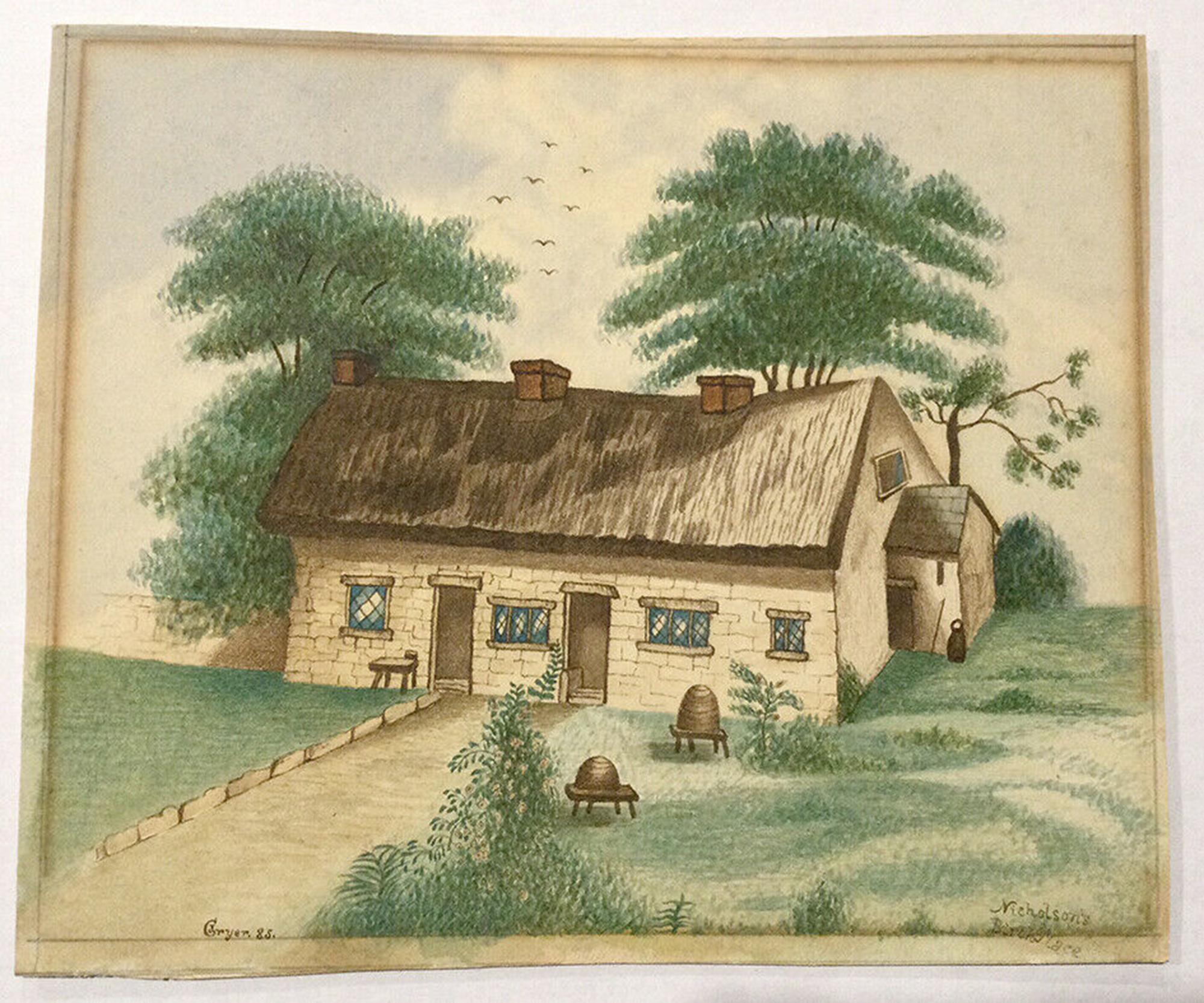 14 April 1843: John Nicholson, “the Airedale Poet,” “the Bingley Baron,” dies after falling into the Aire while drunk
Comment
Comment
Rimbault quotes one John Gregory, who in the Sarum Processionale found the following:
The Episcopus Choristarum was a chorister-bishop chosen by his fellow children upon St. Nicholas’ day… From this day till Innocents’ day at night (it lasted longer at the first), the Episcopus Puerorum [Boy-Bishop] was to bear the name and hold up the state of a bishop, answerably habited, with a crosier or pastoral staff in his hand, and a miter upon his head; and such an one too som had, as was multis episcoporum mitris sumtuosior, saith one – very much richer than those of bishops indeed. The rest of his fellows from the same time being were to take upon them the style and counterfeit of prebends, yielding to their bishops (or else as if it were) no less then canonical obedience. And look what service the very bishop himself with his dean and prebends (had they been to officiate) was to have performed, the mass excepted, the verie same was done by the chorister-bishop and his canons upon this Eve and the Holy Day.
This may be the origin of the York ritual, which nevertheless, and for reasons unknown to me, starts and ends later. The “account of Nicholas of Newark, guardian of the property of John de Cave, boy bishop in the year of our Lord 96” accounts for receipts (offerings in the cathedral, from canons, and from the nobility and monasteries visited) and expenditure (clothing, beer, food, music, etc.). The world-turned-upside-down visitations of the episcopus puerorum/Innocencium and his band remind me somewhat like those practised by the Raad van Elf of carnival associations in the Catholic Netherlands. Was there a similar serious business + drunken fun combination? For example, “the medieval breviary in the Sarum (but not in the Roman) use prescribed ‘O Virgo Virginum’ as antiphon upon the Magnificat for December 23, but was it sung for the boy-bishop on 23 December in humorous reference to his postulated sexual inexperience?
O Virgin of Virgins, how shall this be? For neither before thee was any like thee, nor shall there be after. Daughters of Jerusalem, why marvel ye at me? That which ye behold is a divine mystery (Bls 2007/12/23).
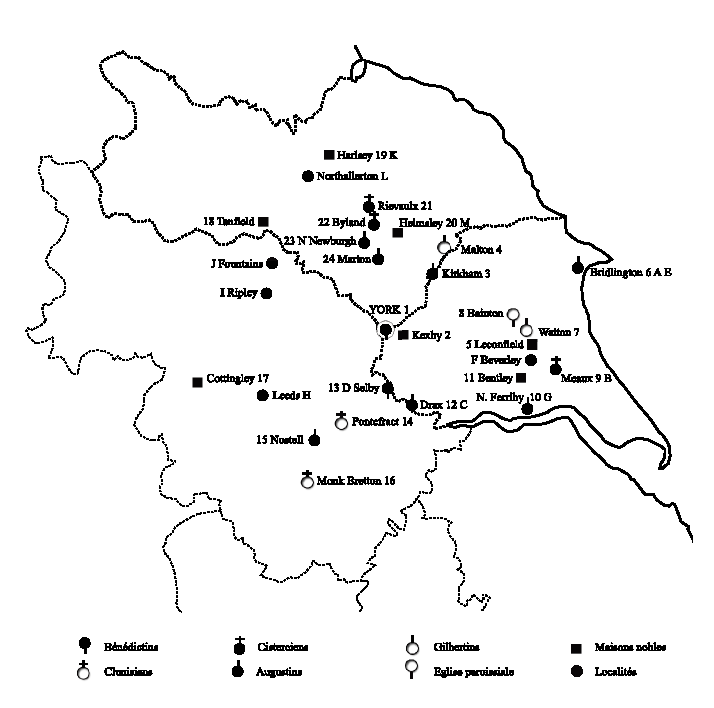
Yann Dahhaoui has compiled a map showing the locations visited by John de Cave numbered in chronological order:
There is a 13th century sculpture of what some say is a boy bishop at the marvellous St Oswald’s Church, Filey – the church guide suggests that it might instead by
one of the canons regular of St Augustine, a member of Bridlington Priory who served the church at Filey. It was not uncommon in the 13th and 14th centuries for such a person to keep up his connection with the church by having his heart buried there with an appropriate miniature representation of himself in stone.
The account documents 42 days starting on 23 December, but I don’t know how long John de Cave’s rule actually lasted. Liz Truss managed 49 days.
Irrelevant, but St. William is presumably William of Donjeon/Bourges, whose feast day is 10 January, to which 7 January was the closest Sunday.
https://archive.org/details/stationsofsunhis0000hutt/page/100/mode/1up
Something to say? Get in touch
Search
Subscribe/buy
Donate
Music & books
Place-People-Play: Childcare (and the Kazookestra) on the Headingley/Weetwood borders next to Meanwood Park.
Music from and about Yorkshire by Leeds's Singing Organ-Grinder.
 RSS feed
 Bluesky
 Extwitter