7 October 1830: Mrs Stanley arrives in Leeds from London, to the surprise of her husband
John Mayhall. 1860. The Annals and History of Leeds, and Other Places in the County of York. Leeds: Joseph Johnson. Get it:
.Unedited excerpt
If an excerpt is used in the book, it will be shorter, edited and, where applicable, translated.
Oct. 8th. Immense sensation was caused in Leeds by the apprehension on a charge of bigamy, of John Stanley, of Crimbles lodge, Camp-road, a most respectable wool merchant and broker. It appears that on the 16th of June, 1829, at Knaresbro’, Mr. Stanley was married to Ann Daniel, governess to Mr. William Gott’s children. On the 7th of October, 1830,a bustling good looking female, attended by her son, aged 22 years, arrived in Leeds from Cumberwell, near London. She brought a letter to a respectable resident, and immediately introduced herself as the wife of Mr. Stanley, whom she married in 1806. She stated also, that she had borne him eleven children, six of whom were living, and the eldest of whom accompanied her. In support of these and other allegations, she produced a regular marriage certificate. Mr. Sowrey, the constable, had charge of the prisoner at Crimbles house, where Mr. Gott and Mr. Barr were taking the usual information in such cases. By some means or other the prisoner was suffered to escape, and was not heard of afterwards.


Comment
Comment
Anyone know where he escaped to? At the time conspiracy theories may have said that Gott had had him killed.
Something to say? Get in touch
Tags
Tags are assigned inclusively on the basis of an entry’s original text and any comment. You may find this confusing if you only read an entry excerpt.
- Bigamy (2) W/G ·
- Camberwell (1) W/G ·
- Corruption (13) W/G ·
- Gott, William (1797-1863) (4), Leeds wool merchant, mill owner, philanthropist, and art collector W/G ·
- Knaresborough (9) W/G ·
- 📌Leeds (249) W/G ·
- London (84) W/G ·
- Police corruption (2) W/G ·
Comment
Comment
Anyone know where he escaped to? At the time conspiracy theories may have said that Gott had had him killed.
Something to say? Get in touch
Similar
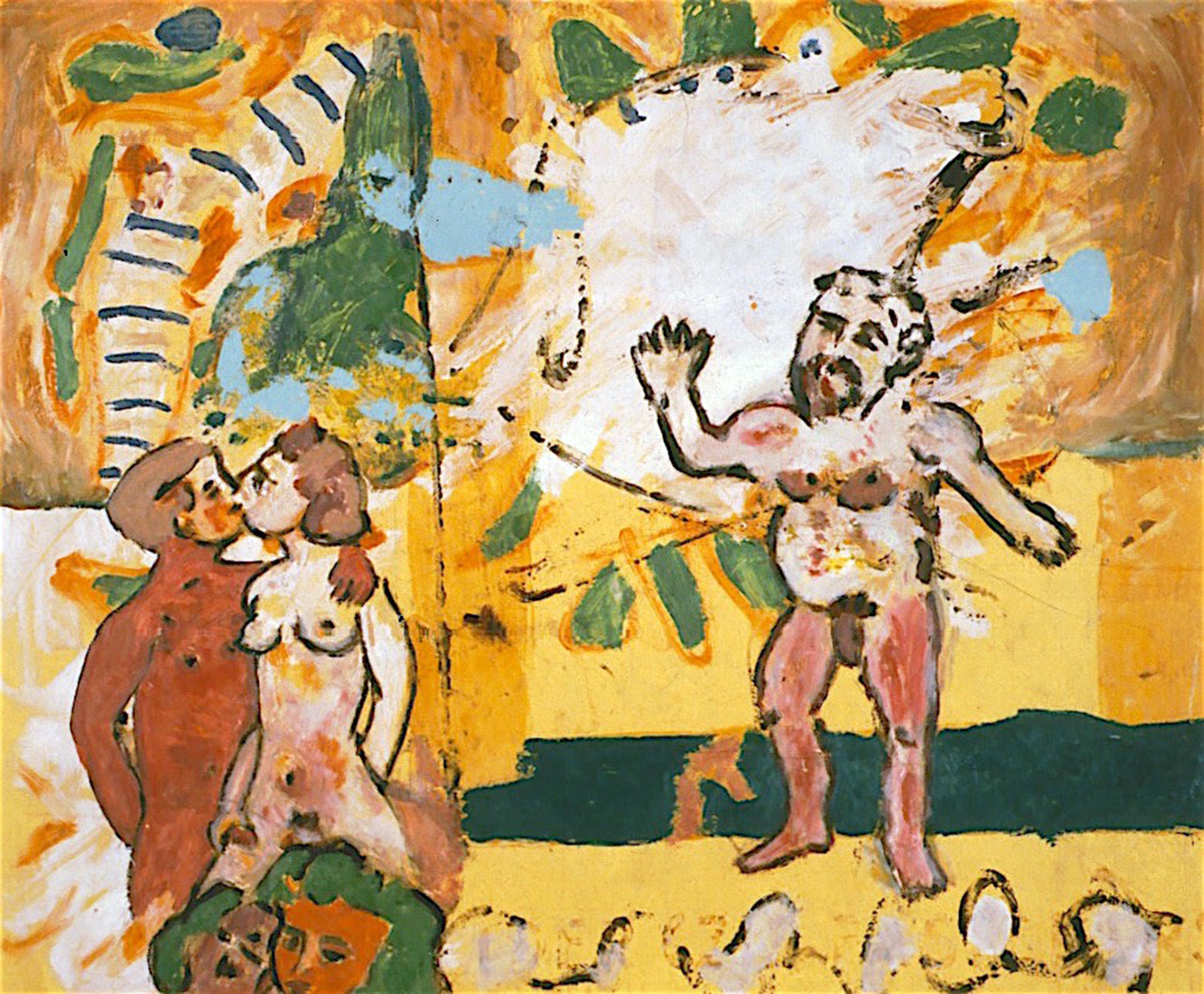 Reproduction by kind permission of Michael Paraskos.20 December 1966: Greek-Cypriot cook and artist Stass Paraskos appears before Leeds magistrates charged with obscenity under the Vagrancy Act 1838
Comment
Comment
Via Roy Wiles (Wiles 1965).
Events
“Sunday last” is 25 August, but Fawcett managed to get in by 11 September:
On Wednesday last Mr. Fawcett for the first time performed Divine Service in the chapel of Holbeck, but was escorted to and from the chapel by a party of Dragoons, who kept guard at the doors during the service. Notwithstanding this precaution, some evil-disposed people found means to break the windows and throw a brickbat at Mr. Fawcett while he was in the reading- desk. The Sunday following he went through the service unmolested. And on Sunday last he preached a most excellent sermon, 46th verse of 13th chapter of Acts… The same night some prophane sacrilegious villains broke into the chapel and besmeared the seats with human excrements.
On 22 September he was able to conduct a reduced Sunday service in peace:
On Sunday last the Rev. Mr. Fawcett was received and behav’d to by his congregation at Holbeck with great decency… One of Mr. F.’s friends admitted their favourite preacher to his pulpit in the town-by this means the tumultuous part of the people were mostly drawn away from Holbeck, and the curate left at liberty to perform his duty amongst the peaceable and well-disposed inhabitants of the chapelry.
However, on 22 October we read that
In the night between the 16th and 17th inst., the windows of the chapel of Holbeck were again broken. No wonder, when Holbeck contains such a nest of vermin whom neither the laws of God or man can confine within the bounds of decency, etc.
For which John Robinson, a “Houlbecker,” was in November sentenced to be whipped and to pay a fine of £5 (Griffith Wright 1895).
In the summer of the following year he published his first Sunday’s sermon and and his resignation letter. I think that in the following Fawcett is quoting things actually said to him:
A man might oftentimes, by due Care and Watchfulness, perhaps very safely defeat the Schemes, and discourage the Practices of the private Pilferer; and yet, whenever this is done, it is commonly suspected to be done rather for the Preservation of his own Property, than out of a pure Regard to the Public-good: But when he is attack’d in his house, or upon the road by open Plunderers, and requir’d to deliver, or suffer himself to be rifl’d of what he is possess’d of, with some one of these dreadful Alternatives, of having his Brains immediately blown out,” or their hands “wash’d in his hearts Blood,” or “having bis “Entrails pull’d out at his Mouth,” or “being “buried alive,” it will Then surely be accounted highly Romantic in him to reject their demands, out of a Pretence to prevent the bad Influence of their Example; and he will be generally suspected of giving a Proof of his Fool-hardiness or his Avarice, rather than of his public Spirit, by such a Refusal.
In the resignation letter he says that he
perform’d the Duty of the Curacy for near Three Months after he gain’d Admission into the Chapel, and this too, rather to prepare a Say for the peaceable Reception of any other Person whom the Patron shou’d think proper to nominate, that out of any Prospect of reconciling the People to himself.
Fawcett declines to attribute responsibility (“Who the Incendiaries were, the Sufferer neither Pretends to Know, nor Desires to be Inform’d”). He also explicitly excuses the lord of the manor, who at this juncture I take to be Lord Irwin (aka Henry Ingram, 7th Viscount of Irvine) rather than the Whiggish Scholey family, as well as other leading citizens (Fawcett 1755).
Was Fawcett a lousy preacher, or was the mob’s alternative, whoever he was, utterly adorable? Was there a Whiggish or Radical element at work? Was there some element of revenge for Samuel Kirshaw’s victory over James Scott in the struggle from 1745-51 for the vicarage of Leeds (Taylor 1865)? Perhaps you know.
Something to say? Get in touch
Search
Subscribe/buy
Donate
Music & books
Place-People-Play: Childcare (and the Kazookestra) on the Headingley/Weetwood borders next to Meanwood Park.
Music from and about Yorkshire by Leeds's Singing Organ-Grinder.
 RSS feed
 Bluesky
 Extwitter