1 July 1840: The opening of the Hull and Selby Railway terminates the threat to Hull’s port from Goole, Scarborough and Bridlington
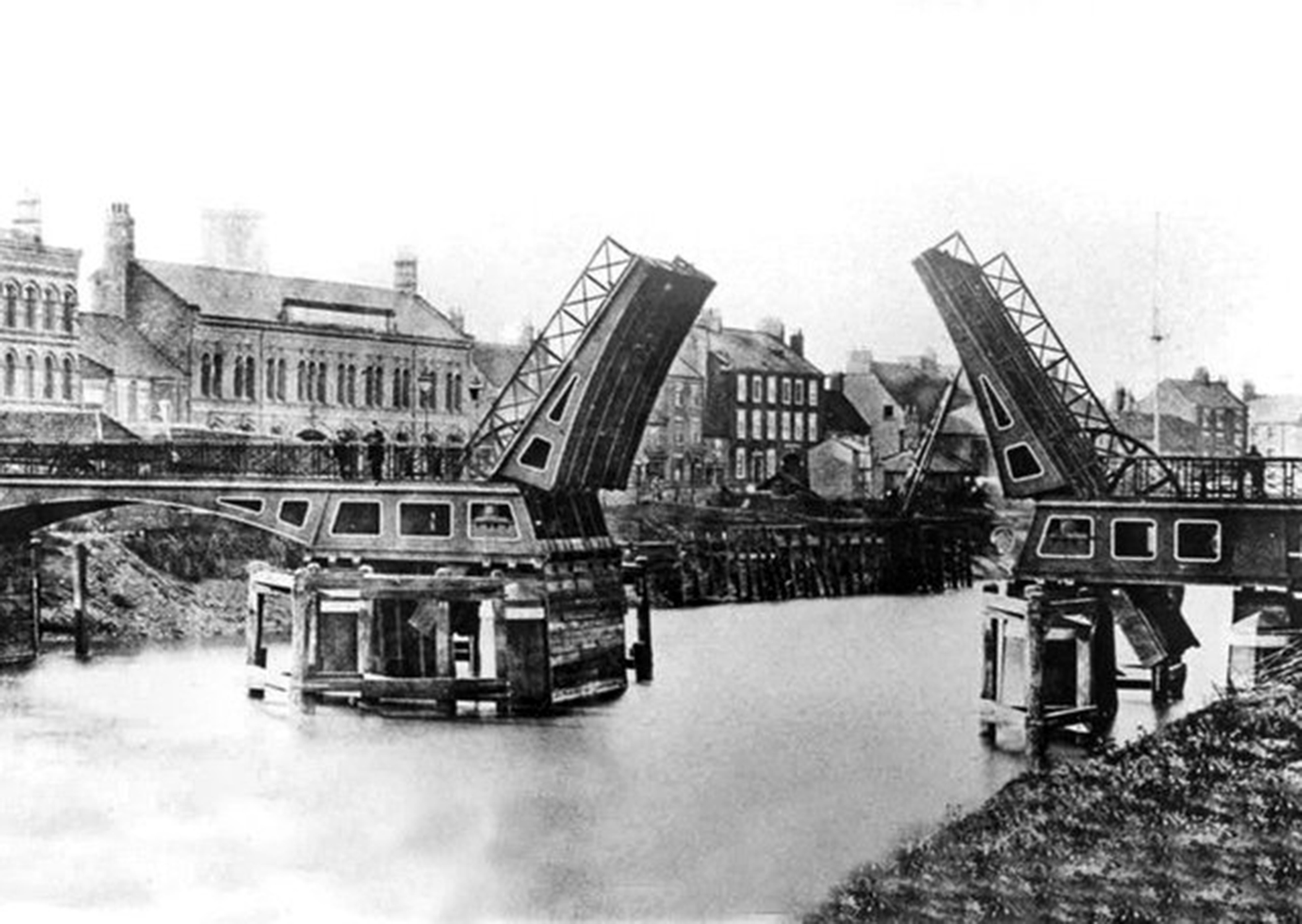
The 1840 double-leaf bascule bridge at Selby (Tomlinson 1915).
William Weaver Tomlinson. 1915. The North Eastern Railway. Newcastle-upon-Tyne: Andrew Reid and Company. Get it:
.Unedited excerpt
If an excerpt is used in the book, it will be shorter, edited and, where applicable, translated.
There was no partial opening of the Hull and Selby Railway — the whole line, 30¾ miles in length, from one parliamentary limit to the other, was brought into use on the 1st of July. Connecting Hull with the Midlands, as well as with the West Riding of Yorkshire, it completed one of the most important trade routes in the country. Hull was the principal port of shipment for the Baltic, and the goods shipped in its docks — cottons of Manchester, woollens and linens of Leeds, lace and net of Nottingham, etc., represented in value one-fifth of the exports of the United Kingdom.
During the early part of the opening day rain fell in torrents, and a public procession through the principal streets, which was to have formed part of the ceremonial proceedings, had to be abandoned. At ten minutes past twelve o’clock four trains left Hull for Selby, the first consisting of eleven carriages, the second of eight, the third of eight, and the fourth of seven. The locomotive engines employed on this occasion were the Exley,[ref]Tomlinson: Called after John Exley, an officer of the Custom House at Hull, whose letter in the Hull Rockingham of 28th December, 1833, started the agitation for a railway between Hull and Selby which eventually led to the formation of the Company. Eastern Counties Herald, 2nd July, 1840.[/ref] the Andrew Marvell, the Kingston, and the Selby, built by Messrs. Fenton, Murray and Jackson, of Leeds, and the Prince, lent by the Leeds and Selby Railway Company. Having the Humber for a considerable distance like a broad lake on one side and the Yorkshire Wolds on the other, the trains travelled at a moderate pace past Hessle, Brough, Eastrington, and Wressle, and, crossing the Ouse in close processional order, arrived at Selby at a quarter past two. Leaving Selby at four o’clock, they travelled at an average speed of from 20 to 30 miles an hour, the first train performing the journey in an hour and a minute, exclusive of stoppages, and the others within an hour and a quarter. Brilliant sunshine having succeeded the showers, a large number of spectators had gathered to welcome the returning trains, which were loudly cheered as they passed over the embankment along the foreshore to the terminus near the Humber Dock. There was a dinner in the new goods warehouse, at which speeches were delivered by Henry Broadley, M.P., George Hudson, and others, and then a special train passed along the line from Hull to Selby, conveying the gentlemen of York and Leeds who had been present at the dinner.[ref]Leeds Mercury, 4th July, 1840.[/ref]
A gently undulating line, the Hull and Selby Railway had no gradient steeper than 1 in 572 except when rising towards or falling from a bridge. There was no railway in the kingdom which passed over so level a surface. For 18 miles it was as straight as an arrow. The only earthwork at all noticeable was a cutting at Hessle cliff, 40 feet deep, from which about 230,000 cubic yards of chalk and gravel had been removed.[ref]Proc. Inst. Civil Engineers, vol. 128, p. 207, and vol. 57, p. 31.[/ref] The principal engineering feature on the line was a cast-iron bascule bridge over the River Ouse (1837-40), 191 feet 6 inches in length and 24 feet 1 inch in width over all.[ref]Ibid., vol. 4, p. 86 (with illustrations).[/ref] The movable arch, allowing a clear waterway of 45 feet, consisted of two flaps, with counterpoised tail ends. Each flap, weighing 92¾ tons, was raised and lowered by means of a quadrant and rack worked by hand, the time necessary for either operation being from 50 seconds to a minute. The movable arch was first raised to admit the passage of a vessel on the 13th of February, 1840.
The most interesting feature of the Hull and Selby Railway was its permanent way, which had been adopted by Messrs. Walker and Burges after a personal examination of all the other lines in the country. About 17 miles of the railway were laid with longitudinal, and the remainder with cross, sleepers. The rails were flat-bottomed, or, as they were called, ” web-footed,” those used for the longitudinal sleepers — 2¾ inches in depth — weighing 55 pounds per yard, and those for the cross sleepers — 3¾ inches in depth — 63 pounds. These rails, instead of being bolted down to the sleepers, as on the Newcastle and North Shields Railway, were set respectively in saddles and chairs, and secured to them by means of oak keys, 7 inches long.[ref]Whishaw’s Railways of Great Britain, 1842, p. 165.[/ref] The gauge was 4 feet 9 inches, the variation of half an inch from the standard gauge being made to give more play to the flanges of the wheels.
[A description of the first facilities at Hull and an image.]

Comment
Comment
HULL AND SELBY, OR HULL AND LEEDS JUNCTION, RAILWAY.OPENING OF THE LINEFOR PASSENGERS AND PARCELS ONLY,ON THURSDAY, JULY THE 2nd, 1840The Public are respectfully informed that this RAILWAY will be OPENED THROUGHOUT from HULL to the JUNCTION with the LEEDS and SELBY RAILWAY, at Selby, on WEDNESDAY, the First Day of July next, and that PASSENGERS and PARCELS only will be conveyed on THURSDAY, July 2nd; thus presenting a direct Railway Conveyance from Hull to Selby, Leeds, and York without change of Carriage.
TRAINS WITH PASSENGERS WILL START FROM HULL AS UNDER
AT SEVEN O’CLOCK, A.M. AT THREE O’CLOCK, P.M. AT TEN O’CLOCK, A.M. AT SIX O’CLOCK, P.M. ON SUNDAYS, AT SEVEN O’CLOCK, A.M., AND SIX O’CLOCK, P.M.The Trains from LEEDS and YORK, for HULL, will depart from those Places at the same Hours; and Passengers and Parcels may be Booked through at the Leeds, York, and Hull Stations. Arrangements are also in progress for Booking Passengers to Sheffield, Derby, Birmingham, and London.
THE FARES TO BE CHARGED ARE AS UNDER:
First Class. Second Class. Third Class. Hull to Selby 4s. 6d. 4s. 0d. 2s. 6d. Hull to York 8s. 0d. 6s. 6d. 4s. 6d. Hull to Leeds 8s. 0d. [£41.67 in 2020] 6s. 6d. [£33.86 in 2020] 4s. 6d. [£23.44 in 2020] No Fees are allowed to be taken by the Guards, Porters, or any other Servants of the Company.
The Trains, both up and down, will call at the Stations on the Line, viz.: Hessle, Ferriby, Brough, Staddlethorpe, Eastrington, Howden, and Cliff.
Arrangements for carrying Goods, Cattle, Sheep, &c., will be completed in a short time, of which due Notice will be given.
By Order,
GEORGE LOCKING, Secretary.
Railway Office, Hull, June 24th, 1840.

The company seal (Tomlinson 1915).
Great stuff in this Yorkshire Post piece on the Selby bridge.
Something to say? Get in touch
Tags
Tags are assigned inclusively on the basis of an entry’s original text and any comment. You may find this confusing if you only read an entry excerpt.
- Baltic Sea (6) W/G ·
- Birmingham (8) W/G ·
- Bridlington (10) W/G ·
- Brough railway station (1) W/G ·
- Brough (1) W/G ·
- Cattle (26) W/G ·
- Cliffe, Selby (1) W/G ·
- Cotton (8) W/G ·
- Derby (3) W/G ·
- East Riding of Yorkshire (67) W/G ·
- Eastrington railway station (1) W/G ·
- Eastrington (1) W/G ·
- Fenton, Murray and Jackson (1) W/G ·
- Ferriby railway station (1) W/G ·
- George Hudson (4) W/G ·
- Gilberdyke railway station (1) W/G ·
- Gilberdyke (1) W/G ·
- Goole (8) W/G ·
- Hemingbrough railway station (1) W/G ·
- Henry Broadley (1) W/G ·
- Hessle (3) W/G ·
- Howden railway station (1) W/G ·
- Howden (3) W/G ·
- Hull City Council (2) W/G ·
- Hull and Selby Railway (1) W/G ·
- Humber (21) W/G ·
- International trade (17) W/G ·
- John Gray (locomotive engineer) (1) W/G ·
- John Timperley (civil engineer) (1) W/G ·
- 📌Kingston upon Hull (74) W/G ·
- Lace (1) W/G ·
- Leeds and Selby Railway (2) W/G ·
- 📌Leeds (249) W/G ·
- London (84) W/G ·
- Manchester (22) W/G ·
- Marvell, Andrew (1621-78) (5), metaphysical poet, satirist and politician, friend of John Milton, born near Hull W/G ·
- Newcastle and North Shields Railway (1) W/G ·
- North Ferriby (2) W/G ·
- North Sea (20) W/G ·
- 📌Port of Hull (19) W/G ·
- Rail transport (24) W/G ·
- Rain (15) W/G ·
- River Derwent, Yorkshire (3) W/G ·
- River Ouse, Yorkshire (19) W/G ·
- 📌Scarborough (21) W/G ·
- Selby railway station (1) W/G ·
- Selby (8) W/G ·
- Sheep (28) W/G ·
- 📌Sheffield (80) W/G ·
- Textile manufacturing (60) W/G ·
- West Riding of Yorkshire (150) W/G ·
- Wool (28) W/G ·
- Wressle (2) W/G ·
- 📌York (165) W/G ·
Comment
Comment
HULL AND SELBY, OR HULL AND LEEDS JUNCTION, RAILWAY.OPENING OF THE LINEFOR PASSENGERS AND PARCELS ONLY,ON THURSDAY, JULY THE 2nd, 1840The Public are respectfully informed that this RAILWAY will be OPENED THROUGHOUT from HULL to the JUNCTION with the LEEDS and SELBY RAILWAY, at Selby, on WEDNESDAY, the First Day of July next, and that PASSENGERS and PARCELS only will be conveyed on THURSDAY, July 2nd; thus presenting a direct Railway Conveyance from Hull to Selby, Leeds, and York without change of Carriage.
TRAINS WITH PASSENGERS WILL START FROM HULL AS UNDER
AT SEVEN O’CLOCK, A.M. AT THREE O’CLOCK, P.M. AT TEN O’CLOCK, A.M. AT SIX O’CLOCK, P.M. ON SUNDAYS, AT SEVEN O’CLOCK, A.M., AND SIX O’CLOCK, P.M.The Trains from LEEDS and YORK, for HULL, will depart from those Places at the same Hours; and Passengers and Parcels may be Booked through at the Leeds, York, and Hull Stations. Arrangements are also in progress for Booking Passengers to Sheffield, Derby, Birmingham, and London.
THE FARES TO BE CHARGED ARE AS UNDER:
First Class. Second Class. Third Class. Hull to Selby 4s. 6d. 4s. 0d. 2s. 6d. Hull to York 8s. 0d. 6s. 6d. 4s. 6d. Hull to Leeds 8s. 0d. [£41.67 in 2020] 6s. 6d. [£33.86 in 2020] 4s. 6d. [£23.44 in 2020] No Fees are allowed to be taken by the Guards, Porters, or any other Servants of the Company.
The Trains, both up and down, will call at the Stations on the Line, viz.: Hessle, Ferriby, Brough, Staddlethorpe, Eastrington, Howden, and Cliff.
Arrangements for carrying Goods, Cattle, Sheep, &c., will be completed in a short time, of which due Notice will be given.
By Order,
GEORGE LOCKING, Secretary.
Railway Office, Hull, June 24th, 1840.
The company seal (Tomlinson 1915).
Great stuff in this Yorkshire Post piece on the Selby bridge.
Something to say? Get in touch
Similar
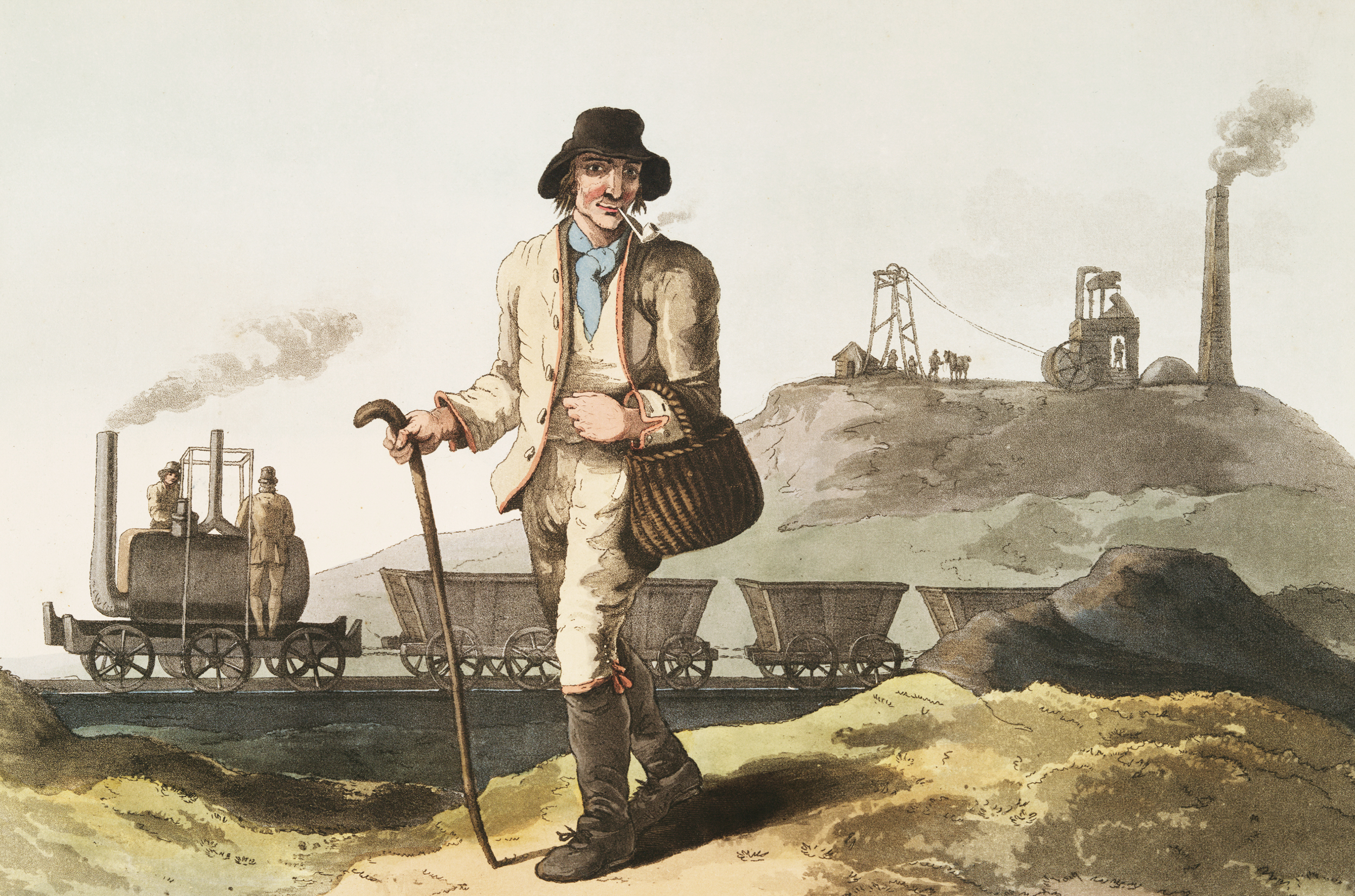 9 June 1758: Entry into law of the first dedicated railway enabling act, for Richard Humble and Charles Brandling’s wagonway from Middleton Colliery to the Aire at Leeds
Comment
Comment
The fiscal fatigue caused by the Hundred Years’ War was a cause of the 1343-45 Truce of Malestroit.
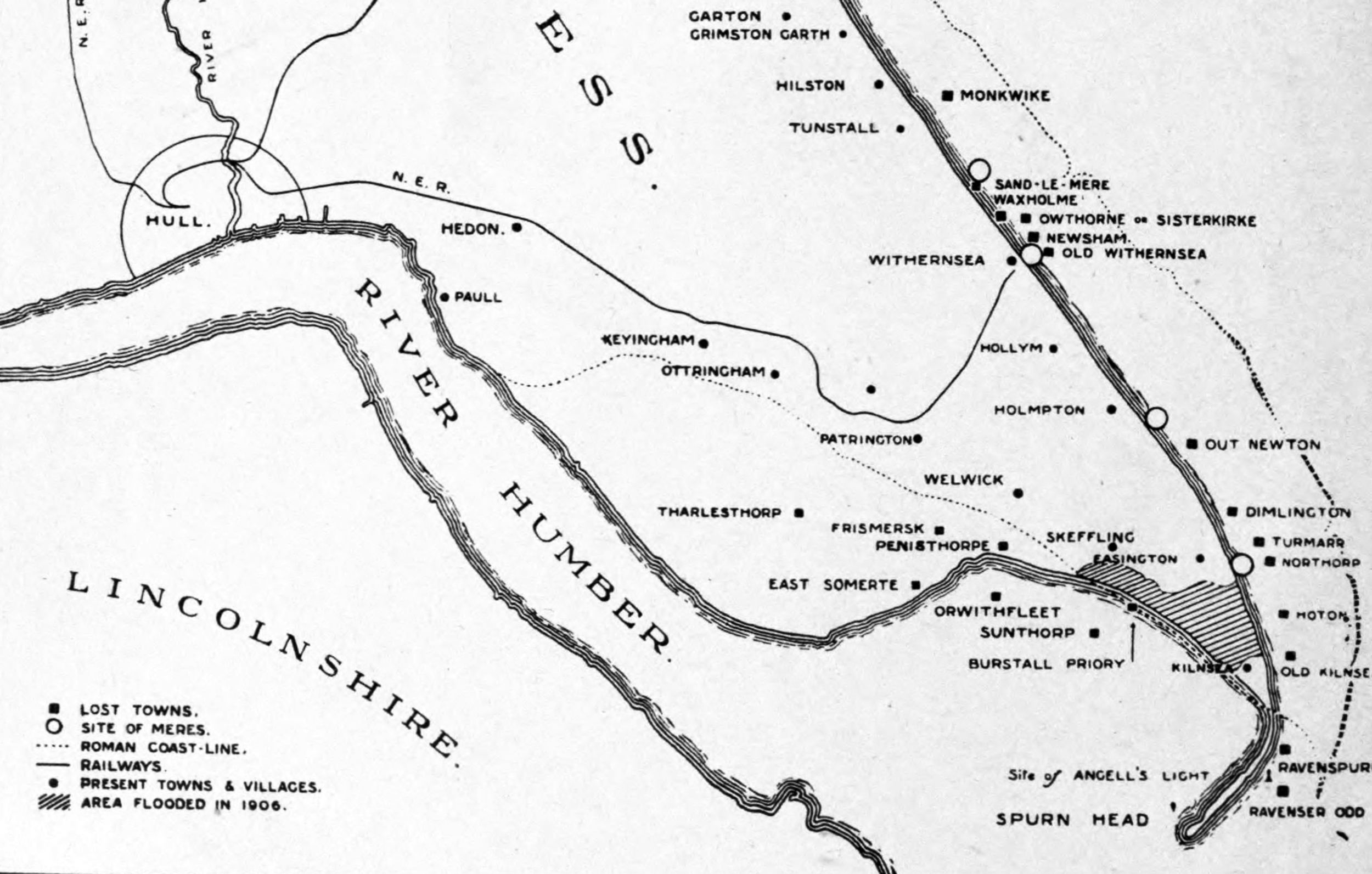
Thomas Sheppard is a good starting point for respectively Ravenser and Ravenser Odd:
William Shelford … points out that Spurn Point, even in Roman times, must have been 2,250 yards at least beyond the present coastline ; and that at or near this spot the Danes landed in 867, planted their standard “The Raven,” and practically originated the town of Ravensburg, or Ravenser, or Ravenseret, within Spurn Head. The town developed into “one of the most wealthy and flourishing ports of the kingdom. It returned two Members to Parliament, assisted in equipping the navy, had an annual fair of thirty days, two markets a week, is mentioned twice by Shakespeare,[King Henry VI, part iii, Act iv, Scene 7; and Richard II, Act 2, Scene 1] and considered itself honoured by the embarkation of Baliol with his army for the invasion of Scotland in 1332; by the landing of Bolingbroke, afterwards Henry IV, in 1399; and by the landing of Edward IV in 1471, not long after which it was entirely swept away.” Today, we cannot even be certain where the place was. […] In 1296 “Kaiage” [right to tax wharf occupation] was granted to the inhabitants by Edward I. Two years later Ravenser petitioned the king for certain privileges, and offered 300 marks in payment. In 1300 the magistrates of Ravensere were enjoined to stop the export of bullion; in 1305 it sent Members to Parliament. In 1310 Ravensere remonstrated against the depredations of the Earl of Holland, and in the same year Ravenness sent ships for Edward II.’s expedition to Scotland. Two years later the inhabitants were empowered to levy a tax to defend their walls. In 1323 commissions were issued for the “Wapentak of Ravensere.” In 1335-6 warships of Ravensere are referred to, and in 1341 Ravensere sent one Member to “a sort of” naval Parliament of Edward III. In 1346 one ship only was sent by Ravenser to the siege of Calais; (Hull sent 16). In 1355 bodies were washed out of their graves in the chapelyard at Ravenser. In 1361 [i.e. 1362 – the Second St. Marcellus flood] the floods drove the merchants to Hull and Grimsby; and by 1390 nearly all trace of the town, as such, was gone.* In 1413 a grant was made for the erection of a hermitage at Ravenscrosbourne, and in 1428 Richard Reedbarowe, the hermit of the chapel of Ravensersporne obtained a grant to take tolls of ships for the completion of his light-tower. In 1538 Leland refers to Ravenspur in his ” Itinerary,” which seems to be the last reference to the place. As pointed out elsewhere, the place is not included in Holinshed’s ” List of Ports and Creeks,” which was issued before 1580.
[…]
Ravenser-odd (also referred to as Odd near Ravenser, Ravenserot, Ravensrood, Ravensrodd, Ravensrode, etc.), probably originated in the early part of the thirteenth century, soon after Ravenser, the adjoining port, came to be of importance. Ravenser-odd was apparently built on an island.
In 1251 some monks obtained half an acre of ground on which to erect buildings for the preservation of fish, in the burg of Od near Ravenser. The chronicler of Meaux wrote that “Od was in the parish of Esington, about a mile distant from the mainland. The access to it was from Ravenser by a sandy road covered with round yellow stones, scarcely elevated above the sea. By the flowing of the ocean it was little affected on the east, and on the west it resisted in a wonderful manner the flux of the Humber.”
In 1273 there was a dispute about a chapel at Od, and this was carried on for some time.
In 1300 Edward I. gave some lands in Ravenserodde to the convent of Thornton in Lincolnshire, and others to St. Leonard’s Hospital, York.
In 1315 the burgesses of Ravenserod agreed to pay the king £50 for the confirmation of their charters, and “Kaiage” for seven years. In 1326 the king granted dues and customs in the port of Ravenserod, and about 1336 William De-la-Pole left Ravenserod for Hull. Ravenserode sent a representative to Edward III.’s “naval Parliament” in 1344, as well as a man well versed in naval affairs.
In 1346 Ravensrodde was one of the places mentioned by the Abbot of Meaux as suffering by the sea. In the following year it was frequently inundated, and in 1360 [presumably 1362] “Ravenser Odd was totally annihilated by the floods of the Humber and inundations of the great sea.”
In 1355 the bodies in the chapel yard, which, “by reason of inundations were then washed up and uncovered,” were removed and buried in the churchyard at Easington.
About this time we read the following curious note in the Meaux Chronicle : — ” When the inundations of the sea and of the Humber had destroyed to the foundations the chapel of Ravenserre Odd, built in honour of the Blessed Virgin Mary, so that the corpses and bones of the dead there buried horribly appeared, and the same inundations daily threatened the destruction of the said town, sacrilegious persons carried off and alienated certain ornaments of the said chapel, without our due consent, and disposed of them for their own pleasure ; except a few ornaments, images, books, and a bell which we sold to the mother church of Esyngton, and two smaller bells to the church of Aldeburghe. But that town of Ravenserre Odd, in the parish of the said church of Esyngton, was an exceedingly famous borough, devoted to merchandise, as well as many fisheries, most abundantly furnished with ships and burgesses amongst the boroughs of that sea-coast. But yet, with all inferior places, and chiefly by wrong-doing on the sea, by its wicked works and piracies, it provoketh the wrath of God against itself beyond measure. Wherefore, within the few following years, the said town, by those inundations of the sea and of the Humber, was destroyed to the foundations, so that nothing of value was left.”
Notwithstanding this, “In the Hedon inquisition of January 1401, the chapel of Ravenserodde, with the town itself, was declared to be worth, in spiritualities, more than £30 per annum.”
William Wheater treads a similar path, perhaps better – haven’t read it (Wheater 1889).
The rise and fall of a tsunami are among the 15 signs of doom in a Middle English poem, The Pricke of Conscience, and are illustrated in a medieval (ca. 1410) window in All Saints’ Church, North Street, York:
Þe first day of þas fiften days,
Þe se sal ryse, als þe bukes says,
Abowen þe heght of ilka mountayne,
Fully fourty cubyttes certayne,
And in his stede even upstande,
Als an heghe hille dus on þe lande.
Þe secunde day, þe se sal be swa law
Þat unnethes men sal it knaw.
Þe thred day, þe se sal seme playn
And stand even in his cours agay[n],
Als it stode first at þe bygynnyng,
With-outen mare rysyng or fallyng
(Anon 1863)
Britta Sweers, “Trutz, Blanke Hans” – Musical and Sound Recollections of North Sea Storm Tides in Northern Germany
Something to say? Get in touch
Search
Subscribe/buy
Donate
Music & books
Place-People-Play: Childcare (and the Kazookestra) on the Headingley/Weetwood borders next to Meanwood Park.
Music from and about Yorkshire by Leeds's Singing Organ-Grinder.
 RSS feed
 Bluesky
 Extwitter