5 November 1841: The over-provision of cottage-style housing in Sheffield by speculative builders
George Calvert Holland. 1843. The Vital Statistics of Sheffield. London: Robert Tyas. Get it:
.Unedited excerpt
If an excerpt is used in the book, it will be shorter, edited and, where applicable, translated.
The speculative builders never dream of the legitimate necessities of the population. The situation and style of the houses attract purchasers or tenants, when thousands are unoccupied, and thus encouragement to build co-exists with great commercial depression and an immense surplus of accommodation. These are startling truths, but in the further consideration of the subject they will be fully established.
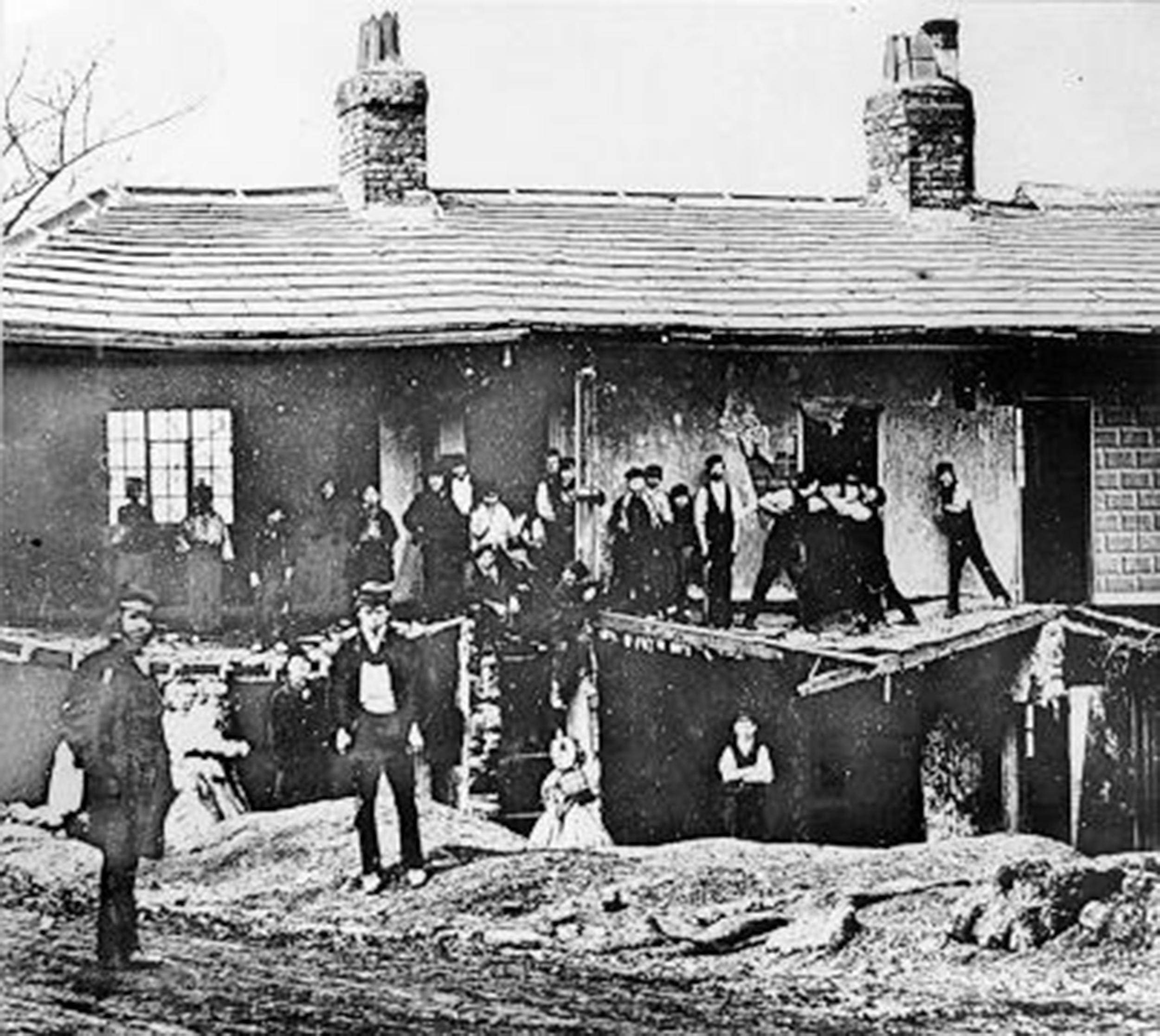
The tendency to the over-production of cottage accommodation prevails largely at this moment,[5 November 1841] as may be shewn by a particular case that falls under our immediate observation. The street in which we reside [which?] is pleasantly situate apart from the bustle of the town, and contains twenty unoccupied dwellings. In line with it commences a recently improved road, and the land on each side is let for building purposes. About twelve months ago, a person erected nine houses on speculation, half of which were untenanted until within a short time. They are now occupied with the exception of one. A large painted board states that they may be bought by private contract. Within the past few weeks, the same individual has built eight others in continuation with the former, also on speculation, when eight out of twenty-seven in the same situation, and twenty in the adjoining street, are untenanted! Numerous facts of the same kind are observed in every part of the town.
There is one speculator alone destitute of capital, who has built 200 houses, not in the space of years, but almost in the course of months, numbers of which are at present untenanted. As evidence of the general character of this class of men, some of them actually cannot write their names.
The mode in which these things are accomplished on a large scale, is to get clay on the site fixed upon, and to make bricks as long as the ground can be spared, or means furnished by the forced sales of the property either partly or wholly finished; and on the completion of the undertaking, the projectors are often prepared to take the benefit of the insolvent act, or fall into embarrassed circumstances, involving in their ruin many other parties. The bricklayer – the joiner – the glazier – and the painter frequently combine their efforts – we can scarcely say their capital – in extensive building speculations, and the existence of the whole body depends on a sale being effected, when the market is already glutted with cottage accommodation.


Comment
Comment
I’m not clear exactly as to what is meant by “cottage,” but here is Engels:
Every great city has one or more slums, where the working-class is crowded together. True, poverty often dwells in hidden alleys close to the palaces of the rich; but, in general, a separate territory has been assigned to it, where, removed from the sight of the happier classes, it may struggle along as it can. These slums are pretty equally arranged in all the great towns of England, the worst houses in the worst quarters of the towns; usually one- or two-storied cottages in long rows, perhaps with cellars used as dwellings, almost always irregularly built. These houses of three or four rooms and a kitchens form, throughout England, some parts of London excepted, the general dwellings of the working-class. The streets are generally unpaved, rough, dirty, filled with vegetable and animal refuse, without sewers or gutters, but supplied with foul, stagnant pools instead. Moreover, ventilation is impeded by the bad, confused method of building of the whole quarter, and since many human beings here live crowded into a small space, the atmosphere that prevails in these working-men’s quarters may readily be imagined. Further, the streets serve as drying grounds in fine weather; lines are stretched across from house to house, and hung with wet clothing (Engels 1892).
Something to say? Get in touch
Tags
Tags are assigned inclusively on the basis of an entry’s original text and any comment. You may find this confusing if you only read an entry excerpt.
- Cottage (1) W/G ·
- Engels, Friedrich (1820-95) (2), philosopher, critic of political economy, historian, political theorist, revolutionary socialist, Manchester mill-owner W/G ·
- Home construction (3) W/G ·
- Poverty (16) W/G ·
- 📌Sheffield (80) W/G ·
- Slum (4) W/G ·
- Speculation (2) W/G ·
Comment
Comment
I’m not clear exactly as to what is meant by “cottage,” but here is Engels:
Every great city has one or more slums, where the working-class is crowded together. True, poverty often dwells in hidden alleys close to the palaces of the rich; but, in general, a separate territory has been assigned to it, where, removed from the sight of the happier classes, it may struggle along as it can. These slums are pretty equally arranged in all the great towns of England, the worst houses in the worst quarters of the towns; usually one- or two-storied cottages in long rows, perhaps with cellars used as dwellings, almost always irregularly built. These houses of three or four rooms and a kitchens form, throughout England, some parts of London excepted, the general dwellings of the working-class. The streets are generally unpaved, rough, dirty, filled with vegetable and animal refuse, without sewers or gutters, but supplied with foul, stagnant pools instead. Moreover, ventilation is impeded by the bad, confused method of building of the whole quarter, and since many human beings here live crowded into a small space, the atmosphere that prevails in these working-men’s quarters may readily be imagined. Further, the streets serve as drying grounds in fine weather; lines are stretched across from house to house, and hung with wet clothing (Engels 1892).
Something to say? Get in touch
Similar
 10 March 1665: Blizzards and Dutch attacks prolong Restoration-induced shortages of fodder and coal at Northowram (Halifax)
 9 April 1833: Messrs. Verdon Brittain & Co. claim before a Sheffield court that razor-maker William Harrison of Sims Croft has plagiarised the mark granted them by the Cutlers’ Company
Comment
Comment
Thomas Frost comments re two other impresarios:
The haze which envelopes the movements of travelling circuses prior to the time when they began to be recorded weekly in the Era cannot always be penetrated, even after the most diligent research. Circus proprietors are, as a rule, disposed to reticence upon the subject; and the bills of tenting establishments are seldom preserved, and would afford no information if they were, being printed without the names of the towns and the dates of the performances (Frost 1875).
However, the circumstantial evidence provided by Wallett has encouraged me to conjecture the date used in the entry – refutations welcome.
In the 19th century, the St Leger Stakes at Doncaster, Wallett’s destination, was run in September, so we have the month. This episode follows his trip to Gainsborough mart, where he stays in a beer house that opened after passing of the New Beer Act, which came into operation on 11 October 1830. Gainsborough fair commenced on Easter Monday, so at the earliest we’re talking on this evidence is September 1831. Wallett was married to Mary Orme in April 1839 despite the famous protests (perhaps exaggerated or invented for PR) of her father, and my impression is that he is unmarried here, so the latest possible date is probably September 1838.
The itinerant actor-manager William Abbott (?-?) – with whom Wallett had worked, with whom he stayed in Tickhill, and whom he saw for the last time at the end of the chapter – does not help date this episode. Wallett says he is “of the Theatre Royal, Crowle” – a thriving but small Lincolnshire market town – in humorous reference to the famous actor-manager William Abbot(t) (1790-1843), who worked inter alia at the Theatre Royal, Covent Garden, and, like our Abbott, was bankrupted in England and died in the States (but of apoplexy in Baltimore or New York, rather than cholera in St. Louis). William Slout says Wallett spent four years with the Abbotts after starting his theatrical career at Hull in 1830 (Slout 1998), which might suggest September 1835, 1836 or 1837, but I don’t know his evidence.
Cholera may help. If Charley Yeoman really did die of cholera (about?) two months after his split with Wallett at Gainsborough, then he might have been a victim of the second pandemic, then this might confirm September 1832 as the sole candidate: cholera was only general in England in summer and autumn of 1832 (Underwood 1947/11/03) – see e.g. reports of the 1832 St. Leger (Highflyer 1832). But Yeoman might instead have been a victim of indigenous cholera or something similar. I haven’t read anything about cholera in the USA, so can’t comment on the cholera deaths of the Abbotts, apparently in St Louis, Missouri (the famous William Abbott died in New York or Baltimore of apoplexy).
But Wallett mentions having worked for “Little Jemmy Scott’s Coronation Pavilion” under usurper Charley Yeoman at Gainsborough this year, and Frost says Wallett was with Charles Yeoman’s Royal Pavilion in Gainsborough (Frost 1875), suggesting that circus celebrations in Brighton following William IV’s coronation in June 1830 took to the road.
Rain may be our greatest ally. Which Doncaster meeting was marred by rain on the Monday, the day before the St. Leger? 1831 mentions torrential rain on the evening of the day before, which is the one he was travelling on – he completed the outfit two days before – perhaps there were heavy local showers, and he was rained on https://babel.hathitrust.org/cgi/pt?id=nyp.33433066598982&view=1up&seq=450&q1=Chorister No mention of rain
Something to say? Get in touch
Search
Subscribe/buy
Donate
Music & books
Place-People-Play: Childcare (and the Kazookestra) on the Headingley/Weetwood borders next to Meanwood Park.
Music from and about Yorkshire by Leeds's Singing Organ-Grinder.
 RSS feed
 Bluesky
 Extwitter