10 September 1855: Leeds celebrates the fall of Sevastopol during the Crimean War
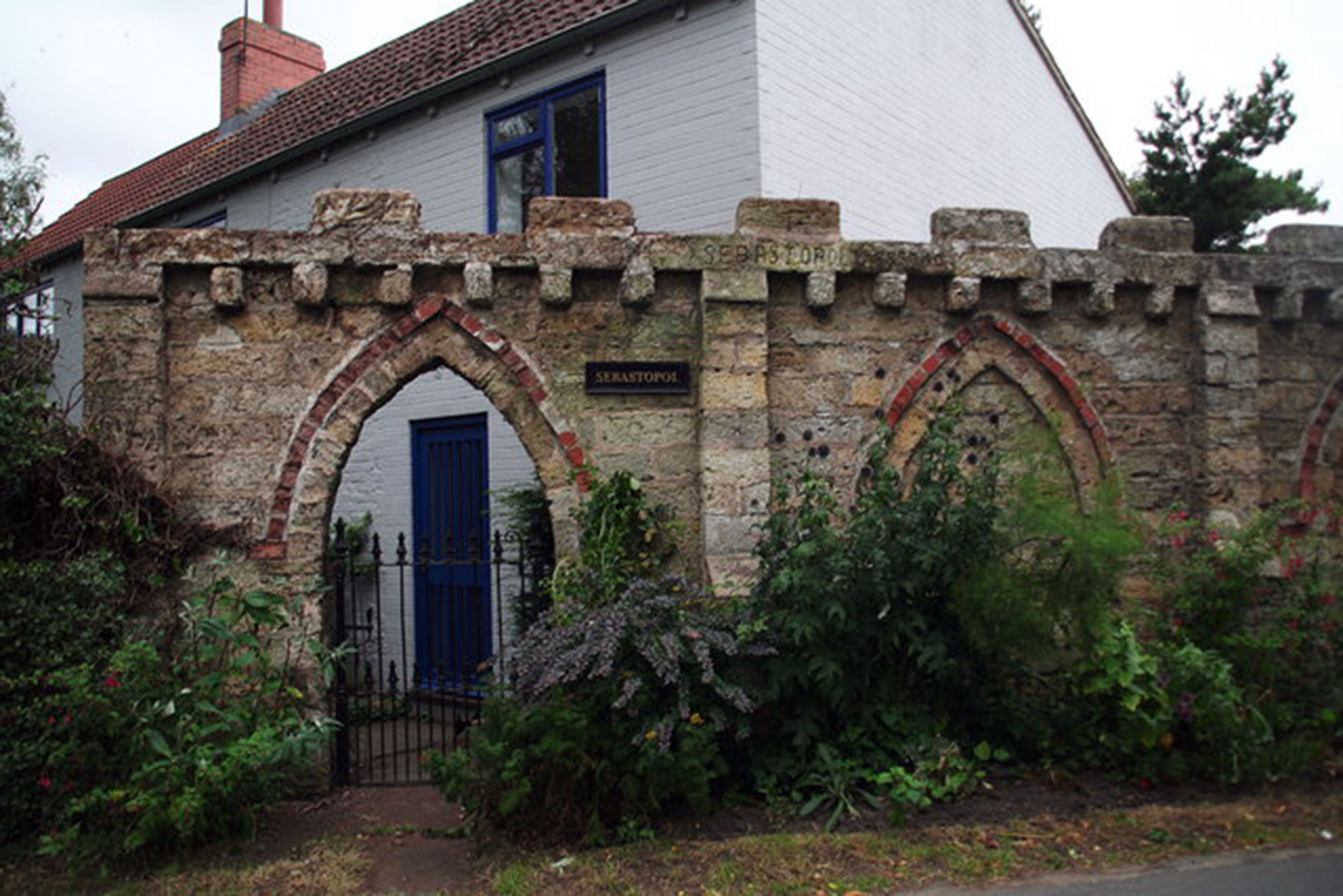
The Sebastopol Wall at Ellerker in the East Riding: “This wall round Sebastopol Cottage was built in 1857 by the owner of Ellerker Hall. He had shipped arms to Sebastopol in the Crimea and used ballast on the way home, and this was used to build the wall in order to hide the owner from view of the Hall when she used the privy” (Chris 2012/09/16).
John Mayhall. 1860. The Annals and History of Leeds, and Other Places in the County of York. Leeds: Joseph Johnson. Get it:
.Unedited excerpt
If an excerpt is used in the book, it will be shorter, edited and, where applicable, translated.
On the 10th of September, the telegraph announced the news of the fall of Sebastopol, which produced the liveliest sensations in all parts of the kingdom. In Leeds the bells of the parish church rang a merry peal nearly all night. For several days the joy of the inhabitants was unbounded. Bands of music paraded the streets. In the evenings especially the excitement was very great, and an immense quantity of fireworks and coloured fires were let off in Briggate, and other streets. There was scarcely a warehouse, shop, or private house, without a banner or flag hung out; many of them really handsome, and bearing appropriate devices and inscriptions. Two or three immense banners were hung across Briggate; a monster tricoloured one was thrown across the north end of Leeds Bridge, bearing the words “Honour to the Allies.” Mr. Appleby exhibited in front of his shop in Briggate the head of a bear, stuffed, and muzzled, with a flag suspended above it, inscribed “The Russian Bear muzzled at last.”

Comment
Comment
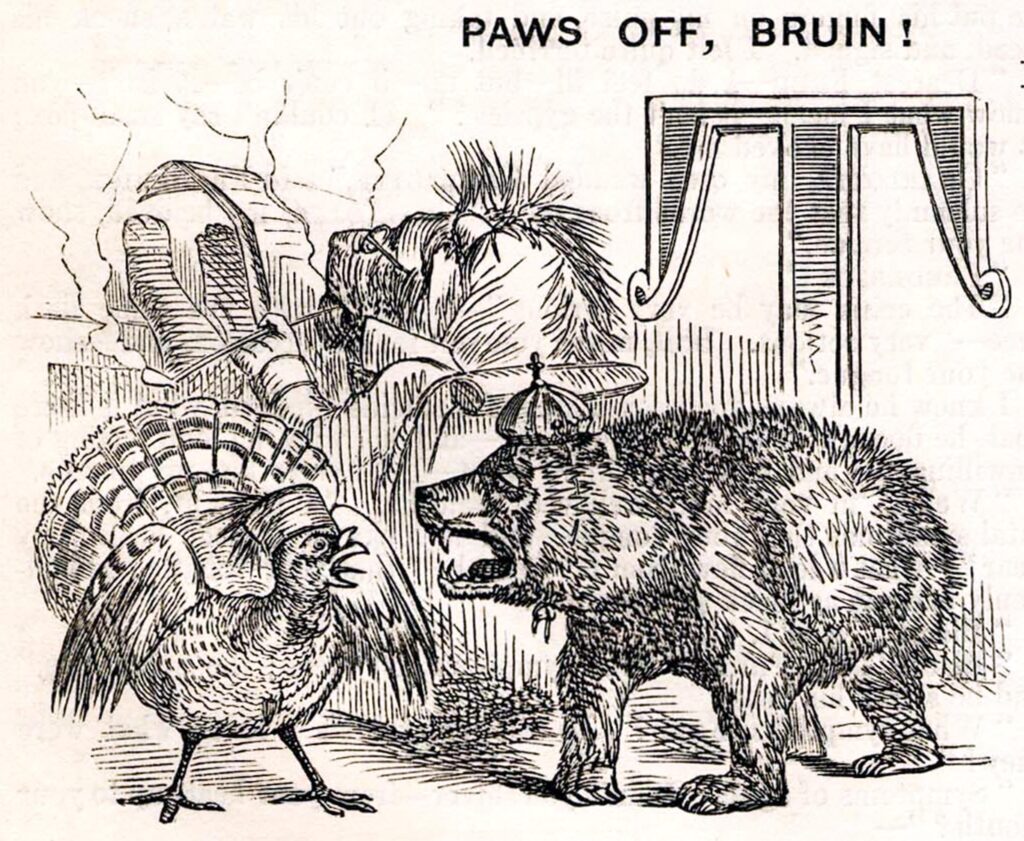
Is there a picture of the bear’s head? Were bears’ heads readily available in Leeds? An earlier cartoon by John Tenniel shows the Russian Bear threatening Turkey during the dispute over the guardianship of the Holy Places while the British Lion lounges in the background:
Sebastopol Wall via Angus Young.
Something to say? Get in touch
Tags
Tags are assigned inclusively on the basis of an entry’s original text and any comment. You may find this confusing if you only read an entry excerpt.
- Bear (3) W/G ·
- 📌Briggate (14), Leeds' old north-south bridge street and main street W/G ·
- British brass band (6) W/G ·
- Crimea (2) W/G ·
- Crimean War (6) W/G ·
- Fireworks (4) W/G ·
- Flag (2) W/G ·
- France (34) W/G ·
- Kingdom of Sardinia (1) W/G ·
- Leeds Bridge (4) W/G ·
- Leeds Minster (12) W/G ·
- 📌Leeds (249) W/G ·
- Music (26) W/G ·
- Ottoman Empire (6) W/G ·
- Queen Victoria (10) W/G ·
- Russia (8) W/G ·
- Russian Empire (5) W/G ·
- Siege of Sevastopol (1854–1855) (3) W/G ·
- Telegraphy (2) W/G ·
- Turkey (4) W/G ·
Comment
Comment
Is there a picture of the bear’s head? Were bears’ heads readily available in Leeds? An earlier cartoon by John Tenniel shows the Russian Bear threatening Turkey during the dispute over the guardianship of the Holy Places while the British Lion lounges in the background:
Sebastopol Wall via Angus Young.
Something to say? Get in touch
Similar
Comment
Comment
James Appell:
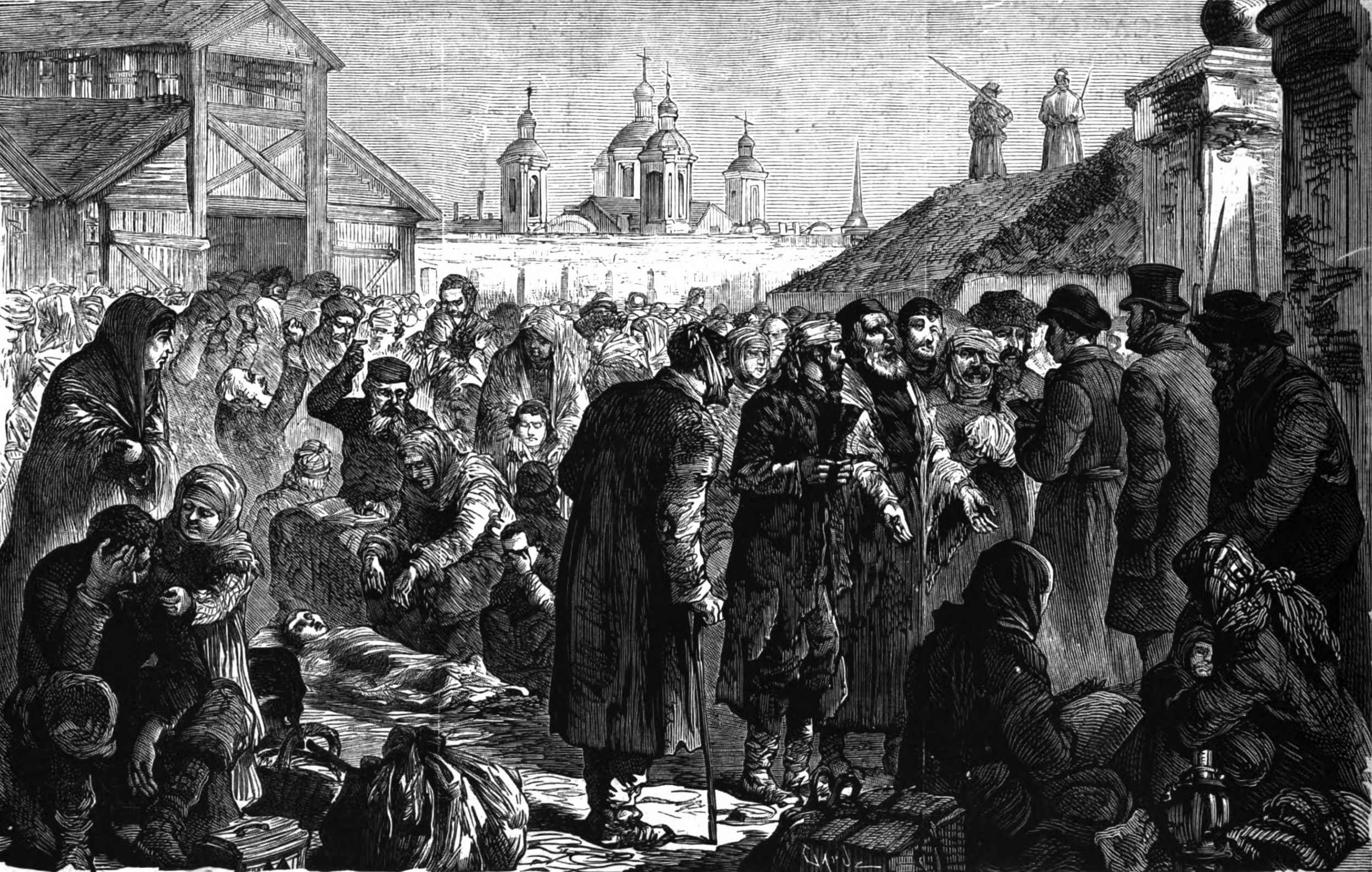
The wartime discord prompted some soul-searching within the community, which began questioning whether the economic and social bonds between Jew and non-Jew, forged in Leeds by the conditions of the tailoring trade, were really as strong as the trade unions and socialist movements might have portrayed. The Jewish Chronicle offered its own analysis just a few weeks after the Leeds riot concluded:
There has been a very large and sudden increase in the Jewish population of Leeds during the last few years, and that there has in consequence been considerable inconvenience in many directions to the indigenous inhabitants … Towns, like countries, can assimilate only a certain Jewish element in a certain time, and the Jewish addition to the population of Leeds has been too much and too fast.
The rapid entry of nearly 20,000 Jews into Leeds within the space of two generations clearly exerted pressures on the local population. In this respect Leeds may have differed from London and other provincial cities, where Jewish immigration from Eastern Europe was of a longer duration, where an Anglo-Jewish community already existed and where tensions were less marked than in Leeds. Poverty and mode of employment may have united the two groups, but ultimately religious difference divided them. In such circumstances, therefore, Leeds Jews’ identity as Yorkshiremen was only ever going to be fragile (Appell 2019).
Via Lola Fraser, who thinks the perception that Leeds’s (eastern European) Jews were evading military service would have been exacerbated by the Leeds socialist-pacifist convention on 3 June 1917 in support of revolutionary Russia’s withdrawal from World War I (Fraser N.d.).
Something to say? Get in touch
Search
Subscribe/buy
Donate
Music & books
Place-People-Play: Childcare (and the Kazookestra) on the Headingley/Weetwood borders next to Meanwood Park.
Music from and about Yorkshire by Leeds's Singing Organ-Grinder.
 RSS feed
 Bluesky
 Extwitter