13 June 1876: Christopher Jackman (sculptor) and Charles Barrett (tailor) deny having been in enclosed premises – at the home of the Bradford MP, Henry Ripley – for an unlawful purpose
Leeds Mercury. 1876/06/17. A Caution to Young Men. Leeds. Get it:
.Unedited excerpt
If an excerpt is used in the book, it will be shorter, edited and, where applicable, translated.
A CAUTION TO YOUNG MEN.-At the West Riding Police-court, Leeds, on Tuesday, before Dr. Heaton, Mr. Ikin, and Mr. Joseph Lupton, two young men, Chas. Barrett, tailor and draper, Yeadon, and Christopher Jackman, sculptor, (the latter in the employ of Mr. Charles Abbey, sculptor, Bradford,) were charged with being in enclosed premises for an unlawful purpose. The defendants, who were fashionably dressed and wore each an imposing bunch of “lilies of the valley” in the button-hole of their coats, had been found under somewhat suspicious circumstances on the premises of Mr. H. W. Ripley, M.P. (Bradford), Acacia, Rawdon, on Friday afternoon last. Mr. Granger appeared for the defendants. William Henry Thorp, a man-servant in the service of Mr. Ripley, stated that he found the defendants half dressed in bed in the laundry-maids’ bedroom. The laundry-maids were at their work in the laundry. When he accosted the defendants, they said they had been walking and had asked to lie down. In reply to Mr. Granger, Thorp said he did not know that the defendants were engaged to two of the laundry-maids. Mr. Granger, addressing the Bench, said he was in a position to prove that the defendants, who had been locked up over Friday night and brought before Mr. Ikin on Saturday and remanded on bail until to-day, were most respectable men. They had, in fact, obtained the permission of Mrs. Sunderland (Mr. Ripley’s daughter) to visit their sweethearts in the laundry, and in the case of Jackman the ring had been already purchased, and the banns put up at Halifax. (Laughter.) They had certainly been indiscreet, but when in the laundry, seeing that some one was likely to come in from whose observation they wished to escape, they had run upstairs and secreted themselves in the bedroom. Mr. T. Greenwood Teale (magistrates’ clerk) said it should be explained, in justice to Mr. Ripley, M.P., that he had recently lost several articles of linen, and that he was therefore naturally suspicious when two young men were found on the premises under such circumstances.-Mr. Granger then called Alice Bernard and Mary Halliday, laundry-maids, the former engaged to Barrett, and the last-named to Jackman. Bernard stated that she had requested the defendants to go into the bedroom to get out of the way whilst some one was looking about the laundry. Halliday said that she was engaged to Jackman, and proffered to exhibit the wedding-ring, which had been already purchased. Mr. Abbey, sculptor, gave Jackman an excellent character, and was satisfied that the defendants were not on Mr. Ripley’s premises for any felonious purposes.-The defendants were discharged.


Comment
Comment
I doubt you will find record of marriages between Alice Bernard and Charles Barrett, or Mary Halliday and Christopher Jackman, for this is a mock trial: not of Barrett and Jackman, but of the English legal system, and conducted by the West Riding Liberal establishment. Everyone knows that the men are guilty according to laws made in Westminster, but no one cares to convict them. (Perhaps someone will explain to me why the Crown went with the Vagrancy Act 1824.) Immediate precedent can be found in Gilbert and Sullivan’s satirical Trial by Jury, premiered the year before, but there is material a-plenty here for a Loiner Lorenzo da Ponte to give us an Airedale Così fan tutte. I’ll take care of the music if someone will write me a libretto.
Something to say? Get in touch
Tags
Tags are assigned inclusively on the basis of an entry’s original text and any comment. You may find this confusing if you only read an entry excerpt.
- Abbey, Charles (ca 1836-1901) (1), Hull-born sculptor W/G ·
- 📌Bradford (73) W/G ·
- Comedy (drama) (9) W/G ·
- Comedy (7) W/G ·
- Comic opera (2) W/G ·
- Cottaging (1) W/G ·
- Cover-up (1) W/G ·
- Gilbert, W.S. (1) W/G ·
- 📌Halifax (43) W/G ·
- Homosexuality (3) W/G ·
- Human sexual activity (5) W/G ·
- 📌Leeds (249) W/G ·
- Liberal Party (UK) (11) W/G ·
- Lupton, Joseph (1816-94) (1), one of the Leeds Luptons, Liberal and Unitarian, campaigner against slavery and for female suffrage W/G ·
- Mozart, Wolfgang Amadeus (2) W/G ·
- Perjury (4) W/G ·
- Ponte, Lorenzo da (1) W/G ·
- Rawdon, West Yorkshire (4) W/G ·
- Ripley, Henry William (1813-82) (1), Bradford-based businessman, philanthropist and Liberal Party politician who switched to the Conservative Party W/G ·
- Sexual intercourse (6) W/G ·
- Sullivan, Arthur (1) W/G ·
- Teale, Thomas Greenwood (1827-93) (1) W/G ·
- Trial by Jury (2) W/G ·
- Vagrancy Act 1824 (3) W/G ·
Comment
Comment
I doubt you will find record of marriages between Alice Bernard and Charles Barrett, or Mary Halliday and Christopher Jackman, for this is a mock trial: not of Barrett and Jackman, but of the English legal system, and conducted by the West Riding Liberal establishment. Everyone knows that the men are guilty according to laws made in Westminster, but no one cares to convict them. (Perhaps someone will explain to me why the Crown went with the Vagrancy Act 1824.) Immediate precedent can be found in Gilbert and Sullivan’s satirical Trial by Jury, premiered the year before, but there is material a-plenty here for a Loiner Lorenzo da Ponte to give us an Airedale Così fan tutte. I’ll take care of the music if someone will write me a libretto.
Something to say? Get in touch
Similar
 23 January 1643: Thomas Fairfax, the Rider of the White Horse, captures Leeds from the Beast with the help of Psalm 68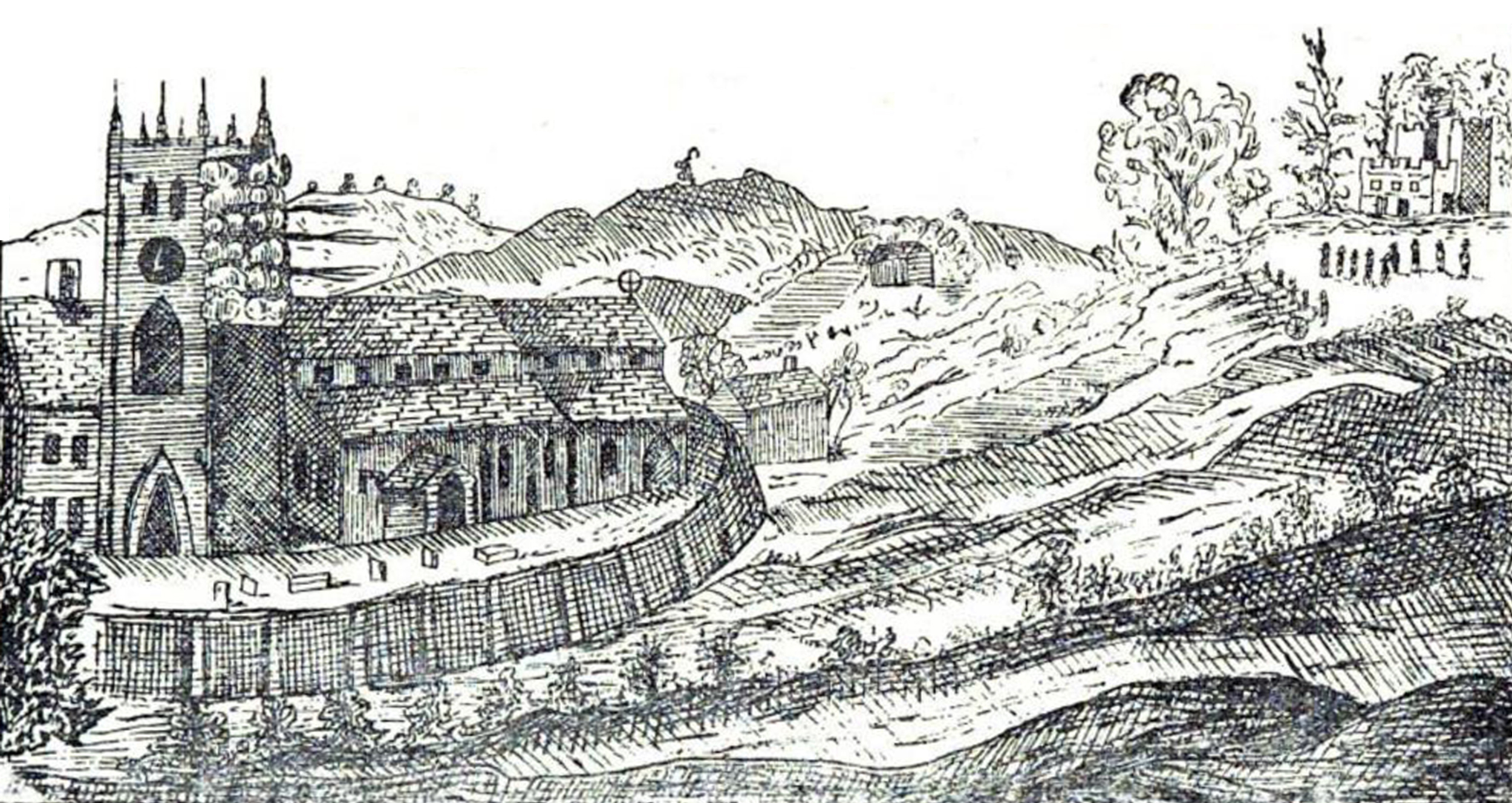
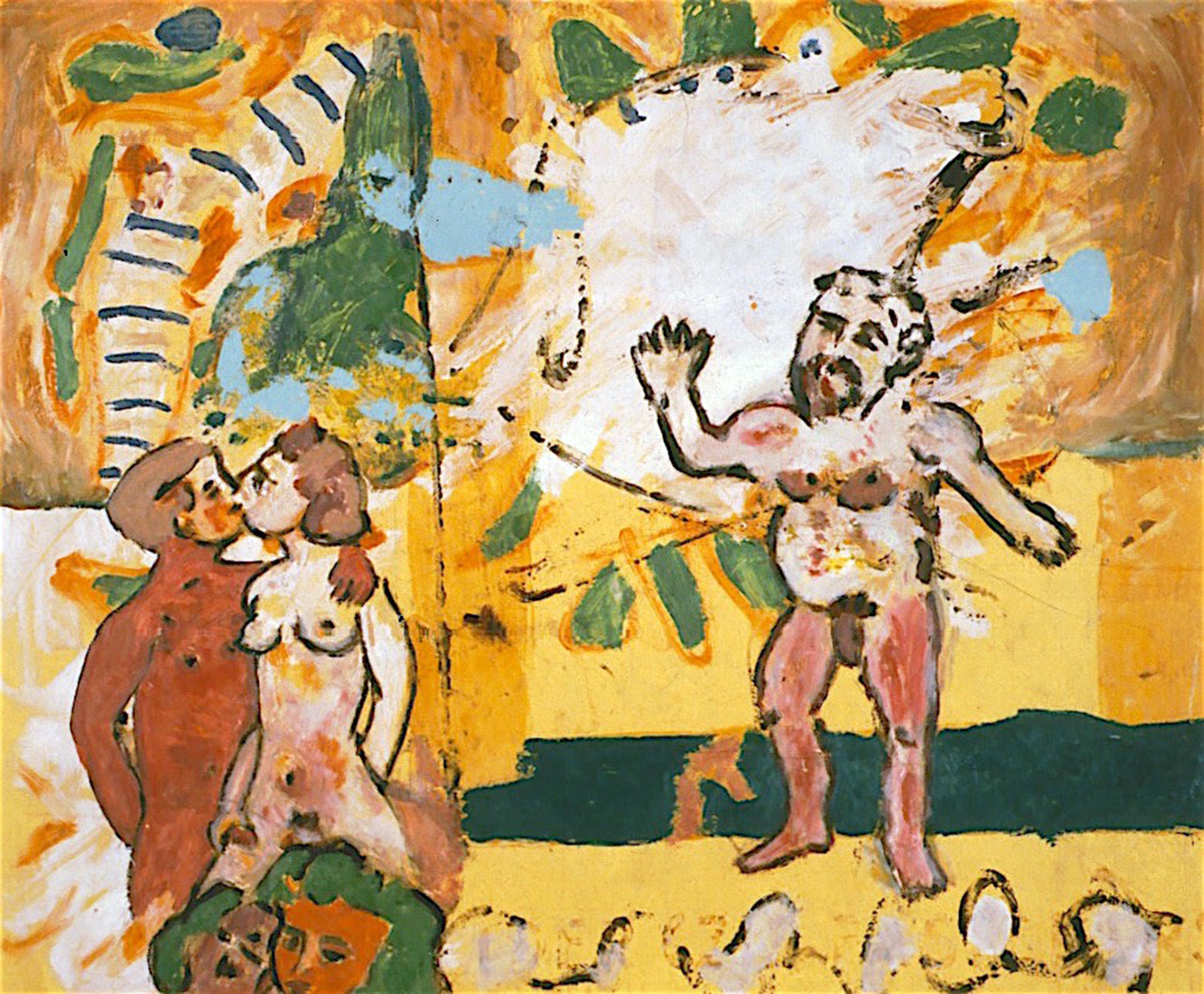 Reproduction by kind permission of Michael Paraskos.20 December 1966: Greek-Cypriot cook and artist Stass Paraskos appears before Leeds magistrates charged with obscenity under the Vagrancy Act 1838
Comment
Comment
Via Leeds Riot Map:
A great number of the tickets were overstamped “Men only”, and the door stewards were commanded to not allow any woman not holding one thus stamped; this was because the organisers knew that the suffragettes could disguise themselves to make them appear fully respectable members of a Liberal audience. Meanwhile, in Victoria Square, a large meeting of unemployed took place by the Leeds Permanent Committee on Unemployment, chaired by a man, Mr. Kitson. As the PM Asquith approached the Coliseum, some 600 or so men moved up the hill to where Ms Baines was declaring that unemployment was “more a woman’s question than a man’s, for it was the wife that had to meet the landlord’s demand for rent”. Precisely what happened next, and what was intended, remains unclear. The press, in the form of the Evening News and the Leeds Mercury, agreed that Ms Baines was heard to say “Break down the barricades and compel a hearing”, but it is not clear if this was intended as an explicit incitement to the men to interpret her literally. Whatsoever, there was a rush of people which was subsequently interpreted as a riot, although the only recorded damage was a broken pane of glass. It seems one stone was thrown which a policeman claimed had hit him, but no injury was recorded, to him or anyone else. In Leeds, Kitson and five suffragettes were arrested. Trial proceedings dragged on into the next year and the excitement subsided, but Jennie Baines is recorded the honour of being the first suffragette to be imprisoned after conviction.
Who was Vera Lambert? Who was Mr Kitson? Presumably no relative of Lord Airedale. I hope I’ve tagged the right Gladstone.
Something to say? Get in touch
Search
Subscribe/buy
Donate
Music & books
Place-People-Play: Childcare (and the Kazookestra) on the Headingley/Weetwood borders next to Meanwood Park.
Music from and about Yorkshire by Leeds's Singing Organ-Grinder.
 RSS feed
 Bluesky
 Extwitter