12 April 1924: The Bloomsbury Group’s Amabel Williams-Ellis finds little art for art’s sake in Leeds
Amabel Williams-Ellis. 1924/04/12. Through the Smoke. Spectator. London. Get it:
.Unedited excerpt
If an excerpt is used in the book, it will be shorter, edited and, where applicable, translated.
Once, when the achievement of Victorian industrialism seemed at its zenith – at the moment of its highest prosperity – the most celebrated Victorian writer on the arts admitted in a moment of candour that England was comparable to a beleaguered city, “where only the grave and desperate needs of everyday” can be attended to. It is with an echo of these ominous words in his mind that the traveller will return from a visit to Sheffield and Leeds.
You will not be long in either town before you shed away any fanciful liking you may have had for whims and flourishes in the visual arts. In the past you may often have turned from the sound and second-rate in pictures, statues, architecture, painting. Now you will look back through the smoke at your old self, wonder that you were not more thankful for small mercies, and will hail the mildest effort with enthusiasm. I say “visual arts” because in both towns there is a feeling for literature and music, and for literature especially as it expresses itself through the drama, but of that more presently.
There is a difference between Leeds and Sheffield. Both, though less dirty than, say, Wigan or Burnley, are black and shabby beyond the imagination of those who have not seen an English industrial town, both are practically without any sort of visible beauty, but in Leeds there are palpable, visible and even impressive signs that “the desperate needs of everyday” are being attended to. In Sheffield, at least to the casual visitor, there are no signs of such provision.
It is an interesting and curious experience to meet day after day, as I did in Sheffield, Hull and Leeds, charming, sensible, even deeply imaginative people – the intelligentsia of the town – who appear never to have experienced any emotion connected with the beauty that appeals to the eye. For it is not that they prefer what I think ugly. That is perfectly comprehensible. But to them one page of print is as good as another page, to them every picture tells a story, and a façade may represent sane provision for physical needs, financial solvency, civic decency or pride, but never and in no circumstances can it represent beauty.
I was told a story of an alderman of the last generation whose favourite boast it was that the whole of the Art Gallery cost less per annum than the heating of the Town Hall. But that story was told me by a curator, and after a time I began to doubt if it would have seemed funny to the average business man.
And so if I say no more of public buildings and squares the reader must not think that I have abandoned my fanciful notion that a town should be a place to live in. I still believe that where man has substituted his work for that of nature he has failed if he does not substitute beauties of his own making for those natural beauties which a town must thrust out. The point is simply that if one is to write anything but a jeremiad about Leeds and Sheffield one must for the moment abandon this position. I also started with the generally accepted idea that besides seemliness and beauty the other criterion by which we might judge the sane city is the abundance and variety of recreation that it provided for its young inhabitants. Here I think Leeds deserves a better reputation.
At Leeds there is even an attempt at modernity and chic in the world of amusement – an effort against the old-fashioned dowdiness that is apt to seize upon all English people when they play. On one side this new alertness shows itself in the wonderful list of productions which the Leeds Art Theatre has to its credit. This society has, for instance, produced plays by Conrad, Shaw, Galsworthy, Gordon Bottomley, Tchekov, Maeterlinck and Strindberg. All lovers of the drama will look forward greatly to next season’s list, and will most sincerely hope that nothing will make the Leeds Art Theatre lower the standard of artistic first-rateness which it has here planted. It is so easy to substitute Barrie for Shaw, and Sutro for Wilde.
At the other end of the scale of recreations and almost, though not quite, as good of its kind, is the Majestic Cinema, a big and important, if ugly, house, which shows nearly good films, and has a restaurant attached. Here people can dance and wear their smart clothes without feeling foolish, either at tea, dinner or supper.
As for outdoor amusements, that subject is bound up with the really interesting and hopeful side of Leeds activities, the great housing and town-planning scheme upon which the municipality is engaged. Mr. Charles Lupton, who took me round, is the Chairman of the Improvements Committee, and is a man equally remarkable for his vision, his understanding of his town as a whole, and the determination and persistence with which he insists upon the materialization of his dreams.
Leeds lies in the valley of a river, at a point where the hills stand back a little, the river valley narrowing both above and below. At the time of the great industrial expansion, houses, factories and warehouses were all crowded together in the river valley, a fine congestion of back-to-back houses and narrow and tortuous streets being produced by “pressure” from the hills up which the speculative builder was unwilling that his houses should climb. The city’s development till some fifteen years ago followed the usual course. The richer inhabitants bought large estates on the surrounding hills and escaped to them out of the smoke of this central district. Gradually the speculative builder followed them, but this time with rather superior dwellings, intended for the salary-drawer rather than for the wage-earner. From straggling suburbs thus formed roads led down star fashion into Leeds, but there were no circular roads, so that to get to one suburb from another you had to descend and go through the main city, which grew constantly more congested and more grimy as the number of mills increased. Then came the men of the present generation, among them the Mr. Charles Lupton. We will take him to typify the town-planning spirit in Leeds. He saw that the state of the city was intolerable. Smoke abatement seeming then impracticable (it seems so still to many people in Leeds) he conceived the idea of moving the population bodily out on to the hills above the smoke line. It was calculated that the smoke rose to a height of 200 feet, the hills rose to 400 feet, and at this height there was a considerable plateau area. He determined that it was in this way and not by sprawling further down the valley that Leeds should grow, and it was to these areas that he intended to move out the population from the centre of the town. Everything has been considered – communication by road and train, water supply, open spaces and schools for the new satellites, and now the work of the Improvement Committee has borne fruit. At Middleton, Crossgates, Meanwood, Hawkesworth Wood, and Wyther Estates large satellite villages have been built, or are in course of construction. Leeds is approached by the workers who live in them through woods belonging to the corporation. The outskirts are served by corporation tramways, while a great road, in many places 120 feet wide, and always planted with trees, encircles the whole scheme, provides communication between satellite and satellite, between them and the larger open spaces where golf courses, &c., are to be found, and deflects all motor traffic from the area of busy local traffic.
Leeds people seem to have supported the Improvements Committee in a remarkable way; again and again I was told, “Here is land that was given to the corporation, either as an open space or for building – as we choose,” or “These woods we hold in trust”; “This was sold to us for a song.” The magnitude, sanity and clear-headedness of the undertaking has appealed to people, as well it might.
Readers who are interested will, by the way, have an opportunity of seeing a model of the whole scheme at Wembley.
The magnitude of the problem of our growing population appears in the following figures. About 3,500 houses have been erected, the yearly average per year being 1,024. But the increase in population for the last census decade is 13,170. As this is in some part accounted for by an enlargement of the city boundaries, it is considered that 500 houses a year will meet the increase. Therefore, even after its great effort, Leeds has only been able to substitute about 1,700 good houses in suitable positions for 1,700 bad houses in unsuitable positions. It is a pity that it is to our birth per thousand that attention is always paid, and not to net increases of population. For the increase is in arithmetical progression, and the birth-rate must fall much more rapidly than it yet shows signs of doing if we are to have a stabilized population. In a few years, that is, unless we establish the principle of birth control or voluntary parenthood, Leeds will find that she will have to build not 500, but 600 houses yearly, and then 700 and so on, before she can begin the great work of civilizing and improving. When shall we realize that it is not so much that our houses are too few for us as that we are too many for our houses?
A. Williams-Ellis.


Comment
Comment
Something to say? Get in touch
Tags
Tags are assigned inclusively on the basis of an entry’s original text and any comment. You may find this confusing if you only read an entry excerpt.
- Aesthetics (1) W/G ·
- Affordable housing (3) W/G ·
- Air pollution (13) W/G ·
- Alfred Sutro (1) W/G ·
- Amabel Williams-Ellis (1) W/G ·
- Anton Chekhov (1) W/G ·
- August Strindberg (1) W/G ·
- Bloomsbury Group (1) W/G ·
- Burnley (4) W/G ·
- George Bernard Shaw (4) W/G ·
- Gordon Bottomley (1) W/G ·
- Industrial Revolution (22) W/G ·
- Industrialisation (4) W/G ·
- J. M. Barrie (1) W/G ·
- John Galsworthy (1) W/G ·
- Joseph Conrad (1) W/G ·
- 📌Kingston upon Hull (74) W/G ·
- Leeds Art Gallery (1) W/G ·
- Leeds Arts Club (1) W/G ·
- Leeds City Council (34) W/G ·
- Leeds Playhouse (1) W/G ·
- Leeds Town Hall (16) W/G ·
- 📌Leeds (249) W/G ·
- Literature (2) W/G ·
- Lupton, Charles (1855-1935) (2), Leeds solicitor, chair of Leeds General Infirmary, Lore Mayor 1915-16, Deputy-Lieutenant for the West Riding 1918, chairman of the council's Improvements Committee, promoted the Outer Ring Road in the post-war years and the widening of the Upper and Lower Headrows W/G ·
- Maurice Maeterlinck (1) W/G ·
- Music (26) W/G ·
- Oscar Wilde (1) W/G ·
- Pollution (10) W/G ·
- Population growth (2) W/G ·
- 📌Sheffield (80) W/G ·
- Slum clearance (5) W/G ·
- Smoke (4) W/G ·
- Textile manufacturing (60) W/G ·
- Theatre (24) W/G ·
- Urban planning (2) W/G ·
- Visual arts (2) W/G ·
- Wigan (2) W/G ·
Comment
Comment
Something to say? Get in touch
Similar
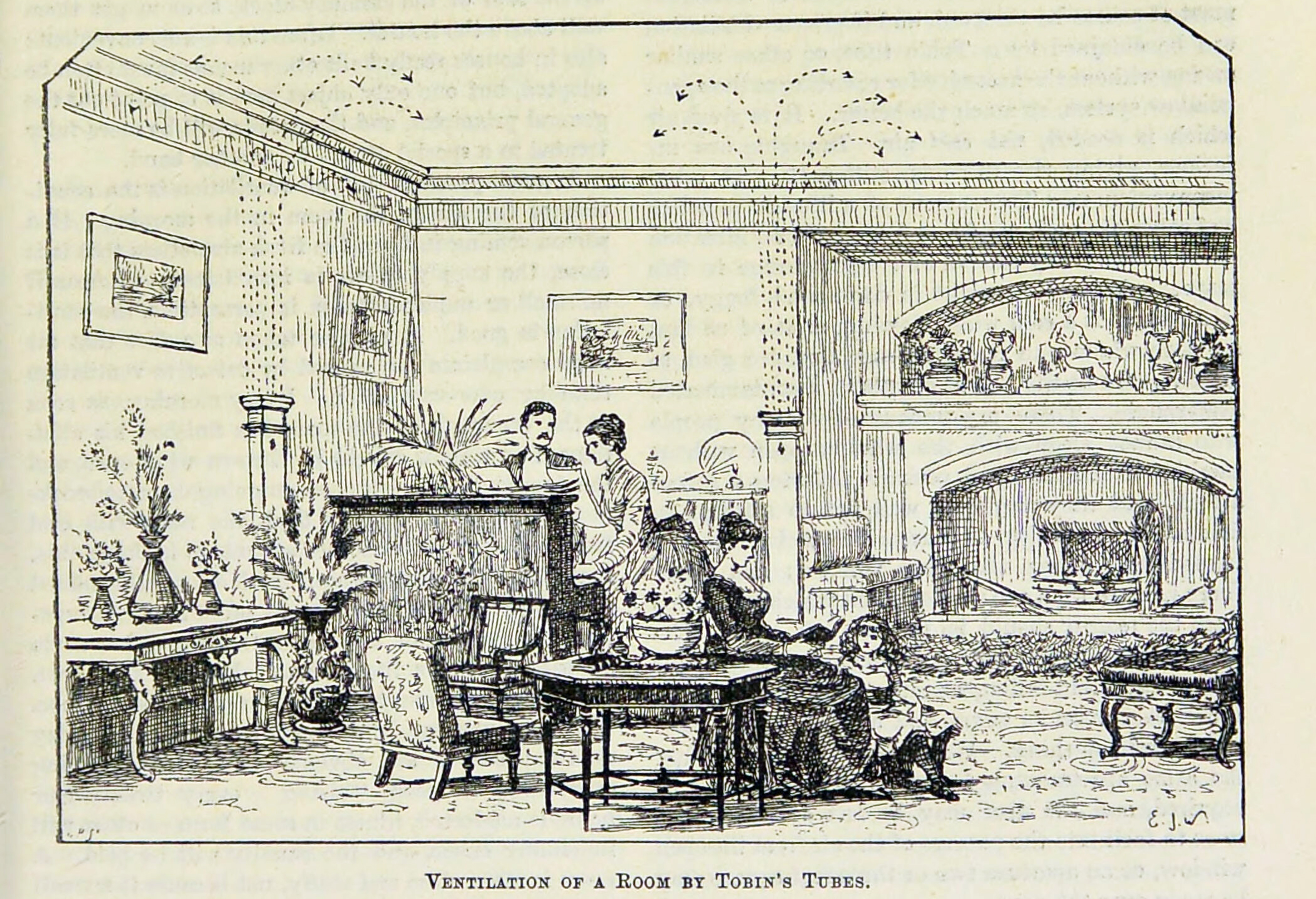 12 April 1875: The Times says that the ventilation tubes patented by Martin Tobin, a retired Leeds merchant, have ended air pollution in the borough’s police court
 9 June 1758: Entry into law of the first dedicated railway enabling act, for Richard Humble and Charles Brandling’s wagonway from Middleton Colliery to the Aire at Leeds
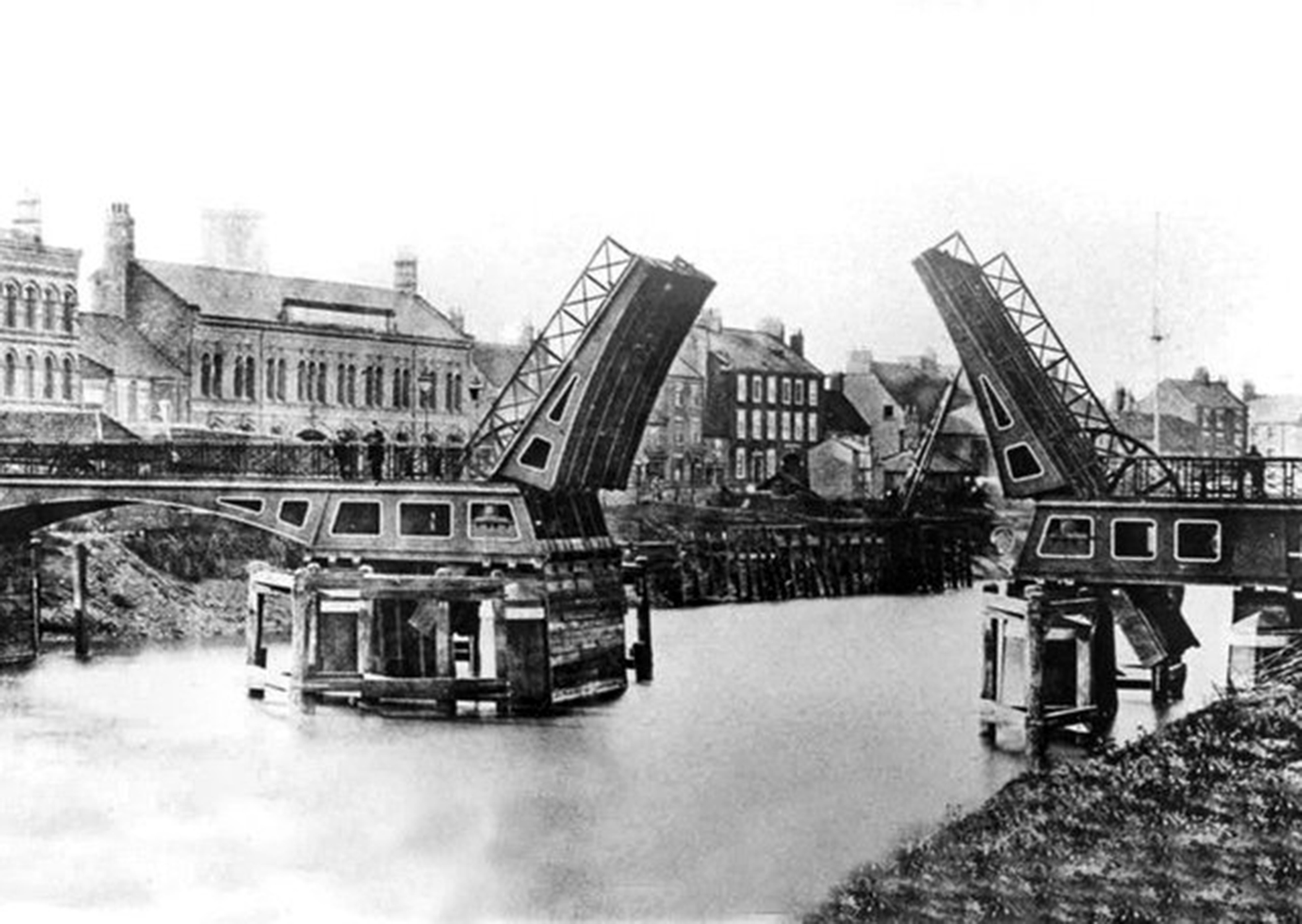 1 July 1840: The opening of the Hull and Selby Railway terminates the threat to Hull’s port from Goole, Scarborough and Bridlington
 8 August 1863: The police are invited to a cricket match on Woodhouse Moor (Leeds), designed to test the byelaws passed during its conversion from common land to People’s Park
Comment
Comment
See also the report in The Times in January 1893 and the complicated judgment issued in February by Mr Justice Kekewich:
MR. JUSTICE KEKEWICH said,- As between the National Telephone Company, whom I shall treat as the sole plaintiffs, although another is associated with them, and the Leeds Corporation, whom I shall treat as the real defendants, although not appearing on the record, there is no question of title and no question but that each is lawfully exercising undoubted rights. Nor is there any question but that the acts of the defendants interfere with the exercise by the plaintiffs of their lawful rights. This would, I believe, have been undoubtedly true if the case had been thrashed out on evidence without the advantage of Mr. Macrory’s report; but that report renders it unnecessary to deal with the evidence on this point. And the interference is of a serious character, so that, if actionable, the remedy would properly be by injunction rather than by damages. The real and only question in the case is whether the interference is actionable. It was practically admitted by the plaintiffs, and my own view certainly is, that, if they can maintain the action against the defendants at all, it must be on the application of the principle now well known as that of Fletcher v. Rylands” (L.R., S, H. L., 330). That principle,, for the purposes of application to the case in band, may conveniently be stated by reference to the second of four propositions set out in the fifth chapter of Mr. Garrett’s book on the Law of Nuisance,” which I have consulted in connexion with more than one point in this case, and gladly take this opportunity of mentioning as a work of uncommon merít.. The proposition is, I think, capable of improvement by the substitution for “non-natural” of extraordinary,” which is the term employed by Lord Kingsdown in defining somewhat analogous water rights in his well-known judgment in Miner v. Gilmour” (12 Moore’s P. C. Cases, 131). The land into which the plaintiffs and defendants alike discharge their electric current does not belong to either of them; but, for the reasons above indicated, there cannot, as between them, be any question that the principle ought to be applied (if it be applicable at all) on the basis of their being absolute owners. That principle has never yet been applied in English law to such a matter as is now under consideration; and perhaps it would not be too much to say that those who enunciated the law in Fletcher v. Hylands,” and have commented on and followed it in other cases, never had present to their minds the application of the doctrine to an electric current and the possible consequences of its discharge into the earth. The question has been carefully considered in America, and I have studied with deep interest the case of Cumberland Telephone and Telegraph Company v. United Electric Railway” (42 Federal Reporter, 273). The judgment of the Court in that case, though in nowise binding on me, has commanded my earnest attention and respect, and but for one circumstance I should not hesitate to allow my own conclusion to be guided by the powerful arguments there set forth. That one circumstance is the want of full adoption of the principle of “Fletcher v. Rylands.” American law apparently holds the owner of land used for a non-natural or extraordinary purpose responsible for the consequences of such user to his neighbour only when they result from that owner’s negligence, and if he can satisfy the Court that he has not been guilty of negligence, the resulting damage to his neighbour is not actionable. It seems to me that, if the principleof “Fletcher v. Bylands” had been fully adopted in America, the conclusion of the Court m the ease just cited must have been different. 1 believe that in Scotland, too, the principle of Fletcher v. Rylands ” has not been accepted and is not regarded as consistent with justice between man and man. It does not fall to me to consider so large a proposition. The principle is thoroughly weli settled here, and my duty is merely to consider whether it is applicable. It would be easy, of course, to point out differences between all the cases to which it has hitherto been applied and the present; and I have already said that injury arising from such a case as the discharge of electric current can scarcely have been contemplated by any Judge in previous cases. But, after reflecting much on the novelty of the case, on the arguments addressed to me, and on the peculiarity of an electric current as distinguished from every other power, I fail to see any reason why the principle should not be applied to it. I cannot see my way to holding that a man who has created, or, if that be inaccurate, called into special existence, an electric current for his own purposes and who discharges it into the earth beyond his control, is not as responsible for damage which that current does to his neighbour as he would have been if, instead, he had discharged a stream of water. The electric current may be more erratic than water, and it may be more difficult to calculate or to control its direction or force, but when once it is established. that the particular current is the creation of, or owes its special existence to, the defendant and is discharged by him, I hold that, if it finds its way on to a neighbour’s land and there damages the neighbour, the latter has a cause of setion. At any rate I think that if a distinction is to be taken between this and other forces for this purpose, that distinction must be made by a higher tribunal and not by a Judge of first instance. It was endeavoured to be argued on behalf of the defendants that the current injuring the plaintiffs was only part of the general body of electricity which may be now said to exist everywhere and to be proceeding in every direction; but the effect of the defendants operations is to collect a particular: portion of this body and to discharge it into the earth at a particular spot; and there can be no doubt bat that the disturbance of the plaintiffs’ telephonic system is caused by the particular quantity thus discharged. Assuming the action to be maintainable on the principle of Fletcher v. Rylands,” the defendants rely on two answers to the plaintiffs’ claim. First, they say that the plaintiffs might, by an alteration of their system-that is, by the adoption of what is known as the ” metallic return”-prevent the disturbance complained of; and, secondly, they say that they, the defendants, are acting under statutory powers, and that if, in the proper exercise of those powers they injure the plaintiffs, they are free from blame. The first answer is, to my mind, without foundation. The man who complains of his land being thrown out of cultivation by the incursion of water escaping from his neighbour’s reservoir must not be told that he has no right of action because, if he had interposed a wall, or otherwise taken care to protect himself, the water would not have reached his land. He is using his land in a natural way, is not bound to take extraordinary precautions, and is entitled to rely on his neighbour also using his land in a natural way, or, if he uses it otherwise, taking extraordinary precautions to prevent damage to others therefrom. There is, no doubt, a body of evidence to show that a system different from that adopted by the plaintiffs has been adopted elsewhere with advantage and may possibly prove to be the most convenient though more expensive for them; but the evidence also proves that their present system has been largely adopted and is received with favour by many competent to form an opinion. It also has the merits of economy. They are carrying on their own business lawfully and in the mode which they deem best, and I cannot oblige them to change their system because they might thereby possibly enable the defendants to conduct their business without the mischievous consequences now ensuing. True it is that the analogy, introduced. above fails to this extent, that the plaintiffs are using the law for an extraordinary purpose, but admittedly it is a lawful purpose; and though under an obligation to obviate mischief from their own operations to their neighbours, they are under none, in my judgment, to protect themselves from the defendants or others. The outflow from one reservoir might easily destroy another; but, so far as I am aware, there is no principle or authority in English law for rejecting a claim for damage by the owner of the latter on the ground that his user as well as that of his neighbour, is extraordinary.
The second answer of the defendants to the plaintiffs’ claim has required more examination. Having recently had occasion, in Allison v. City. and South London Railway Company ” and again ia “Rapier v. London Tramways Company,” to consider such plea as is here put forward, and to consider many authorities, and, in particular, the cases of Metropolitan Asylum District v. Hill” (6 App. Ca., 193), and London, Brighton and South Coast Railway Company v. Truman ” (11 App. Ca., 45), and their application to different provisions and circumstances, I do not find it necessary again to state my view of the law or of the lines by which I ought to he guided in applying it to a particular case. Therefore I shall but briefly explain the reasons for my conclusion that the defendants’ plea is good in law, and that they are not responsible to the plaintiffs for the mischief caused by their works. The defendants’ authority is derived under a provisional order confirmed by Act of Parliament. Such provisional orders in connexion with tramways and many other undertakings of a public character are now common, and, I think, must be treated as a well-known and recognized class of legislation, equally as much as the Railway Acts, which were referred to in those terms by the Lord Chancellor in ” London, Brighton, and South Coast Railway Company v. Truman” (11 App. Ca., 58). The Railway Acts (again using the language of the Lord Chancellor in the same case) were assumed to establish the proposition that the railway might be made and used, whether a nuisance were created or not; and in my judgment a like proposition must be assumed to be established by the provisional orders, one of which is here under consideration. The defendants are expressly authorized to use electrical power; and the Legislature must be taken to have contemplated it and to have condoned by anticipation any mischief arising from the reason able use of such power. A distinction was endeavoured to be made between cases where extraordinary powers are directly sanctioned by the Legislature, and those where it is left to some other authority (in this instance the Board of Trade) to determine whether, if at all, they may be brought into operation. It is within the competence of the Legislature to delegate its authority; and when once that delegated authority has been properly exercised by the agent to whom it is intrusted, the sanction is that of the Legislature itself, just as much as if it had been expressed in the first instance in an Act of Parliament. The defendants relied on the 51st section of the provisional order. They argue that the exception there made in favour of the telegraphic, which would include telephonic, lines of the Postmaster-General indicates that interference with any other like lines was intended to be permitted. The reference supports the more general argument, and I have: therefore mentioned it; but I rest my decision more: on the established principle laid down in many cases, and ultimately ratified by the House of Lords in London, Brighton, and South Coast Railway Company v. Truman.” To this plea of statutory power the plaintiffs have a rejoinder. They say that such power cannot avail the defendants, unless they have acted reasonably in the exercise thereof and have done their best to avoid injury to their neighbours. The argument being sound in law, one is compelled to examine the facts. The defendants work their tramways on what is called the “single trolly system.” There are other systems which have from time to time been used, and, it seems, are still in use elsewhere, and there are at least some good reasons for the conclusion that, by the adoption of one or other of these systems, the defendants might wholly or partially avoid the mischief which they now occasion. There is a contest on the evidence whether any of these other systems can be regarded as good apart from comparison with that of the defendants; and there is a farther conflict of evidence whether, if good, they are comparable in merit with that of the defendants. My conclusion from the evidence is that the defendants system is, on the whole, the best which practical science has yet discovered, but there is no occasion really to go as far as this. It is enough to say – and about this I entertain no doubt – that it is at least as good as any other, and has been proved by experience, especially in the United States, where there have been larger opportunities for experiment and consideration, to be as likely as any other to meet the requirements of traffic, and the convenience of all concerned in the protection of the site of tramways for the use of legitimate purposes other than those of the tramway undertaking. It cannot be that in the application of the law which I am now considering the Court is bound to hold a railway or other company liable for the consequences of acts done under statutory powers, because it has not adopted the last inventions of ever-changing, ever-advancing, scientific discovery. It is surely impossible, with any regard to that common sense which after all is the foundation of this and many other branches of law, to say that a railway company which was not liable last year, last month, or even yesterday, because, until then, its undertaking was carried on according to rules acknowledged to be the best, it is liable now, not because those rules have been proved to be altogether wrong in practice or unscientific in principle, but because some diligent worker in this department has discovered what is held for the moment to be a large improvement, but may tomorrow turn out to be only a step in the progress of further advance, and yet this might be the necessary conclusion in many cases, and, indeed, might be the necessary conclusion here, if I were driven to support the plaintiffs’ claim on the ground that the single trolly system, so largely approved where it has been largely tried, does not avail the defendants as a proper exercise of their statutory powers because another system is in use, and apparently successful use, at Budapest or elsewhere. I do not wish to prejudice the question whether a charge of negligence in the exercise of statutory powers can be supported by cogent evidence that the company exercising those powers has failed to adopt alterations or precautions, which sufficient experience has shown to be of large, indisputable, and permanent value. That question may easily arise in many of the disputes which are likely enough from time to time to occur between public companies and those whom their operations injuriously affect; and it may even arise between the parties to this litigation. Suffice it to say that it does not arise now.
Holding on the above grounds that the plaintiffs cannot maintain an action, either for an injunction or for damages, against the defendants, I must order them to pay the general costs. If ever there has been or can be a case to which the distinction between the two scales of costs is properly applicable, this is the one; and the costs must be taxed on the higher scale. But it remains to make an exception, and that of some extent. I have already stated that the interference with the plaintiffs by the defendants is beyond doubt. I do not think that this ought to have been litigated. Mr. Macrory’s report shows that one fair experiment would have proved the facts about which there really was very little doubt, independent of his report, and that much time was uselessly spent on evidence. Not only must the plaintiffs be excused payment of the defendants’ costs of this issue, which must be defined to be the issue whether the plaintiffs’ telephonic system was in fact interfered with by the defendants’ operations, but the costs thus excepted from the general costs of the action must be borne by the defendants, and set off. Those costs will, of course, include those incurred in the experiments conducted at Leeds under Mr. Macrory’s superintendence. They must also include the fee payable to Mr. Macrory which it was agreed I should settle. I have communicated with him and ascertained the time occupied, and also the expenses incurred by him in railway journeys and the like, including the expenses of the gentleman (Mr. Cuninghame) whom he asked to assist him; and taking into consideration these items, I have fixed the fee at 50 guineas to cover all expenses, and also such fee as he thinks fit to pay Mr. Cuninghame. I am glad to think that the course pursued with the concurrence of both parties of sending him down to make experiments and report was not only successful in finally settling, an issue of fact, but also shortened the trial and saved the further costs, which further dispute on this point would necessarily have involved. There will be judgment for the defendants with costs modified in the manner above expressed. (Times 1893/02/06)
I haven’t checked whether this, like many of his rulings, was appealed, but as of 1960, the principal protective measures adopted in Great Britain against the frequent interference by high-power circuits in neighbouring low-power ones under such circumstances were the screening and the sheathing of railway cables, and the use of booster transformers with some form of return, rather than the protection of phone cables (p. 7) (Klewe 1960).
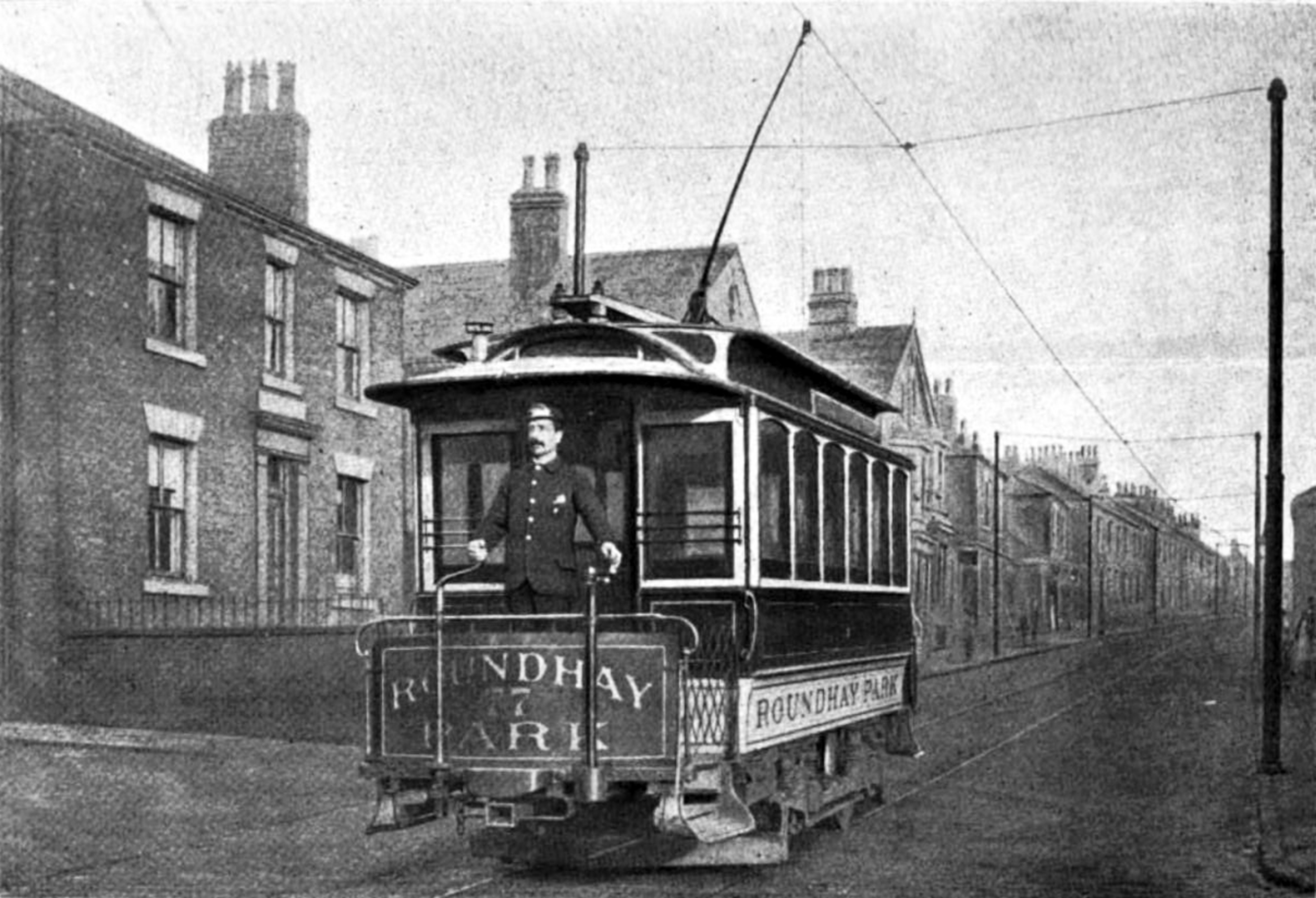
Unfortunately the issue and case don’t figure in Daniel Clark’s excellent contemporary account of the Roundhay line (Clark 1894).
Discussion in one of the Mercury links about running off batteries
Opened 11/11/1891
Something to say? Get in touch
Search
Subscribe/buy
Donate
Music & books
Place-People-Play: Childcare (and the Kazookestra) on the Headingley/Weetwood borders next to Meanwood Park.
Music from and about Yorkshire by Leeds's Singing Organ-Grinder.
 RSS feed
 Bluesky
 Extwitter