28 September 1827: The good life at Stapleton Park (Pontefract), country house of the still unmarried and vaguely solvent horse-racer and politician Edward Petre, 33 today
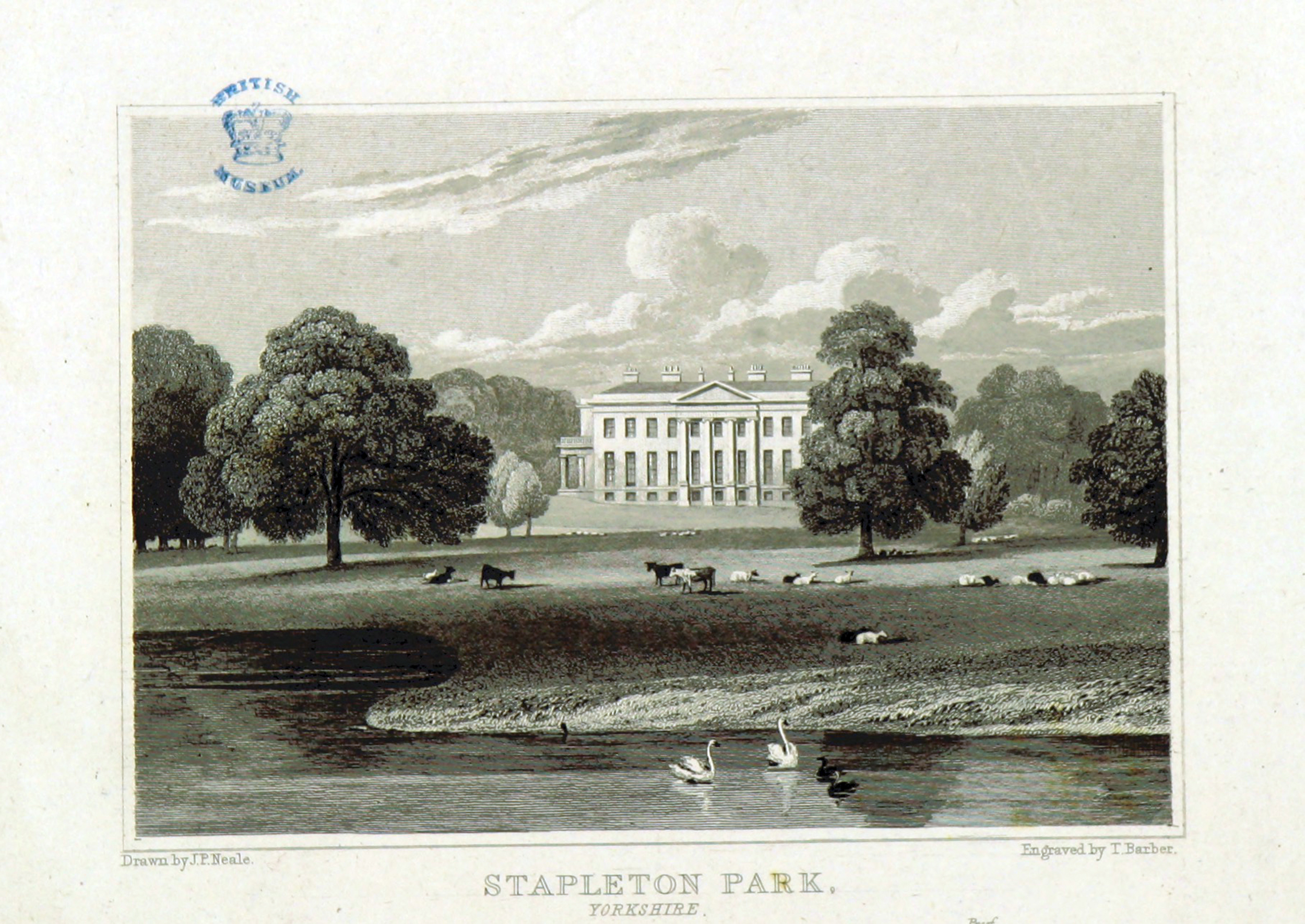
(Neale 1818).
Thomas Creevey. 1904. The Creevey Papers, 2nd Ed., Vol. 2. Ed. Herbert Maxwell. London: John Murray. Get it:
.Unedited excerpt
If an excerpt is used in the book, it will be shorter, edited and, where applicable, translated.
What a comfortable house this is, and how capitally “dear Eddard” lives. What a fool this good-natured Eddard is to be eat and drunk out of house and harbour, and to be treated as he is. The men take his carriages and horses to carry them to their shooting ground, and leave his fat mother [Juliana Barbara Howard] to waddle on foot, though she can scarcely get ten yards. Then dinner being announced always for seven, the men neither night have been home before 8, and it has been ¼ to 9 that Dowager Julia and her ladies have been permitted to dine. Then these impertinent jades, the Ladies Ashley, breakfast upstairs, never shew till dinner, and even then have been sent to and waited for. Dowager Julia makes one eternally split with her voice and her words and her criticism upon everybody. She is always at it and always right, and a good honest soul as ever was.


Comment
Comment
Editor Maxwell in his footnote confuses Edward Robert Petre and Robert Edward Petre.
He married the 18-year-old Laura Stafford-Jerningham two years later:
Mr. Petre was universally supposed to be the possessor of an enormous fortune. Though, as we have said, Lord and Lady Stafford would never have urged their daughters to marry merely for money, yet it is only natural that the idea of their future son-in-law’s wealth must have been the reverse of a drawback in their eyes. He would, in fact, have been extremely rich had his estates been managed with prudence and his income spent with discretion. But he had no head for business, and left his pecuniary affairs entirely in the hands of his steward. He had no taste for study or any sedentary occupation, but spent the greater part of his time in the open air, riding, hunting, shooting. Well would it have been for him had he remembered the necessity for the constant supervision of l’oeil du maître. He had a town house in Chelsea, at that time one of the most fashionable quarters of London, strange as the fact may appear to those whose lot is cast in later years. His estates were situated in Yorkshire, in the vicinity of Doncaster, Pontefract and Selby respectively. The splendid domain of Stapleton Park formed, as it were, the centre of the group. It was here that he spent the principal part of the year before he resolved to marry. His favourite amusement was racing, and this alone would be sufficient to account for his diminished resources, for a princely fortune indeed is necessary to those who keep racing stables and frequent the turf, with all the heavy and numerous expenses which this delightful amusement entails. If we blame Mr. Petre for pursuing it to an extent of which his means did not allow, we cannot refuse him our sympathy when we remember how great must be the charm of superintending the training and exercising of the beautiful animals, how great the interest of betting, how intense and all-absorbing the excitement of their owner when the grand day arrives and the brilliant assembly of spectators is gathered together. Mr. Petre was, moreover, successful on the turf. He won the St. Leger three times, in three successive years in 1827 with ‘Matilda,” in 1828 with “The Colonel,” in 1829 with “Rowton.” Subsequently to this final victory he abandoned racing altogether. There is every reason to believe that his affection for Lord Stafford’s daughter formed a potential motive for taking this step. But he had been piously brought up, and it appears that his conscience reproached him for having hitherto led a life wholly devoted to pleasure, and for having during a long series of years wasted alike his money and his time. As far as he was concerned, his choice of a wife was wise indeed. Her influence over him was very great, and the strength of her character remedied the weakness of his own, and directed his natural love of spending into channels which made him, in after years, a help and blessing to many of his co-religionists. … Had he not been possessed of true principles and a high sense of honour, he could never have nerved himself to so great an act of renunciation as the abandonment of his favourite and most exciting amusement.
Mrs. Petre had only been married a few months when she discovered the apparently hopeless condition of her husband’s finances. Already his creditors were knocking loudly at the door. His recent alliance with a daughter of Lord Stafford naturally encouraged them to hope for speedy payment, and thus rendered them more importunate than they would otherwise have been. The large sums spent upon the turf, the manner in which he had lent to his friends money which they had never returned, the lavish and reckless footing upon which his household had been conducted, all combined to render his annual expenditure greater than was warranted by the income he derived from his estates. In a word, without his wife’s intervention he would have been completely ruined.
Fully aware of his own inability to cope with the situation, he was only too thankful to leave everything in her hands, and invest her with complete and irresponsible power to do whatever she thought best. The task would have been no easy one for a man who was experienced in such matters. For the shoulders of a girl of nineteen it was a heavy burden indeed. She took it up with a courage and high spirit which commanded universal admiration, and astonished all who came into contact with her. She devoted all her intellectual powers to her dreary and distasteful occupation, entered into the minutest details, made herself mistress of the most intricate subjects, until, with the aid of her lawyers, she arrived at a clear and complete comprehension of the state of her husband’s finances.
One thing was apparent, namely that prompt and extensive retrenchments were an absolute necessity, and that great sacrifices must be made. A large portion of the Yorkshire estates were sold, and even the furniture of the mansion which stood in Stapleton Park. Mr. and Mrs. Petre quitted this beautiful place in 1830 or 1831, never to return there. The management of the property which was not sold was placed in the hands of administrators, who were to retain control over it until all debts should have been discharged. In order that this might be more speedily accomplished, the husband and wife resolved to spend several months of every year abroad, at least for some time to come, since, if they continued to mix in the society to which they had been accustomed, it would have been absolutely impossible for them to economise as they had determined to do.
How different was all this from the future which Laura must have pictured to herself on her marriage morning! Yet so high was her spirit, so dauntless her courage, so immense her power of self-control, that, whatever she felt, she never allowed herself to appear gloomy or depressed. Her perfect health was of course no small aid to her, and enabled her to support and sustain her invalid husband.
Something to say? Get in touch
Tags
Tags are assigned inclusively on the basis of an entry’s original text and any comment. You may find this confusing if you only read an entry excerpt.
- 📌Darrington, West Yorkshire (2) W/G ·
- Laura Stafford-Jerningham (1811-86) (1), married Edward Petre and became a nun after his death W/G ·
- Petre, Edward Robert (1794-1848) (1), horse racer and politician, lived at Stapleton Park W/G ·
- 📌Pontefract (20) W/G ·
- Shooting (7) W/G ·
- St Leger Stakes (5) W/G ·
- 📌Stapleton Park (1), (demolished) mansion near Pontefract designed by John Carr, with extensive kitchen gardens, pleasure grounds, lake and a landscape park of 182 hectares W/G ·
- Thomas Creevey (1) W/G ·
Comment
Comment
Editor Maxwell in his footnote confuses Edward Robert Petre and Robert Edward Petre.
He married the 18-year-old Laura Stafford-Jerningham two years later:
Mr. Petre was universally supposed to be the possessor of an enormous fortune. Though, as we have said, Lord and Lady Stafford would never have urged their daughters to marry merely for money, yet it is only natural that the idea of their future son-in-law’s wealth must have been the reverse of a drawback in their eyes. He would, in fact, have been extremely rich had his estates been managed with prudence and his income spent with discretion. But he had no head for business, and left his pecuniary affairs entirely in the hands of his steward. He had no taste for study or any sedentary occupation, but spent the greater part of his time in the open air, riding, hunting, shooting. Well would it have been for him had he remembered the necessity for the constant supervision of l’oeil du maître. He had a town house in Chelsea, at that time one of the most fashionable quarters of London, strange as the fact may appear to those whose lot is cast in later years. His estates were situated in Yorkshire, in the vicinity of Doncaster, Pontefract and Selby respectively. The splendid domain of Stapleton Park formed, as it were, the centre of the group. It was here that he spent the principal part of the year before he resolved to marry. His favourite amusement was racing, and this alone would be sufficient to account for his diminished resources, for a princely fortune indeed is necessary to those who keep racing stables and frequent the turf, with all the heavy and numerous expenses which this delightful amusement entails. If we blame Mr. Petre for pursuing it to an extent of which his means did not allow, we cannot refuse him our sympathy when we remember how great must be the charm of superintending the training and exercising of the beautiful animals, how great the interest of betting, how intense and all-absorbing the excitement of their owner when the grand day arrives and the brilliant assembly of spectators is gathered together. Mr. Petre was, moreover, successful on the turf. He won the St. Leger three times, in three successive years in 1827 with ‘Matilda,” in 1828 with “The Colonel,” in 1829 with “Rowton.” Subsequently to this final victory he abandoned racing altogether. There is every reason to believe that his affection for Lord Stafford’s daughter formed a potential motive for taking this step. But he had been piously brought up, and it appears that his conscience reproached him for having hitherto led a life wholly devoted to pleasure, and for having during a long series of years wasted alike his money and his time. As far as he was concerned, his choice of a wife was wise indeed. Her influence over him was very great, and the strength of her character remedied the weakness of his own, and directed his natural love of spending into channels which made him, in after years, a help and blessing to many of his co-religionists. … Had he not been possessed of true principles and a high sense of honour, he could never have nerved himself to so great an act of renunciation as the abandonment of his favourite and most exciting amusement.
Mrs. Petre had only been married a few months when she discovered the apparently hopeless condition of her husband’s finances. Already his creditors were knocking loudly at the door. His recent alliance with a daughter of Lord Stafford naturally encouraged them to hope for speedy payment, and thus rendered them more importunate than they would otherwise have been. The large sums spent upon the turf, the manner in which he had lent to his friends money which they had never returned, the lavish and reckless footing upon which his household had been conducted, all combined to render his annual expenditure greater than was warranted by the income he derived from his estates. In a word, without his wife’s intervention he would have been completely ruined.
Fully aware of his own inability to cope with the situation, he was only too thankful to leave everything in her hands, and invest her with complete and irresponsible power to do whatever she thought best. The task would have been no easy one for a man who was experienced in such matters. For the shoulders of a girl of nineteen it was a heavy burden indeed. She took it up with a courage and high spirit which commanded universal admiration, and astonished all who came into contact with her. She devoted all her intellectual powers to her dreary and distasteful occupation, entered into the minutest details, made herself mistress of the most intricate subjects, until, with the aid of her lawyers, she arrived at a clear and complete comprehension of the state of her husband’s finances.
One thing was apparent, namely that prompt and extensive retrenchments were an absolute necessity, and that great sacrifices must be made. A large portion of the Yorkshire estates were sold, and even the furniture of the mansion which stood in Stapleton Park. Mr. and Mrs. Petre quitted this beautiful place in 1830 or 1831, never to return there. The management of the property which was not sold was placed in the hands of administrators, who were to retain control over it until all debts should have been discharged. In order that this might be more speedily accomplished, the husband and wife resolved to spend several months of every year abroad, at least for some time to come, since, if they continued to mix in the society to which they had been accustomed, it would have been absolutely impossible for them to economise as they had determined to do.
How different was all this from the future which Laura must have pictured to herself on her marriage morning! Yet so high was her spirit, so dauntless her courage, so immense her power of self-control, that, whatever she felt, she never allowed herself to appear gloomy or depressed. Her perfect health was of course no small aid to her, and enabled her to support and sustain her invalid husband.
Something to say? Get in touch
Similar
 31 October 1674: Riding home to Pontefract from Wakefield fair, a sozzled Silvanus Rich enters the River Calder in flood at Wakefield bridge
Comment
Comment
From the Spanish Civil War I’m familiar with deals where people from place A sin in place B, and vice versa, in order to avoid recognition, but I don’t get the impression from the articles in the Mercury that the troublemakers were all strangers, though it may have been convenient to say so – perhaps in order to maintain Lister’s commitment to the pit.
How to construe “queer”? Irvin Saxton, who has done a brilliant job of collecting material relating to the history of Featherstone, says the jury was chosen by Sergeant Sparrow and included miners, checkweighmen, deputies, a builder, a timekeeper and a postman (Saxton 2021/03). What does “chosen” mean, etc. etc.? And oh! to have been a fly on the wall as they balanced truth with expediency!
Saxton cites Asquith, home secretary in Gladstone’s 1892-95 Liberal government, and his self-justification is also interesting:
The Featherstone Riot … aroused considerable controversy at the time, and earned for me for some years in the rhetoric of the Labour platform the designation of “Asquith the Murderer.” It came about as follows. A miners’ coal strike had been for some time going on at or near Featherstone in the West Riding of Yorkshire. Its progress was marked by growing disturbances, which developed into organized violence and arson. The local magistrates, with whom the responsibility for the preservation of peace and the protection of property primarily rests, were soon brought to the end of their resources; they tried in vain to supplement their own police by borrowing from adjoining areas; and at last, in response to their repeated appeals to the Home Office, I sanctioned their applying for the necessary help from the military forces in the neighbourhood, whose legal duty it is, according to the Common Law of England, as citizens, to come to the aid of the civil power in such an emergency.
Their intervention put an end to the whole disturbance within forty-eight hours. A magistrate was present with the troops; he made no fewer than seven appeals to the crowd, who were armed with sticks and bludgeons, to discontinue the work of destruction, much valuable property being already ablaze; the Riot Act was read; a bayonet charge was unavailingly made; and as the defensive position held by the small detachment of soldiers (fewer than thirty men) was becoming untenable, and the complete destruction of the colliery was imminent, the magistrate gave orders to the commander to fire. Two men on the fringe of the crowd were unfortunately killed.
As I was not satisfied, after a careful study of the evidence given at the two inquests, that all the facts had been adequately investigated, I took the unusual course of appointing a Special Commission to examine and report upon the whole affair. The commissioners whom I nominated were Lord Bowen, one of the most eminent of the judicial members of the House of Lords, Sir Albert Rollit, a solicitor of wide experience and a Conservative M.P., and Mr. Haldane, then a Liberal member, and afterwards Lord Chancellor.
No one disputed the impartiality and competence of the Commission, and after an exhaiistive inquiry at Wakefield they made a Report, setting out in detail all the facts, defining in a passage which has become a classic in our law, the respective duties of the civil and military powers in such cases, and completely justifying in every respect the action both of tlie magistrates and of the officers and rank and file of the soldiers. The matter was then fully debated in the House of Commons, when I challenged in vain my accusers to prefer and make good any charge which they thought fit to make.
It took years, however, to dissipate the legend, assiduously circulated, mainly by ejaculations from the back benches of so-called “Labour” meetings, that I had sent down the soldiers deliberately to help the owners in the dispute and to thin the ranks of the strikers.
(Asquith 1928)
It is with a kind of despair that those who have hoped that this dispute might end with some concession on the part of the coal-owners now see a small reckless percentage of the colliers throwing away tactical advantages. Hitherto public sympathy has been remarkably evenly divided between the parties. The miners’ refusal of arbitration has been resented by many; the abrupt and tactless demand of the coal-owners for a heavy [wage] reduction “in one piece” has been resented by about as many more.
But riots like this bring a mass of fresh public opinion to bear. The miners appear as wanton robbers and destroyers, the coal-owners as law-abiding men subjected to cruel injury.
For the sake of the miners and of trade unionism itself, we hope that every repetition of these blundering crimes will be repressed with more common sense than when soldiers were helplessly looking on for want of a magistrate to read the Riot Act.
(Guardian 1893/09/09)
A Mercury article published on the same day or shortly thereafter contradicts the Guardian line that three died: apparently Tomlinson survived.
Something to say? Get in touch
Search
Subscribe/buy
Donate
Music & books
Place-People-Play: Childcare (and the Kazookestra) on the Headingley/Weetwood borders next to Meanwood Park.
Music from and about Yorkshire by Leeds's Singing Organ-Grinder.
 RSS feed
 Bluesky
 Extwitter