25 December 1916: I wish you a merry Christmas and a happy New Year, and other carols and mummery
Frederic William Moorman. 1916. Yorkshire Dialect Poems (1673-1915) and Traditional Poems. London: Sidgwick and Jackson. Get it:
.Indices for all ballads etc. mentioned here: Roud 394 @ Vaughan Williams ML & Bodleian / Roud 209 @ Vaughan Williams ML & Bodleian
Unedited excerpt
If an excerpt is used in the book, it will be shorter, edited and, where applicable, translated.
I wish you a merry Kessenmas an’ a happy New Year,
A pokeful o’ money an’ a cellar-full o’ beer.
A good fat pig an’ a new-cauven coo;
Good maisther an’ misthress, hoo do you do?

Comment
Comment
Year assigned as per Moorman, but someone will probably be able to find an older version. Moorman has versions of other songs which I, perhaps mistakenly, think of as more southerly: his Cleveland Christmas Song, which he has from Florence Cleveland (Tweddell 1875), is a version of God rest you merry gentlemen (“God a-rist you, merry gintlemen”), then there is a version of God bless the master of this house / Here we come a-wassailing. His Come all ye jolly mummers (A mumming we will go) has much in common with the eponymous, marvellous song in an anonymous 1830s/-40s Sheffield mummers’ chapbook (Pearce 1840).
Something to say? Get in touch
Tags
Tags are assigned inclusively on the basis of an entry’s original text and any comment. You may find this confusing if you only read an entry excerpt.
- Christmas carol (4) W/G ·
- Christmas (16) W/G ·
- Cleveland (county) (3) W/G ·
- Moorman, Frederic William (1872–1919) (4), Devon-raised Yorkshire dialectologist, poet and playwright, Professor of English Language at the University of Leeds (1912-18), allegedly translator of rules of football into German W/G ·
- Poetry (75) W/G ·
- Yorkshireness (9) W/G ·
Comment
Comment
Year assigned as per Moorman, but someone will probably be able to find an older version. Moorman has versions of other songs which I, perhaps mistakenly, think of as more southerly: his Cleveland Christmas Song, which he has from Florence Cleveland (Tweddell 1875), is a version of God rest you merry gentlemen (“God a-rist you, merry gintlemen”), then there is a version of God bless the master of this house / Here we come a-wassailing. His Come all ye jolly mummers (A mumming we will go) has much in common with the eponymous, marvellous song in an anonymous 1830s/-40s Sheffield mummers’ chapbook (Pearce 1840).
Something to say? Get in touch
Similar


Comment
Comment
Rimbault quotes one John Gregory, who in the Sarum Processionale found the following:
The Episcopus Choristarum was a chorister-bishop chosen by his fellow children upon St. Nicholas’ day… From this day till Innocents’ day at night (it lasted longer at the first), the Episcopus Puerorum [Boy-Bishop] was to bear the name and hold up the state of a bishop, answerably habited, with a crosier or pastoral staff in his hand, and a miter upon his head; and such an one too som had, as was multis episcoporum mitris sumtuosior, saith one – very much richer than those of bishops indeed. The rest of his fellows from the same time being were to take upon them the style and counterfeit of prebends, yielding to their bishops (or else as if it were) no less then canonical obedience. And look what service the very bishop himself with his dean and prebends (had they been to officiate) was to have performed, the mass excepted, the verie same was done by the chorister-bishop and his canons upon this Eve and the Holy Day.
This may be the origin of the York ritual, which nevertheless, and for reasons unknown to me, starts and ends later. The “account of Nicholas of Newark, guardian of the property of John de Cave, boy bishop in the year of our Lord 96” accounts for receipts (offerings in the cathedral, from canons, and from the nobility and monasteries visited) and expenditure (clothing, beer, food, music, etc.). The world-turned-upside-down visitations of the episcopus puerorum/Innocencium and his band remind me somewhat like those practised by the Raad van Elf of carnival associations in the Catholic Netherlands. Was there a similar serious business + drunken fun combination? For example, “the medieval breviary in the Sarum (but not in the Roman) use prescribed ‘O Virgo Virginum’ as antiphon upon the Magnificat for December 23, but was it sung for the boy-bishop on 23 December in humorous reference to his postulated sexual inexperience?
O Virgin of Virgins, how shall this be? For neither before thee was any like thee, nor shall there be after. Daughters of Jerusalem, why marvel ye at me? That which ye behold is a divine mystery (Bls 2007/12/23).
Yann Dahhaoui has compiled a map showing the locations visited by John de Cave numbered in chronological order:
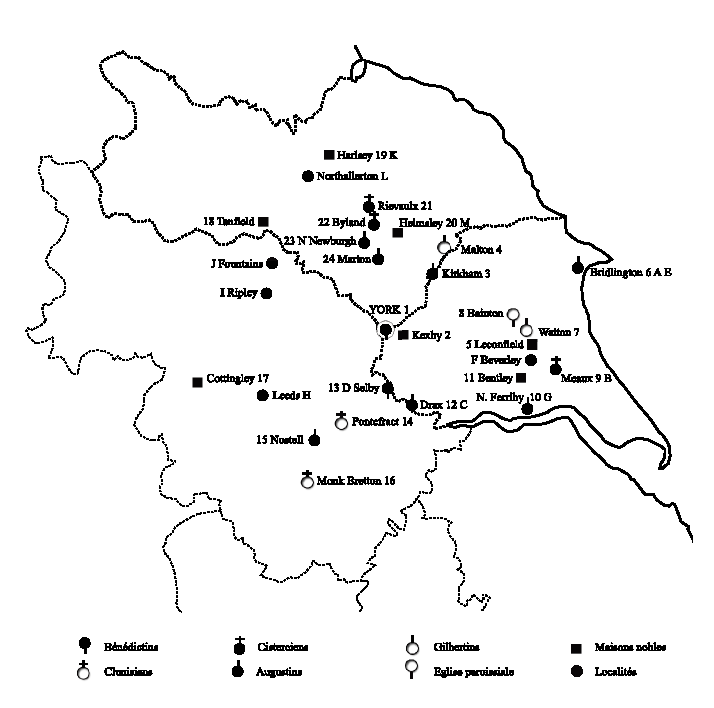
There is a 13th century sculpture of what some say is a boy bishop at the marvellous St Oswald’s Church, Filey – the church guide suggests that it might instead by
one of the canons regular of St Augustine, a member of Bridlington Priory who served the church at Filey. It was not uncommon in the 13th and 14th centuries for such a person to keep up his connection with the church by having his heart buried there with an appropriate miniature representation of himself in stone.
The account documents 42 days starting on 23 December, but I don’t know how long John de Cave’s rule actually lasted. Liz Truss managed 49 days.
Irrelevant, but St. William is presumably William of Donjeon/Bourges, whose feast day is 10 January, to which 7 January was the closest Sunday.
https://archive.org/details/stationsofsunhis0000hutt/page/100/mode/1up
Something to say? Get in touch
Search
Subscribe/buy
Donate
Music & books
Place-People-Play: Childcare (and the Kazookestra) on the Headingley/Weetwood borders next to Meanwood Park.
Music from and about Yorkshire by Leeds's Singing Organ-Grinder.
 RSS feed
 Bluesky
 Extwitter