27 July 1822: An inquest at York finds that John Furnel of the Queen’s Regiment of Foot died of flogging and resulting illness

A British army drummer administering a flogging: coloured etching after Henry Alken (Alken 1820).
York Courant. 1822. Soldier Dead from Flogging. Cobbett’s Weekly Political Register, Vol. 43. London: C. Clement. Get it:
.Unedited excerpt
If an excerpt is used in the book, it will be shorter, edited and, where applicable, translated.
[Copied from the York Courant, Tuesday, July 30]
In our last we stated that a Coroner’s Inquest had been held by Mr. Cowling of this city on the previous Monday [22 July] at the York Barracks over the body of John Furnel, a private in the 2d or Queen’s regiment of Foot, who had been flogged at Hull, and within one week afterwards removed to our Barracks, where he lingered in great torture till Friday week, when death closed his earthly sufferings. The inquest was, however, adjourned till yesterday, and we therefore were not able to give any official information on the subject in our last; but as it is our duty, we now lay the purport of the whole before the public.
The inquest on Monday week commenced at about half-past eleven in the forenoon, and the only witness then examined was Mr Andrew Browne, a Surgeon in the 2d Dragoon Guards, now stationed in our Barracks, and under whose medical care the deceased had been placed on his arrival. The purport of his evidence was as follows – that the man had received 300 lashes for an offence at Hull, the exact nature of which he was not fully acquainted with; that about seven days afterwards, the regiment being removed to Ireland, the deceased was conveyed to York on baggage cart; that the deceased informed the witness, that a servant, whilst removing the portmanteau from the baggage cart, let it fall upon his back; that a mortification ensued, but that it ceased on the 11th; that had the man been able to have taken sufficient support, he might have recovered; that he believed he sunk under debility, which debility might have owed its origin to a three years’ residence in the West Indies. He, however, acknowledged, that when the man was removed from Hull, the weather was extremely hot, and that he must have been much jolted on the baggage cart.
Colonel Kearney, of the Dragoons, now stepped forward and said, that in the absence of everyone connected with the 2d Regiment of Foot, he was anxious to express his full conviction the officers of that regiment were generally men of very kind and humane dispositions, and men who, he was quite certain, would not wilfully act a cruel part.
Two witnesses belonging to the 2d Regiment of Foot being expected from Ireland, the inquest was adjourned till Monday the 29th day of July, at two o’clock.
Before the Jury left the room, however, Mr Browne, the surgeon, re-entered, and announced that he had just opened the body, and that he found the lungs in a state of putrefaction. On that account he wished the Jury to inspect the same, and give their opinion on the subject. Some of the Jury went up stairs, and one of them, on his return into the jury-room, stated that the whole body was in a state of putrefaction, and therefore the lungs so only as a natural result. He, however, added “that the man’s bones were as bare of skin and flesh, as if his back had been scraped with a knife.” The Jury then dispersed, and the remains of the deceased were interred in Fulford church-yard at two o’clock the same afternoon.
SECOND DAY, SATURDAY, JULY 27.
Although the Inquest had been adjourned to Monday, yet the witnesses having arrived on Friday, and expressed great anxiety to return to Ireland as soon as possible, Mr. Cowling summoned the Jury to assemble at three o’clock on Saturday afternoon, which they accordingly did, and the examination proceeded.
Andrew Browne, the Surgeon of the 2d Dragoons, not having opened the body when last examined, was now questioned relative thereto. His evidence, however, on the subject amounted to nothing; for he acknowledged that though he found the lungs in a state of disease, that might have subsequent to the punishment.
Henry Waring, the Lieutenant and active Adjutant of the Second Regiment of Foot, deposed, that the said regiment was in the garrison at Hull, in June; and that on the 21st of that month, the deceased was tried by a Court Martial “for a highly irregular and unsoldier-like conduct, in having in his possession a silver spoon or spoons, the property of the Officers’ Regimental Mess, between the 1st and 14th June, and offering to dispose of the same, knowing it or them to have been improperly come by.” That the man was found Guilty, and sentenced to receive 300 lashes. – That the sentence being confirmed by the Commanding Officer, Lieut. Col. Jordan, it was carried into effect on the 22d June. That no more lashes were inflicted than the sentence authorized, and that the deceased was then sent to the hospital, which is about a mile from the garrison. – That on the 27th of June the regiment marched from Hull to York: that he rode on the baggage cart, but that he walked from York to the barracks.
Maurice Alexander, the Surgeon of the Second Regiment of Foot, confirmed the above, and said that only one sick man had been left behind, but that if he had thought the deceased unable to travel, he also should have been left. Witness examined the back of the deceased at Beverley, after the first day’s march, and dressed it. He then appeared to be doing well. After the second day’s march, he saw the deceased at Market Weighton. He then complained of his back, and on examination the witness found that a mortification had commenced, and that the deceased was labouring under a smart fever. The back of the deceased was dressed, and proper medicines were administered. The next morning the mortification had increased, but the fever had subsided – witness, however, did not know of any proper medical gentleman, (meaning, we suppose, an army surgeon,) under whose care he could leave the deceased, and he therefore was taken to York. The deceased complained of having received a hurt on the baggage cart – and the witness concluded by acknowledging that the weather was extremely hot during the march.
Thus closed the evidence, and the Jury, after due consideration, returned a verdict – that the deceased received three hundred lashes, and that he died of the same, and of the fever, mortification, and debility, arising therefrom.


Comment
Comment
John Gordon Smith, a distinguished medic, cited the portmanteau that allegedly fell on Furnel’s back in the baggage cart and found “the verdict to be in reality founded on the repugnance generally felt towards this form of punishment, and not upon the real truth of the matter as given in evidence” (Smith 1824).
The Times, reflecting popular opinion, and citing the 17th century jurist Matthew Hale’s History of the pleas of the Crown, called for those responsible to be tried for murder:
In a case of this sort, assuming as true all that was given in evidence on the Coroner’s Inquest, it is most inportant to the parties and the public, that strict inquiry should be made whether the culprit in his trial and punishment was fairly dealt by. Avoiding to irritate the national feeling on this event, we shall put interrogatively what appears to us to be liable to any difference of opinion. 1st, then, on the understanding that the deceased soldier had committed a military crime, which fairly subjected him to trial by Court-martial, we should like to be informed whether he did not undergo an excessive punishment, and in that case whether, though it had not killed him, there would be no room for demanding redress? The man dies of the punishment inflicted – yet he was not guilty of a capital offence; for in that case he could not have been tried by a regimental court-martial. In the eye of the law of England and of reason, if death is inflicted for a crime not capital, it amounts to murder. The bearing of the common law of England upon this point is stated by Lord Hale. “If a person sentenced to be whipped, is whipped with that rigour that he dieth of it, this is murder!” … “Also if a man be deliberately beaten beyond the apparent intent (or legal object) of punishment, so that he dieth, it is murder by express malice, although there be not a design to kill him.” … [T]he verdict of the inquest is a warrant to take up and commit for trial the officers, the surgeon who attended at the punishment, the drummers who inflicted it, and all the parties concerned in the shocking transaction, as in every other case of murder (Times 1822).
William Cobbett used this as an example of what he saw as a contrast between William Wilberforce’s concern for the freedoms of black subjects abroad, specifically in the latter’s Appeal to the religion, justice and humanity of the inhabitants of the British Empire in behalf of the negro slaves in the West Indies, and disinterest in those of white subjects at home (Cobbett 1823).
Something to say? Get in touch
Tags
Tags are assigned inclusively on the basis of an entry’s original text and any comment. You may find this confusing if you only read an entry excerpt.
- Beverley (22) W/G ·
- British Army (19) W/G ·
- Cat o’ nine tails (1) W/G ·
- Cobbett, William (1763-1835) (6), populist pamphleteer, journalist, politician and farmer W/G ·
- Corporal punishment (8) W/G ·
- Court-martial (2) W/G ·
- East Riding of Yorkshire (67) W/G ·
- Flagellation (6) W/G ·
- Fulford, North Yorkshire (3) W/G ·
- Historia Placitorum Coronæ (1) W/G ·
- Inquest (15) W/G ·
- John Gordon Smith (surgeon) (1) W/G ·
- 📌Kingston upon Hull (74) W/G ·
- Market Weighton (4) W/G ·
- Medical jurisprudence (1) W/G ·
- Murder (38) W/G ·
- Queen’s Royal Regiment (West Surrey) (1) W/G ·
- Theft (11) W/G ·
- West Indies (9) W/G ·
- Wilberforce, William (1759-1833) (8), Hull-born abolitionist, evangelical Christian and Yorkshire MP W/G ·
- 📌York (165) W/G ·
Comment
Comment
John Gordon Smith, a distinguished medic, cited the portmanteau that allegedly fell on Furnel’s back in the baggage cart and found “the verdict to be in reality founded on the repugnance generally felt towards this form of punishment, and not upon the real truth of the matter as given in evidence” (Smith 1824).
The Times, reflecting popular opinion, and citing the 17th century jurist Matthew Hale’s History of the pleas of the Crown, called for those responsible to be tried for murder:
In a case of this sort, assuming as true all that was given in evidence on the Coroner’s Inquest, it is most inportant to the parties and the public, that strict inquiry should be made whether the culprit in his trial and punishment was fairly dealt by. Avoiding to irritate the national feeling on this event, we shall put interrogatively what appears to us to be liable to any difference of opinion. 1st, then, on the understanding that the deceased soldier had committed a military crime, which fairly subjected him to trial by Court-martial, we should like to be informed whether he did not undergo an excessive punishment, and in that case whether, though it had not killed him, there would be no room for demanding redress? The man dies of the punishment inflicted – yet he was not guilty of a capital offence; for in that case he could not have been tried by a regimental court-martial. In the eye of the law of England and of reason, if death is inflicted for a crime not capital, it amounts to murder. The bearing of the common law of England upon this point is stated by Lord Hale. “If a person sentenced to be whipped, is whipped with that rigour that he dieth of it, this is murder!” … “Also if a man be deliberately beaten beyond the apparent intent (or legal object) of punishment, so that he dieth, it is murder by express malice, although there be not a design to kill him.” … [T]he verdict of the inquest is a warrant to take up and commit for trial the officers, the surgeon who attended at the punishment, the drummers who inflicted it, and all the parties concerned in the shocking transaction, as in every other case of murder (Times 1822).
William Cobbett used this as an example of what he saw as a contrast between William Wilberforce’s concern for the freedoms of black subjects abroad, specifically in the latter’s Appeal to the religion, justice and humanity of the inhabitants of the British Empire in behalf of the negro slaves in the West Indies, and disinterest in those of white subjects at home (Cobbett 1823).
Something to say? Get in touch
Similar
 23 April 1642: Having promised parliament to safeguard for it Hull’s crucial arsenal, John Hotham tells it how today he shut the gates of Hull to Charles I
Comment
Comment
The fiscal fatigue caused by the Hundred Years’ War was a cause of the 1343-45 Truce of Malestroit.
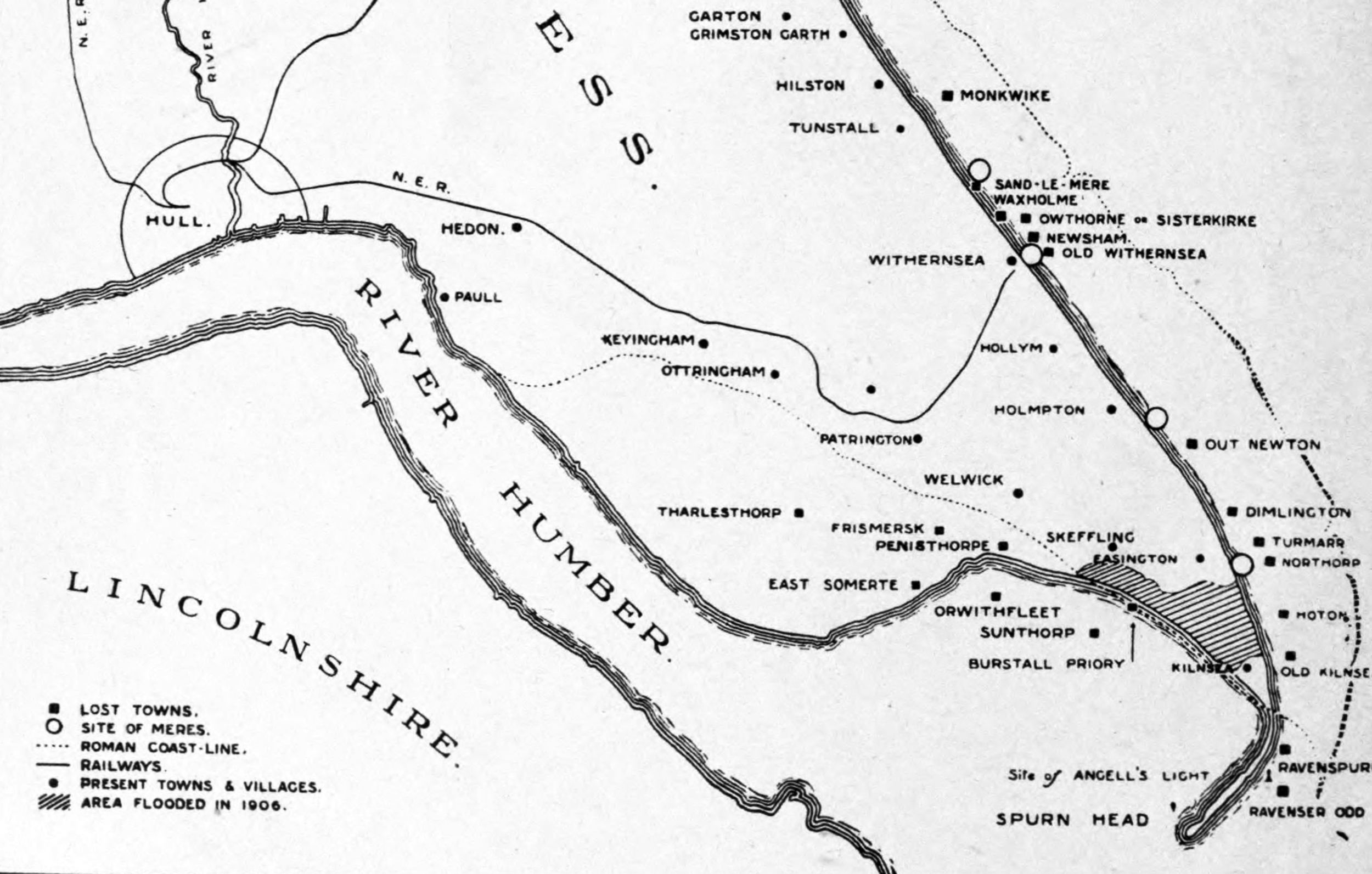
Thomas Sheppard is a good starting point for respectively Ravenser and Ravenser Odd:
William Shelford … points out that Spurn Point, even in Roman times, must have been 2,250 yards at least beyond the present coastline ; and that at or near this spot the Danes landed in 867, planted their standard “The Raven,” and practically originated the town of Ravensburg, or Ravenser, or Ravenseret, within Spurn Head. The town developed into “one of the most wealthy and flourishing ports of the kingdom. It returned two Members to Parliament, assisted in equipping the navy, had an annual fair of thirty days, two markets a week, is mentioned twice by Shakespeare,[King Henry VI, part iii, Act iv, Scene 7; and Richard II, Act 2, Scene 1] and considered itself honoured by the embarkation of Baliol with his army for the invasion of Scotland in 1332; by the landing of Bolingbroke, afterwards Henry IV, in 1399; and by the landing of Edward IV in 1471, not long after which it was entirely swept away.” Today, we cannot even be certain where the place was. […] In 1296 “Kaiage” [right to tax wharf occupation] was granted to the inhabitants by Edward I. Two years later Ravenser petitioned the king for certain privileges, and offered 300 marks in payment. In 1300 the magistrates of Ravensere were enjoined to stop the export of bullion; in 1305 it sent Members to Parliament. In 1310 Ravensere remonstrated against the depredations of the Earl of Holland, and in the same year Ravenness sent ships for Edward II.’s expedition to Scotland. Two years later the inhabitants were empowered to levy a tax to defend their walls. In 1323 commissions were issued for the “Wapentak of Ravensere.” In 1335-6 warships of Ravensere are referred to, and in 1341 Ravensere sent one Member to “a sort of” naval Parliament of Edward III. In 1346 one ship only was sent by Ravenser to the siege of Calais; (Hull sent 16). In 1355 bodies were washed out of their graves in the chapelyard at Ravenser. In 1361 [i.e. 1362 – the Second St. Marcellus flood] the floods drove the merchants to Hull and Grimsby; and by 1390 nearly all trace of the town, as such, was gone.* In 1413 a grant was made for the erection of a hermitage at Ravenscrosbourne, and in 1428 Richard Reedbarowe, the hermit of the chapel of Ravensersporne obtained a grant to take tolls of ships for the completion of his light-tower. In 1538 Leland refers to Ravenspur in his ” Itinerary,” which seems to be the last reference to the place. As pointed out elsewhere, the place is not included in Holinshed’s ” List of Ports and Creeks,” which was issued before 1580.
[…]
Ravenser-odd (also referred to as Odd near Ravenser, Ravenserot, Ravensrood, Ravensrodd, Ravensrode, etc.), probably originated in the early part of the thirteenth century, soon after Ravenser, the adjoining port, came to be of importance. Ravenser-odd was apparently built on an island.
In 1251 some monks obtained half an acre of ground on which to erect buildings for the preservation of fish, in the burg of Od near Ravenser. The chronicler of Meaux wrote that “Od was in the parish of Esington, about a mile distant from the mainland. The access to it was from Ravenser by a sandy road covered with round yellow stones, scarcely elevated above the sea. By the flowing of the ocean it was little affected on the east, and on the west it resisted in a wonderful manner the flux of the Humber.”
In 1273 there was a dispute about a chapel at Od, and this was carried on for some time.
In 1300 Edward I. gave some lands in Ravenserodde to the convent of Thornton in Lincolnshire, and others to St. Leonard’s Hospital, York.
In 1315 the burgesses of Ravenserod agreed to pay the king £50 for the confirmation of their charters, and “Kaiage” for seven years. In 1326 the king granted dues and customs in the port of Ravenserod, and about 1336 William De-la-Pole left Ravenserod for Hull. Ravenserode sent a representative to Edward III.’s “naval Parliament” in 1344, as well as a man well versed in naval affairs.
In 1346 Ravensrodde was one of the places mentioned by the Abbot of Meaux as suffering by the sea. In the following year it was frequently inundated, and in 1360 [presumably 1362] “Ravenser Odd was totally annihilated by the floods of the Humber and inundations of the great sea.”
In 1355 the bodies in the chapel yard, which, “by reason of inundations were then washed up and uncovered,” were removed and buried in the churchyard at Easington.
About this time we read the following curious note in the Meaux Chronicle : — ” When the inundations of the sea and of the Humber had destroyed to the foundations the chapel of Ravenserre Odd, built in honour of the Blessed Virgin Mary, so that the corpses and bones of the dead there buried horribly appeared, and the same inundations daily threatened the destruction of the said town, sacrilegious persons carried off and alienated certain ornaments of the said chapel, without our due consent, and disposed of them for their own pleasure ; except a few ornaments, images, books, and a bell which we sold to the mother church of Esyngton, and two smaller bells to the church of Aldeburghe. But that town of Ravenserre Odd, in the parish of the said church of Esyngton, was an exceedingly famous borough, devoted to merchandise, as well as many fisheries, most abundantly furnished with ships and burgesses amongst the boroughs of that sea-coast. But yet, with all inferior places, and chiefly by wrong-doing on the sea, by its wicked works and piracies, it provoketh the wrath of God against itself beyond measure. Wherefore, within the few following years, the said town, by those inundations of the sea and of the Humber, was destroyed to the foundations, so that nothing of value was left.”
Notwithstanding this, “In the Hedon inquisition of January 1401, the chapel of Ravenserodde, with the town itself, was declared to be worth, in spiritualities, more than £30 per annum.”
William Wheater treads a similar path, perhaps better – haven’t read it (Wheater 1889).
The rise and fall of a tsunami are among the 15 signs of doom in a Middle English poem, The Pricke of Conscience, and are illustrated in a medieval (ca. 1410) window in All Saints’ Church, North Street, York:
Þe first day of þas fiften days,
Þe se sal ryse, als þe bukes says,
Abowen þe heght of ilka mountayne,
Fully fourty cubyttes certayne,
And in his stede even upstande,
Als an heghe hille dus on þe lande.
Þe secunde day, þe se sal be swa law
Þat unnethes men sal it knaw.
Þe thred day, þe se sal seme playn
And stand even in his cours agay[n],
Als it stode first at þe bygynnyng,
With-outen mare rysyng or fallyng
(Anon 1863)
Britta Sweers, “Trutz, Blanke Hans” – Musical and Sound Recollections of North Sea Storm Tides in Northern Germany
Something to say? Get in touch
Search
Subscribe/buy
Donate
Music & books
Place-People-Play: Childcare (and the Kazookestra) on the Headingley/Weetwood borders next to Meanwood Park.
Music from and about Yorkshire by Leeds's Singing Organ-Grinder.
 RSS feed
 Bluesky
 Extwitter