13 January 1536: Richard Layton, dissolver of monasteries, writes to Thomas Cromwell claiming that Yorkshire clergy use birth control
John William Clay, Ed. 1912. Yorkshire Monasteries. London: Yorkshire Archaeological Society. Get it:
.Unedited excerpt
If an excerpt is used in the book, it will be shorter, edited and, where applicable, translated.
It may please your mastership to be advertised, that here in Yorkshire we find great corruption amongst persons religious, even like as we did in the south, tam in capite quam in membris, and worse if worse may be in kinds of knavery, as, retrahere membrum virile in ipso punctu seminis emittendi, ne inde fieret prolis generatio, and nuns to take potations ad prolem conceptum opprimendum, with such other kinds of offences lamentable to hear.
This day, we begin with Saint Mary’s Abbey, whereas we suppose to find much evil disposition both in the abbot and the convent, whereof, God willing, I shall certify you in my next letters. The dean of York was never fully concluded with the treasurer here for the deanery. The dean would not resign unto him, unless he would leave him other possessions; for pension he would none have, fearing such like debatement thereof as was of pensions in the last Parliament. To have taken the treasureship for the lieu of a pension he was once content, whereunto the treasurer would not agree, unless he might have had his prebend also with his deanery, which the dean would not, and so they broke; the treasurer would have had the dean to have written unto you of such towardness in the premises at such time as the treasurer came up last to London, which the dean then refused to do, bycause thereof he persuade no great towardness of any conclusion.
This is the dean’s tale to me, and this I find true; wherefore I shall desire your mastership to continue your good mind towards me, and in the mean time ye shall be fast assured of my faithful service in all such affairs as ye commit unto me, and for no corruption or lucre from my loyalty to swerve in doing my prince’s commandment for your discharge, which hath put your trust and affiance unto me. From Yorke 13 January, by your assured poor priest.

Comment
Comment
“Poor priest” is “poire preste” in the original, “nimble pear” in French. This turns up several times here, but I think not elsewhere: a bilingual punning in-joke between Cromwell and his employees? The pun on member is common.
I’m guessing most of the claims were formulaic fabrication, so the whole thing may have been treated as something of a joke – except by those on the receiving end. But what goes around, comes around: if the dissolution of the monasteries was justified by lies, their founders often also sold a lie – see e.g. Noel Menuge on the use by entrepreneurial monks of a desolation myth to gain cheap control over valuable land (Menuge 2000).
Something to say? Get in touch
Tags
Tags are assigned inclusively on the basis of an entry’s original text and any comment. You may find this confusing if you only read an entry excerpt.
- Abortifacient (2) W/G ·
- Abortion (4) W/G ·
- Anti-clericalism (7) W/G ·
- Birth control (2) W/G ·
- Catholic Church (57) W/G ·
- Coitus interruptus (1) W/G ·
- Cromwell, Thomas (by 1485-1540) (4), advocate of the English Reformation, chief minister to King Henry VIII from 1534 until his beheading W/G ·
- Dissolution of the monasteries (9), the set of administrative and legal processes 1536-41 by which Henry VIII disbanded Catholic monasteries, priories, convents, and friaries, seized their wealth, disposed of their assets, and provided for their former personnel and functions W/G ·
- English Reformation (12) W/G ·
- Henry VIII (1491-1547) (16), ruled 1509 until his death, initiator of the English Reformation, separating the Church of England from papal authority and introducing the theory of the divine right of kings, dissolved convents and monasteries, invested heavily in the navy W/G ·
- Layton, Richard (1500?–1544) (2), churchman, jurist and diplomat, dean of York and a principal agent of Henry VIII and Thomas Cromwell in the Dissolution of the Monasteries W/G ·
- Medieval contraception (1) W/G ·
- Sexual intercourse (6) W/G ·
- St Mary’s Abbey, York (5) W/G ·
- 📌York (165) W/G ·
Comment
Comment
“Poor priest” is “poire preste” in the original, “nimble pear” in French. This turns up several times here, but I think not elsewhere: a bilingual punning in-joke between Cromwell and his employees? The pun on member is common.
I’m guessing most of the claims were formulaic fabrication, so the whole thing may have been treated as something of a joke – except by those on the receiving end. But what goes around, comes around: if the dissolution of the monasteries was justified by lies, their founders often also sold a lie – see e.g. Noel Menuge on the use by entrepreneurial monks of a desolation myth to gain cheap control over valuable land (Menuge 2000).
Something to say? Get in touch
Similar
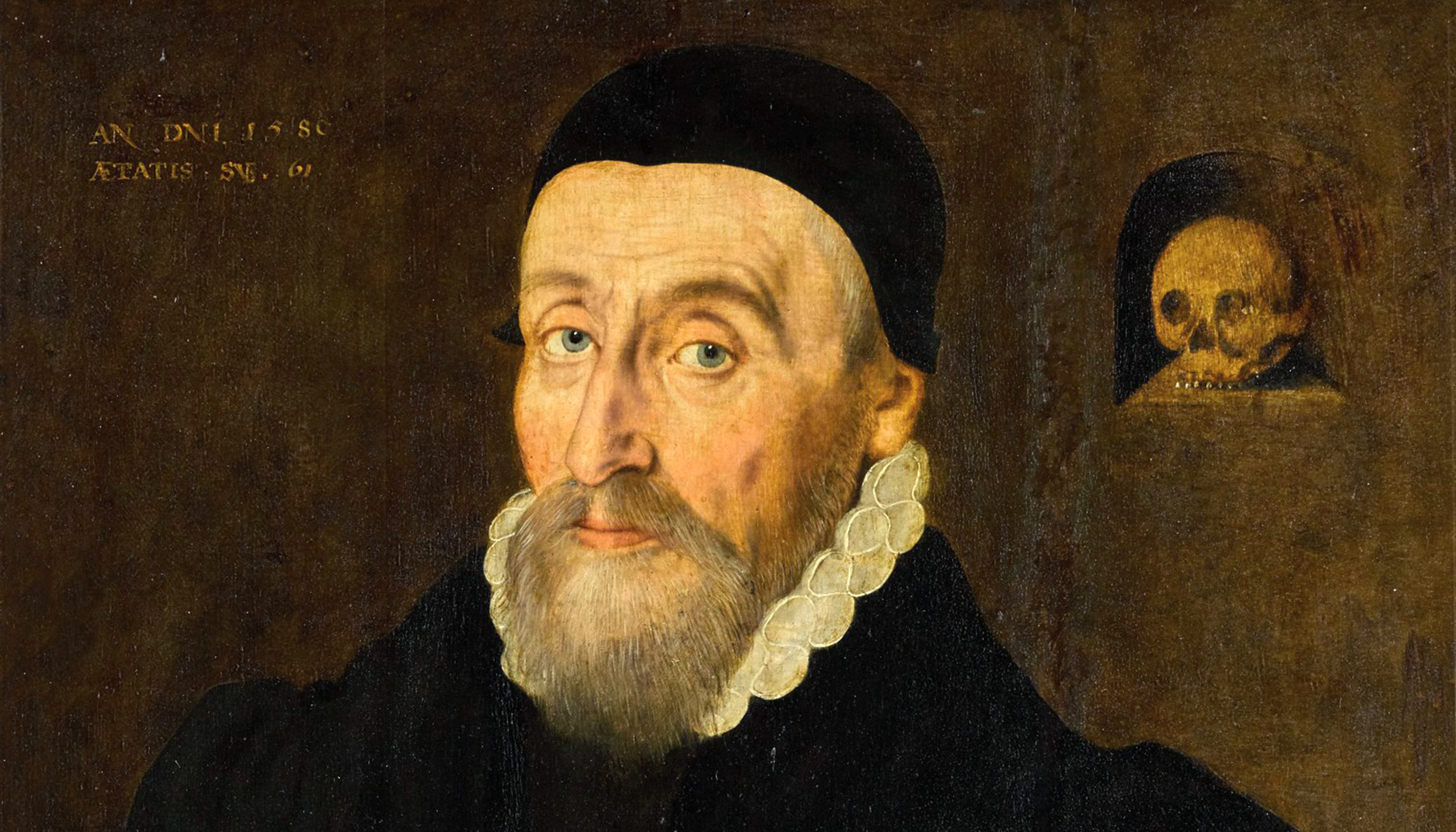 29 August 1570: On arriving in Yorkshire, Archbishop Grindal declares war on bloody-minded folk-Catholicism
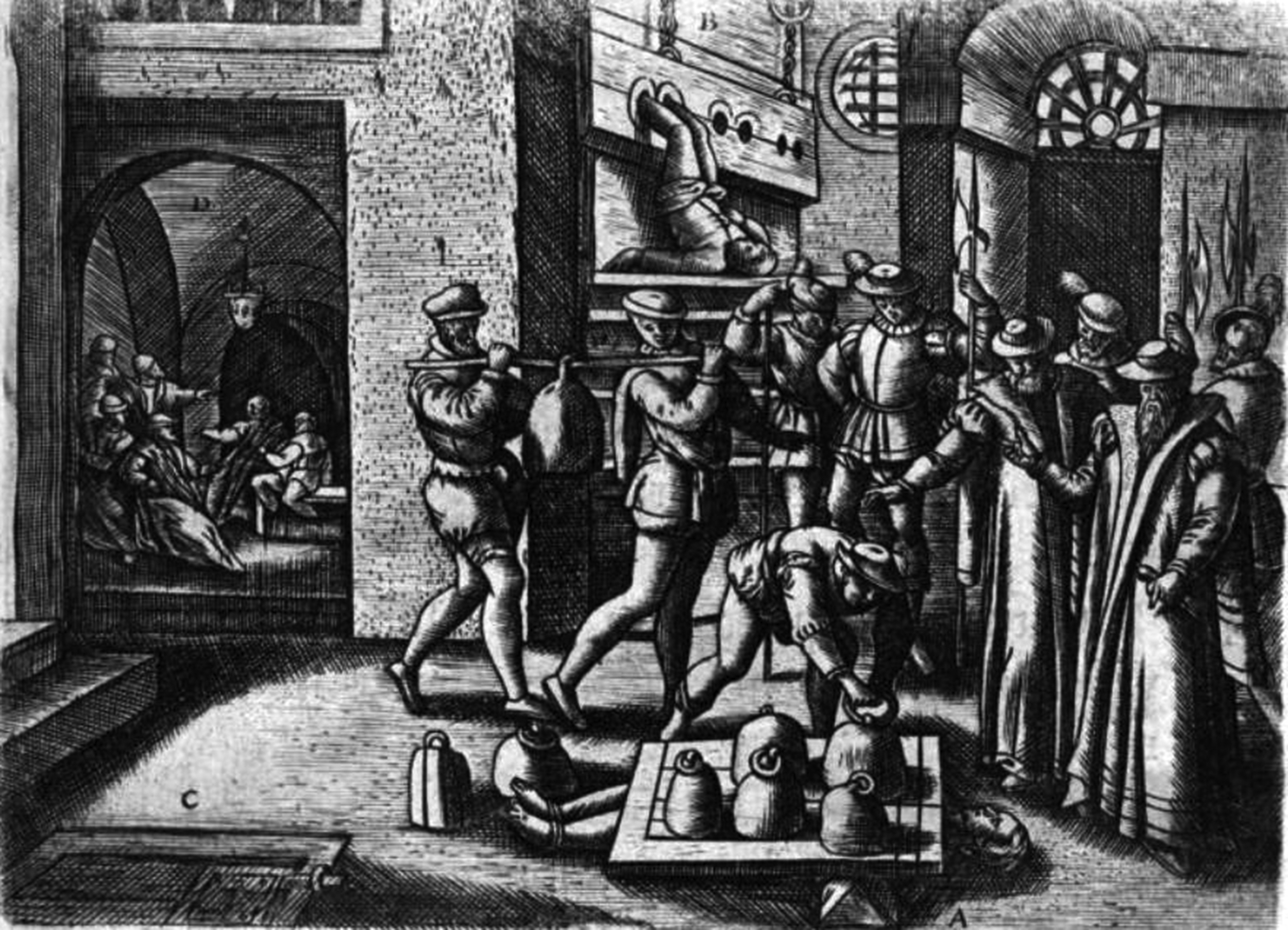 15 March 1586: Offered a jury acquittal, Margaret Clitherow of York, concealer of priests, chooses martyrdom and is crushed under her own front door
Comment
Comment
I don’t understand why, in the full original of this excerpt, Walbran gives the date as 26 December: his version of the MS specifies that it fell on the Feast of John the Evangelist AND the sixth day before the calends of January, both of which are 27 December.
I guess Espec refers to Walter Espec and some incident at the Battle of the Standard.
I haven’t checked out the elm tree story, but recall reading somewhere that, having survived the dissolution which closes the excerpt, an ancient one was felled in the 18th century.
A modern view of Walbran’s source:
Information on its foundation and early history derives mainly from a single record, the Narratio. Today, one pre-Dissolution version is extant, a copy made in the first half of the fifteenth century, probably at the abbey. Research has shown that this copy, and probably earlier versions, transmitted an institutional desire to ‘cistercianize’ the origins of the abbey, achieved through a redactive process of emphasizing some events, omitting others, and by introducing analogies with the origin of Cîteaux itself. Such writing formed part of a general policy promoted around the turn of the twelfth century, designed to counter criticism of the Cistercian movement, and the Fountains model partly emulated the earlier Historia Fundationis of Byland and Jervaulx Abbeys, and the chronicle of its own daughter house, Kirkstall; contemporary models have also been identified at Cistercian houses in Sweden and Denmark.
Making due allowance for the propaganda content of the Narratio, it is nevertheless possible to determine that an incipient monastic establishment was set up at the end of 1132 under the general protection of Archbishop Thurstan of York. The initial community was a group of dissident monks, who were ejected, or departed abruptly, from the Benedictine Abbey of St Mary’s York, without the time or foresight to secure for themselves the patronage of a substantial lay benefactor, which was by then the established procedure for the foundation of a new Cistercian house. In fact, due to its impromptu beginning, the community was not initially Cistercian, and it seems to have endured a precarious existence until autumn 1133, or even possibly 1134, when it was admitted to the Cistercian family.
Cistercian endorsement marked a turning point, after which benefactions began to be received from some of the Yorkshire magnate families, particularly the Mowbrays and the Percys, which permitted the colony to move out of subsistence, and then to grow steadily. By 1136, permanent buildings were being erected on the site and the community had grown to thirty-five monks from the initial group of thirteen.15 A continuing inflow of resources and recruits empowered the community’s spiritual aspirations, so that within a short time an ambitious expansion programme was initiated, and new monasteries were founded. In marked contrast to its own (pre-Cistercian) foundation, the expansion programme shows signs of careful preparation, implementation, and adaptation. From their Yorkshire base, the monastery contributed greatly to the spread of Cistercianism across the country, by establishing no fewer than seven daughter houses across England and three granddaughter houses in the twelve-year period between 1138 and 1150. Each new daughter house was colonized by thirteen monks, so over this period some ninety brethren departed from Fountains; among them were most of the original founders, who went as abbots…. It may be no coincidence that this remarkable expansion took place in the midst of a civil war, when baronial lands were liable to forfeiture and reallocation: in some circumstances, making a grant of lands to a religious house might be seen as a defensive measure.
Something to say? Get in touch
Search
Subscribe/buy
Donate
Music & books
Place-People-Play: Childcare (and the Kazookestra) on the Headingley/Weetwood borders next to Meanwood Park.
Music from and about Yorkshire by Leeds's Singing Organ-Grinder.
 RSS feed
 Bluesky
 Extwitter