14 March 1670: The itinerant Presbyterian, Oliver Heywood, is arrested for preaching in a private house at Little Woodhouse, Leeds
Oliver Heywood. 1882. The Rev. Oliver Heywood, B.A., 1630-1702, Vol. 1/4. Ed. J. Horsfall Turner. Brighouse: A.B. Bayes. Get it:
.Unedited excerpt
If an excerpt is used in the book, it will be shorter, edited and, where applicable, translated.
I stayed at home a day, upon Saturday March 12 I went to Bramhup, preached there upon the Lord’s day, Monday night went to George Horsman’s house at Little Woodhouse, there preached and before I had done was apprehended by constables carried to the Mayor, who sent me to the common prison, called Cappon-Call, by the mediation of friends was released on Tuesday — this March 15 the same day 40 years after I was baptized — a fuller relation of this matter I design – I preached on Wednesday night at Joseph Wood’s near Bramley, came home on Thursday – blessed be God for this journey.


Comment
Comment
Where is Capon Hall/Capon Call/?? Godrey Lawson was mayor at the time.
On 13 July 1670 bailiffs acting under the new Conventicle Act apparently seized the contents of his house to the value of approx. £1550 (2021):
I stayed at home and preached 3 times last lords day – on Monday morning the church-warden and overseer came to this house, told Capt. Hodgson they had a warrant on Sabbath-day night from the justices Mr White and Mr Copley to make distress upon my goods for £10 and bec[?] of my poverty to lay it upon other two men rich: Kershaw and Will Pollard of Wyk – £5 a piece, and some 8 or 10 more their 5s a piece for being at that conventicle at Coley Chapel when I preached there these officers wanted Mr Hodgson’s assistance being an overseer, – on Tuesday morning they came and showed me the warrant, demanded £10 told me it was best to pay, since money cannot be undervalued, but goods may, upon my refusal, they came on wednesday morning i.e. James Mitchel of Crow-Nest constable, Thomas Hanson of Mitham church-warden, Samuel Wadington of Norwood-Green overseer, and brought three men with them, Will Liversidge a joiner and his men, to take down and help to hurry out my goods, they swept all away, three good chests, three tables, chairs, stools, my bed, bedding, curtains — all my goods except a cupboard, and few chairs are gone, – they caryed them to John Appleyards, at Shut, appointed R. Langley, Mic. Empsal – to prize them, they rated them togather with 10 books to ten pound and a noble – cheap penyworths — all this was on Wednesday July 13 1670: blessed be God.
Something to say? Get in touch
Tags
Tags are assigned inclusively on the basis of an entry’s original text and any comment. You may find this confusing if you only read an entry excerpt.
- Act of Uniformity 1662 (4) W/G ·
- Armitage, Richard (1), Mayor of Leeds, 1670 W/G ·
- 📌Bramhope (4) W/G ·
- 📌Bramley, Leeds (5) W/G ·
- Conventicle Act 1664 (2) W/G ·
- Five Mile Act 1665 (2) W/G ·
- Great Ejection (2) W/G ·
- Heywood, Oliver (1630-1702) (34), Bolton-born nonconformist minister and diarist, active in the West Riding, resident at Northowram, ejected for his beliefs W/G ·
- Lawson, Godfrey (-1709) (1), mayor of Leeds 1669-70, endowed the Lawson Library, Leeds' oldest W/G ·
- 📌Leeds (249) W/G ·
- Little Woodhouse (2) W/G ·
- Nonconformism (47) W/G ·
- 📌Northowram (14) W/G ·
- Presbyterianism (20) W/G ·
- Prison (5) W/G ·
- Woodhouse, Leeds (5) W/G ·
Comment
Comment
Where is Capon Hall/Capon Call/?? Godrey Lawson was mayor at the time.
On 13 July 1670 bailiffs acting under the new Conventicle Act apparently seized the contents of his house to the value of approx. £1550 (2021):
I stayed at home and preached 3 times last lords day – on Monday morning the church-warden and overseer came to this house, told Capt. Hodgson they had a warrant on Sabbath-day night from the justices Mr White and Mr Copley to make distress upon my goods for £10 and bec[?] of my poverty to lay it upon other two men rich: Kershaw and Will Pollard of Wyk – £5 a piece, and some 8 or 10 more their 5s a piece for being at that conventicle at Coley Chapel when I preached there these officers wanted Mr Hodgson’s assistance being an overseer, – on Tuesday morning they came and showed me the warrant, demanded £10 told me it was best to pay, since money cannot be undervalued, but goods may, upon my refusal, they came on wednesday morning i.e. James Mitchel of Crow-Nest constable, Thomas Hanson of Mitham church-warden, Samuel Wadington of Norwood-Green overseer, and brought three men with them, Will Liversidge a joiner and his men, to take down and help to hurry out my goods, they swept all away, three good chests, three tables, chairs, stools, my bed, bedding, curtains — all my goods except a cupboard, and few chairs are gone, – they caryed them to John Appleyards, at Shut, appointed R. Langley, Mic. Empsal – to prize them, they rated them togather with 10 books to ten pound and a noble – cheap penyworths — all this was on Wednesday July 13 1670: blessed be God.
Something to say? Get in touch
Similar
 11 December 1680: The Great Comet is seen in Halifax as a natural event, in London – amid Popish Plot hysteria – as a portent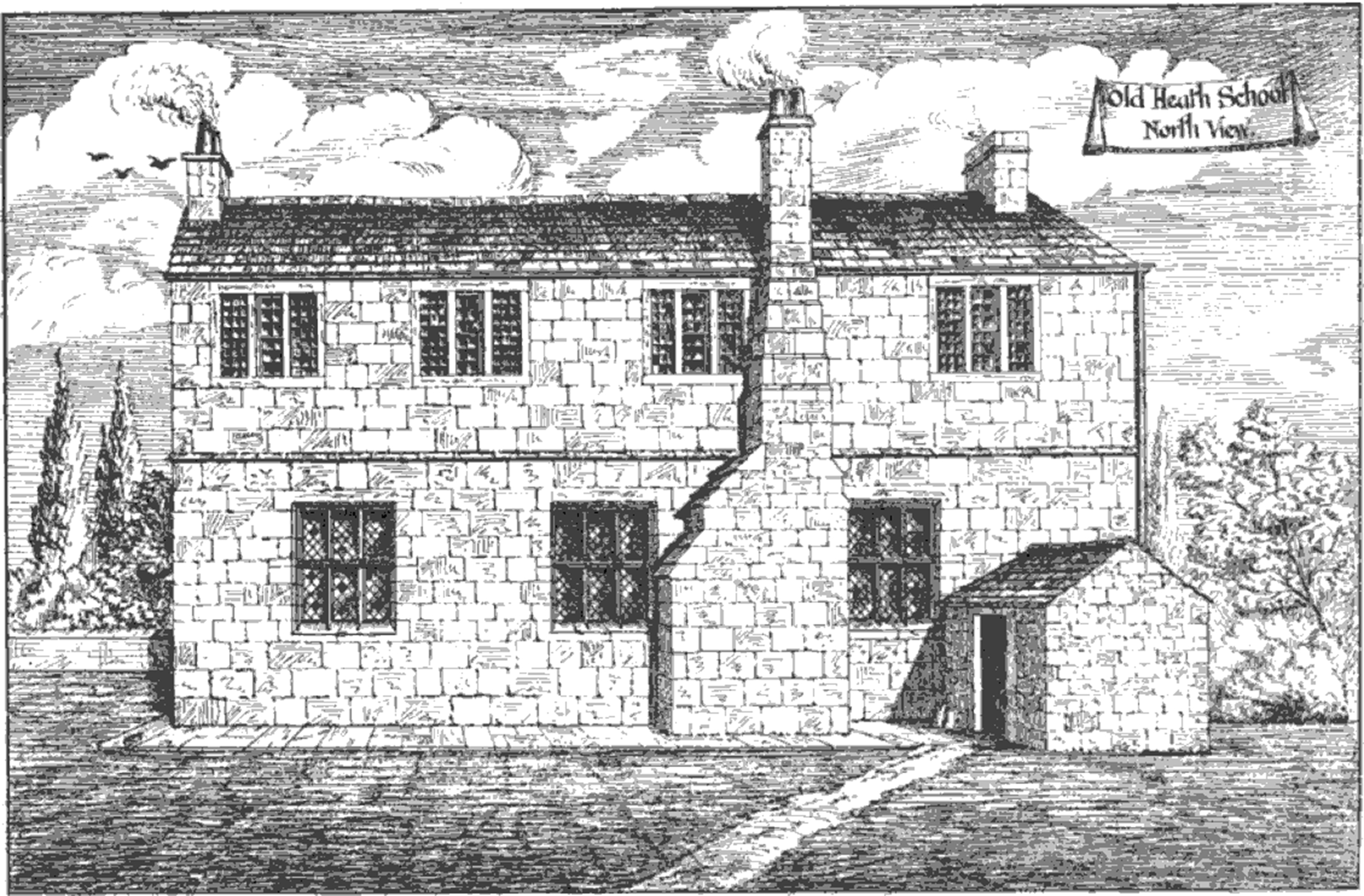
Comment
Comment
Meltings are defined here. Heywood’s bowels do not here perform their normal biological function, as imagined by the facetious, but are “the seat of the tender and sympathetic emotions” (OED), like our “heart.” KJV Philippians 2:1-2:
If there be therefore any consolation in Christ, if any comfort of love, if any fellowship of the Spirit, if any bowels and mercies,
Fulfil ye my joy, that ye be likeminded, having the same love, being of one accord, of one mind.
Cox’s description of the school as it was prior to the 19th century rebuild would have not been unfamiliar to the young Heywoods:
It was … obscured from the road by several insignificant and private buildings, and was approached through an uneven and almost private yard… When examined carefully, it would seem as if it consisted of a long room with three Elizabethan windows in the side, over which had been erected at a later period a series of dormitories, with four windows of a very cottage-like nature. It is probable that the school-room had originally a high-pitched roof, and it was found when the building was pulled down, that the old oak timbers had been used as far as they served, and the deficiencies were supplied by new deal. At the west end of the north side there was an entrance, screened from the north winds by a low porch. On entering, the pupil beheld a room which was fifty feet six inches long, twenty-one feet ten inches broad, and fourteen feet six inches high. [Author note: This room ran so truly east and west that the rays of the setting sun on the day of the Autumnal Equinox shone straight through the west window. The house crossed the east end, due north and south, and projected beyond the school-room, so that the whole formed a Latin Cross with the eastern apex mutilated.] His eye would perhaps light first on the master’s awful desk at the east end, masking a door, by which he would afterwards frequently see a pleasant or frowning face emerge from the school-house: he would at first however become more familiar with the usher’s desk, which was placed near the entrance at the west end, exactly facing the master’s throne. As time went on, and he had opportunities of looking about him, he would observe three mullioned windows on the north side, each with two uprights and a transom, and three similar windows on the south side, but each having three uprights and a transom. A few observant boys would discover that these windows were a foot broader than the northern ones, and would account for it by the north side having to give room to a large fire-place as well as the entrance. But the most attractive sight to the new pupil would be a circular window at the west end, which he would soon learn to distinguish as the apple-and-pear window, though he might at first imagine it to contain a representation in glass of a series of sections of snail shells revolving round a central circle. If he was inquisitive enough, he might learn that it was a Catherine-wheel window, or perhaps a rose window, or even be told that it was an oriel. But it would ever be a puzzle, how or why it got there. Some of his communicative school-fellows would soon be asking him if he had ever heard of old Laury, and would point out a partition of the ceiling where he was said to have painted his name: and he would look at the 28 partitions into which the ceiling was divided by the beams that supported the dormitories, and wonder if he could not himself do something of the kind in future days; but he would soon find an easier way of transmitting his name to after days as he looked at the wainscoting that surrounded the room, ancient and venerable in his eyes, but in reality of so late a date as 1816. If his position allowed him, his eyes would often be taken from his book, by the Stancliffe Tablet on the north side, and he would gaze and gaze again at the awful head on its top, which he would irreverently style “the Nigger”, though he might be emboldened some day with school-boy wit to put a pipe in its mouth. And if transferred, as he might be, to the opposite side of the room, he might (if he was a pupil in the last days) have gazed wistfully at the Tablet which told the Scholarships and the Honour of Senior Classic gained by a former pupil, J.W. Bonser, between 1866 and 1870, dreaming perhaps that such things were often done, but not knowing that few schools except the greatest ever gain such a distinction as Senior Classic. There would be nothing else to engage his attention: he would not care to know that the sash windows went out, and diamond panes came in, with the New Year 1862, and that the desk at which he sat, consisting of a sloping slab of wood on an iron frame that was screwed down to the floor, was no older than the diamond panes. Often however did he feel annoyed by the stone floor on which he had to stand, though there was wood where he sat, and at the distance which lay between him and the fire, a distance so severely felt on a cold day, especially if he was in one of the upper classes (Cox 1879).
Something to say? Get in touch
Search
Subscribe/buy
Donate
Music & books
Place-People-Play: Childcare (and the Kazookestra) on the Headingley/Weetwood borders next to Meanwood Park.
Music from and about Yorkshire by Leeds's Singing Organ-Grinder.
 RSS feed
 Bluesky
 Extwitter