23 December 1689: A Danish soldier is beheaded at Beverley for killing a comrade in a duel, inspiring some doggerel

The memorial plaque to the Danish soldiers is currently outside St Mary’s, Beverley (Craven 2023).
Thomas Allen. 1828. A New and Complete History of the County of York, Vol. 3. London: I.T. Hinton. Get it:
.Unedited excerpt
If an excerpt is used in the book, it will be shorter, edited and, where applicable, translated.
In the churchyard [of St. Mary’s], against the south side of the nave, is an oval tablet with the following doggerel rhyme:
Here two young Danish soldiers lie,
The one in quarrel chanced to die;
The other’s head, by their own law,
With sword was severed at one blow.
In the register of the parish are the following entries:
1689. Dec. 16, Daniel Straker, a Danish trooper, buried.
Dec. 23, Johannes Frederick Bellow (beheaded for killing the other,) buried.
The above event occurred upon the occasion of some Danish soldiers having been landed at Hull, for the service of William III; they were marched to Beverley, and the sick, as well as the ammunition and ordnance, were forwarded at the expense of the corporation. During their short stay, two young men belonging to one of the regiments, having had a quarrel on the passage, which could not be decided on board the vessel, sought the first opportunity of a private meeting to settle their differences by the sword; and their fate is recorded in the above epitaph.


Comment
Comment
Probably apocryphal:
A writer in a Hull paper a few years ago, Mr. Empson, Hessle road, Hull, an old freeman of Beverley, still living, spoke of the story of the actual execution as related to himself, by only the third transmission, from an original eye-witness. This was a girl named Mary Hopwood, who was taken by her mother to see the execution. This Mary Hopwood lived to be 104 years of age, and passed the story to her daughter, who lived to 80, passing it to her daughter, Mrs. Southeran, Westwood Road, who, at the age of 86 (in 1830), told the brief tale to Mr. Empson. A scaffold was erected on the Cornhill (the middle of the large open space where the gas standard now is). Two cartloads of gravel were strewn below the scaffold to absorb the blood which fell. Lines of cavalry were drawn up all round the scaffold, and a great crowd filled the market place, strangers as well as townsmen. The bells of the churches tolled, but with that exception all was silent, till a dull sounding stroke severed the head from the culprit’s body, when a fierce and simultaneous shriek from the females present broke the air.
(Bulmer 1892)
Something to say? Get in touch
Tags
Tags are assigned inclusively on the basis of an entry’s original text and any comment. You may find this confusing if you only read an entry excerpt.
- Beverley (22) W/G ·
- Catholic Church (57) W/G ·
- Decapitation (5) W/G ·
- Denmark (7) W/G ·
- Duel (4) W/G ·
- East Riding of Yorkshire (67) W/G ·
- Glorious Revolution (7) W/G ·
- Jacobite rising of 1689 (1) W/G ·
- Protestantism (25) W/G ·
- Scotland (38) W/G ·
- St Mary’s Church, Beverley (2) W/G ·
- William III (9) W/G ·
Comment
Comment
Probably apocryphal:
A writer in a Hull paper a few years ago, Mr. Empson, Hessle road, Hull, an old freeman of Beverley, still living, spoke of the story of the actual execution as related to himself, by only the third transmission, from an original eye-witness. This was a girl named Mary Hopwood, who was taken by her mother to see the execution. This Mary Hopwood lived to be 104 years of age, and passed the story to her daughter, who lived to 80, passing it to her daughter, Mrs. Southeran, Westwood Road, who, at the age of 86 (in 1830), told the brief tale to Mr. Empson. A scaffold was erected on the Cornhill (the middle of the large open space where the gas standard now is). Two cartloads of gravel were strewn below the scaffold to absorb the blood which fell. Lines of cavalry were drawn up all round the scaffold, and a great crowd filled the market place, strangers as well as townsmen. The bells of the churches tolled, but with that exception all was silent, till a dull sounding stroke severed the head from the culprit’s body, when a fierce and simultaneous shriek from the females present broke the air.
(Bulmer 1892)
Something to say? Get in touch
Similar
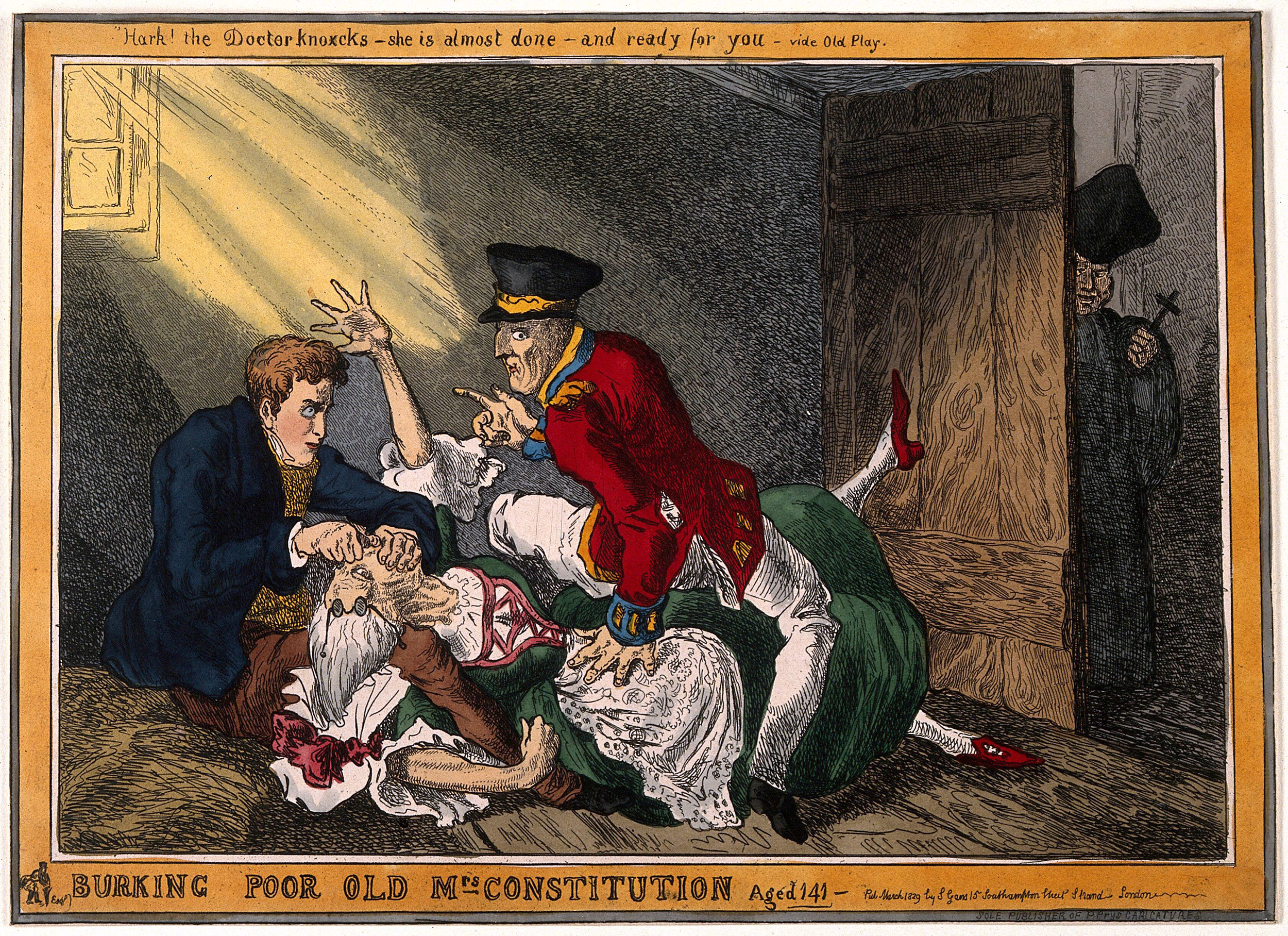 5 March 1829: Henry Burton of Hotham tells a rowdy public meeting at Beverley to petition parliament against Catholic emancipation and preserve “the Protestant constitution”
 3 January 1638: On the eve of the civil war, Henry Slingsby witnesses Royalist cavalry exercising near Wetherby on Bramham Moor, scene of the defeat of the Percy Rebellion in 1408
Comment
Comment
Many tales are told of this battle, or skirmish, or whatever, but I haven’t seen sources even to establish something as simple as the date.
Something to say? Get in touch
Search
Subscribe/buy
Donate
Music & books
Place-People-Play: Childcare (and the Kazookestra) on the Headingley/Weetwood borders next to Meanwood Park.
Music from and about Yorkshire by Leeds's Singing Organ-Grinder.
 RSS feed
 Bluesky
 Extwitter