27 February 1717: Julia Calverley of Esholt Hall completes ten panels of needlework currently displayed at Wallington Hall, Northumberland
Walter Calverley. 1886. Memorandum Book of Sir Walter Calverley, Bart. Yorkshire Diaries and Autobiographies in the Seventeenth and Eighteenth Centuries. Ed. Samuel Margerison. Durham: Surtees Society. Get it:
.Unedited excerpt
If an excerpt is used in the book, it will be shorter, edited and, where applicable, translated.
My wife finished the sewed work in the drawing-room, it having been three years and a half in doing. The greatest part of it has been done with her own hands. It consists of ten panels. The same day I planted the new orchard in the Holme.


Comment
Comment
Carol Leather has cast an expert eye over the panels in situ:
Displayed on the walls were 10 huge needlepoint panels, reaching almost to the ceiling. They were worked in the early 1700s by Lady Julia Calverley, shown in the painted portrait to the right of the panels. As they only took 3 years to make, it is unlikely that she made them all herself! The central panel is dated 1717. They were brought to Wallington, Northumberland in 1755 by Julia’s son, after he sold Esholt Hall… The work was done in tent stitch using wool and silk. The design is thought to be based on oriental textiles which were being imported into England at that time (Leather N.d.)
Margaret Swain writes:
[Another screen by Julia Calverley] and the ten wall panels … offer useful evidence that the domestic needlewoman was capable of executing large pieces, for which a frame was required, with a consummate degree of skill, provided the design on the canvas was well drawn. In the absence of documentary evidence, such as exists in the case of Lady Julia Calverley’s needlework, it is often tempting to suppose that any large piece of embroidery, or large set of chair covers, must have been produced in a professional workroom, if they are well drawn and well worked (Swain 1975).
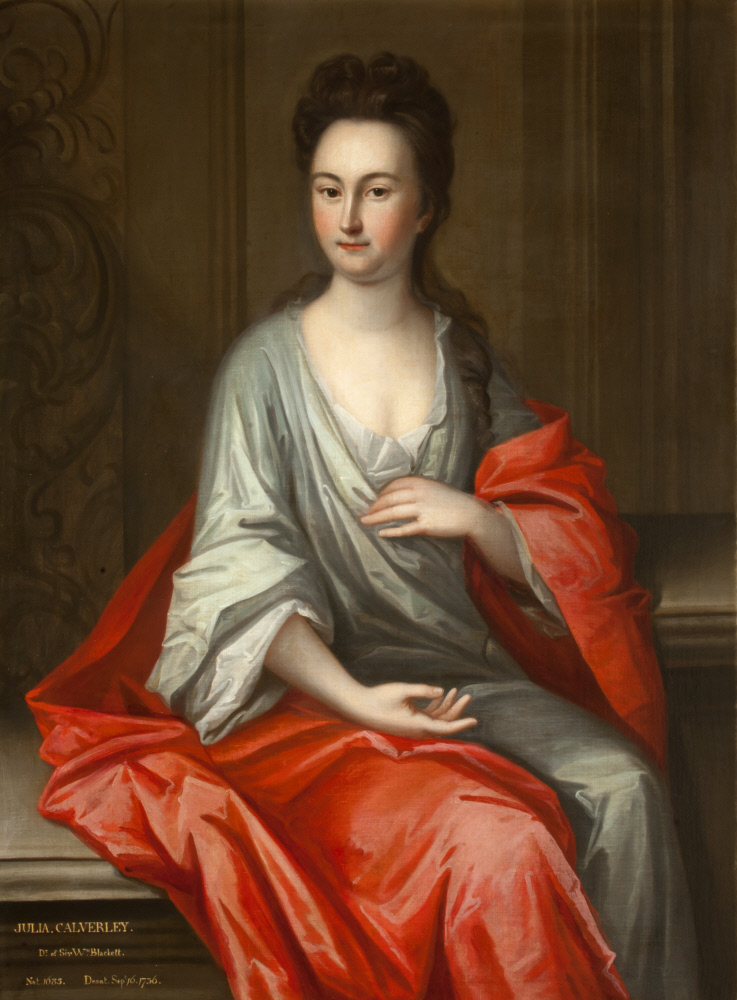
Unfortunately, the anonymous portrait of Lady Calverley made ten years previously ([English School] 1706/7) doesn’t show her hands in detail:
Arthur Ponsonby comments that in his day the panels decorated a bedroom at Wallington (Ponsonby 1923).
Something to say? Get in touch
Tags
Tags are assigned inclusively on the basis of an entry’s original text and any comment. You may find this confusing if you only read an entry excerpt.
- Calverley, Julia (1683-1736) (1) W/G ·
- Calverley, Walter (1670-1749) (4), 1st Baronet, diarist W/G ·
- Embroidery (2) W/G ·
- 📌Esholt Priory (2) W/G ·
- Esholt (2) W/G ·
- Needlepoint (1) W/G ·
- Needlework (1) W/G ·
- Silk (1) W/G ·
- Sir George Trevelyan, 2nd Baronet (1) W/G ·
- Tent stitch (1) W/G ·
- Wallington Hall (1) W/G ·
- Wool (28) W/G ·
Comment
Comment
Carol Leather has cast an expert eye over the panels in situ:
Displayed on the walls were 10 huge needlepoint panels, reaching almost to the ceiling. They were worked in the early 1700s by Lady Julia Calverley, shown in the painted portrait to the right of the panels. As they only took 3 years to make, it is unlikely that she made them all herself! The central panel is dated 1717. They were brought to Wallington, Northumberland in 1755 by Julia’s son, after he sold Esholt Hall… The work was done in tent stitch using wool and silk. The design is thought to be based on oriental textiles which were being imported into England at that time (Leather N.d.)
Margaret Swain writes:
[Another screen by Julia Calverley] and the ten wall panels … offer useful evidence that the domestic needlewoman was capable of executing large pieces, for which a frame was required, with a consummate degree of skill, provided the design on the canvas was well drawn. In the absence of documentary evidence, such as exists in the case of Lady Julia Calverley’s needlework, it is often tempting to suppose that any large piece of embroidery, or large set of chair covers, must have been produced in a professional workroom, if they are well drawn and well worked (Swain 1975).
Unfortunately, the anonymous portrait of Lady Calverley made ten years previously ([English School] 1706/7) doesn’t show her hands in detail:
Arthur Ponsonby comments that in his day the panels decorated a bedroom at Wallington (Ponsonby 1923).
Something to say? Get in touch
Similar
 14 April 1843: John Nicholson, “the Airedale Poet,” “the Bingley Baron,” dies after falling into the Aire while drunk
Comment
Comment
The Leeds Mercury commented immediately on the increased productivity caused by Hirst’s innovation:
The simple, principle of this improvement is, that he doubles the number of spindles in the mule, by putting two rows instead of one. The machine invented by Mr. Cartwright contained double the number of spindles in Sir Rd. Arkwright’s jenny, and Mr. Hirst’s machine therefore contains four times that number. Yet it is surprising that the old jenny is still used in most of the manufactories in this neighbourhood… Mr. Hirst has now a machine all ready for working, containing four hundred spindles, whereas the machines commonly used in this neighbourhood have not more than eighty or ninety. (Leeds Mercury 1825/01/22)
Hirst appended two testimonials to this effect to a letter three months later to the Mercury:
Leeds, April 29, 1825
Hurst’s and Heycock have milled two olive [?] pieces for Messrs. Pawson and Smith, of Farnley, in two days, which would have taken thein four days at their own mill; and their miller declares, they are better milled than they could have done them at their own place. Their miller was with them all the time, and asserts this himself.
(Signed) JONATHAN ROBERTSHAW, Miller to Messrs. Pawson and Smith.
Messrs. John Edwards and Sons, of Pye-nest, near Halifax, also sent two pieces of white Cassimeres to be milled. Their miller stayed till they were done, which was in seven hours, and says, that they would have taken from 12 to 13 hours at home.
(Signed) WM. KITCHIN,
Miller to Messrs. John Edwards and Sons, Pye-Nest.
(Leeds Mercury 1825/04/30)
Something to say? Get in touch
Search
Subscribe/buy
Donate
Music & books
Place-People-Play: Childcare (and the Kazookestra) on the Headingley/Weetwood borders next to Meanwood Park.
Music from and about Yorkshire by Leeds's Singing Organ-Grinder.
 RSS feed
 Bluesky
 Extwitter