14 June 1773: Parliament belatedly awards John Harrison part of the prize due to him for inventing the marine chronometer
Annual Register. 1774. Supplies Granted by Parliament for the Year 1773. The Annual Register, Vol. 16. London: James Dodsley. Get it:
.Unedited excerpt
If an excerpt is used in the book, it will be shorter, edited and, where applicable, translated.
To John Harrison, as a further reward and encouragement, over and above the sums already received by him, for his invention of a time-keeper, for ascertaining the longitude at sea, and his discovery of the principles upon which the same was constructed: £8,750.

Comment
Comment
Harrison seems to have spent most of his life in Lincolnshire and London, so maybe this should be banished.
Something to say? Get in touch
Tags
Tags are assigned inclusively on the basis of an entry’s original text and any comment. You may find this confusing if you only read an entry excerpt.
- Barrow upon Humber (1) W/G ·
- Board of Longitude (1) W/G ·
- Celestial navigation (2) W/G ·
- Clock (2) W/G ·
- Foulby (1) W/G ·
- George III (1738-1820) (17), ruled 1760-1820 W/G ·
- Harrison, John (1693-1776) (1), West Riding-born autodidact carpenter and clockmaker who invented the marine chronometer, a long-sought-after device enabling the calculation of longitude at sea W/G ·
- 📌Leeds (249) W/G ·
- Lincolnshire (15) W/G ·
- London (84) W/G ·
- Longitude Act (1) W/G ·
- Longitude (2) W/G ·
- Marine chronometer (2) W/G ·
- West Riding of Yorkshire (150) W/G ·
Comment
Comment
Harrison seems to have spent most of his life in Lincolnshire and London, so maybe this should be banished.
Something to say? Get in touch
Similar
 19 October 1816: Serenaded by the military, decorated barges leave Leeds for Liverpool to celebrate the completion, after almost 50 years, of the canal uniting east and west
 1 July 1840: The opening of the Hull and Selby Railway terminates the threat to Hull’s port from Goole, Scarborough and Bridlington
 22 December 1857: With only a small clock planned for Cuthbert Brodrick’s over-budget town hall, Leeds Council absents itself from a talk by Edmund Beckett, designer of the mechanism for Big Ben
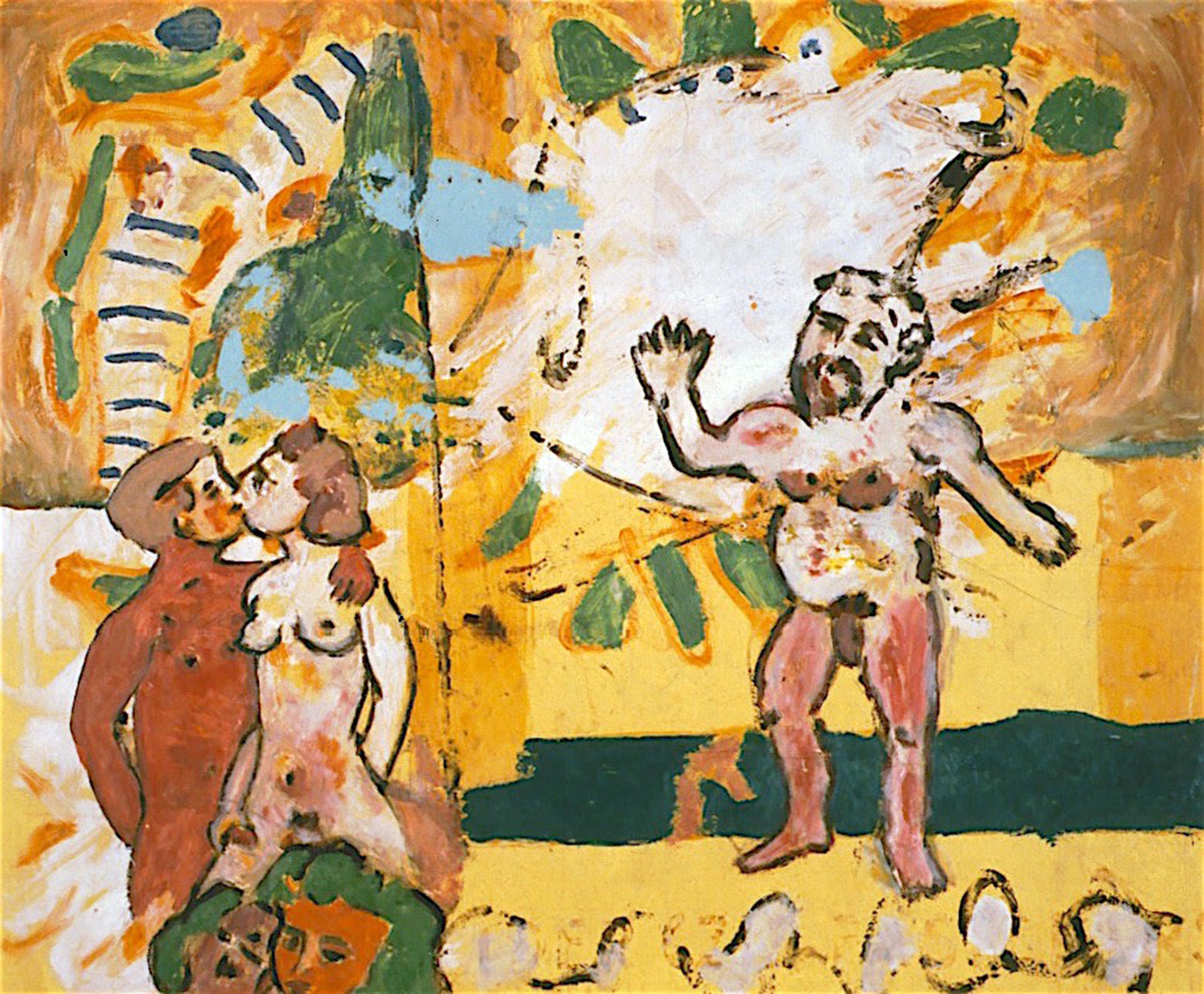 Reproduction by kind permission of Michael Paraskos.20 December 1966: Greek-Cypriot cook and artist Stass Paraskos appears before Leeds magistrates charged with obscenity under the Vagrancy Act 1838
Comment
Comment
The Times establishes the date, but curiously doesn’t mention the better-known experts:
Mr John Edward Jones, a lecturer in painting in the fine art department of Leeds University, giving evidence at Leeds Magistrates’ Court yesterday in the case in which two pictures were alleged by the prosecution to be obscene, said that the work of the artist was “gentle, tender, honest, poetic and lyrical.” He was a witness called on behalf of the artist, Stassinos Paraskos, aged 33, of Lucas Street, Leeds, who had pleaded Not Guilty to two summonses. The first alleged that on April 28 last he wilfully exposed to view in a public place, the Leeds Institute of Art, an obscene picture, a coloured picture entitled “Lost Love”, under section four of the Vagrancy Act 1824 as amended. The second summons alleged that on the same date he exposed to view in the same place an obscene picture, a drawing signed “Stass” dated July 2, 1965. Paraskos was found Guilty on both counts. He was fined £5 on each and was ordered to pay costs not exceeding 10 guineas on each [total ca. £320 in December 2023]. An appeal is being considered (Times 1966/12/21).
Bruce Douglas-Mann in The Spectator, focussing on two contemporary London cases, agrees with The Times that the hearing only took place on one day and mentions nine expert witnesses:
It is not commercialised sex, however, which seems to get prosecuted, but works by serious artists and by writers who are trying to communicate something of significance… It would not be too difficult for those who want to tell us what we may be allowed to read to find magistrates who are known to have little sympathy with modern trends in literature and art, and to ensure that the right to trial by jury is excluded. With books there is at least the right to call evidence of literary merit; when pictures are attacked, despite the intentions of Parliament expressed in the Obscene Publications Act, the defence of artistic merit may be dismissed as irrelevant. Eight distinguished art critics had voluntarily agreed to give evidence of artistic merit in the Robert Fraser case. Six of them spent a fruitless afternoon in court. As the prosecution had chosen to proceed under the Vagrancy Act, the defence of artistic merit was excluded…
Each of these cases shows some disturbing and unsatisfactory features of the law on censorship and the manner of prosecution. Taken together they must cause serious concern, not just to the few who are upset by any individual case, but to anyone who does not wish all his art and literature sifted with every ‘distasteful’ feature of life as it is removed before it reaches us.
A private group of censors with money behind them already exists, as the Last Exit case showed. Sir Cyril was not acting alone. At least one other Tory MP successfully claimed the right to sit behind counsel on the ground that he was ‘behind the prosecution.’ If such a group is allowed loose in our libraries and galleries, and, by operating under antique laws, to exclude the defences that Parliament intended, we may come to recognise Dr Bowdler as an amateur (Douglas-Mann 1966/12/30).
The Vagrancy Act 1838 (1 & 2 Vict. c. 38) was an Act of Parliament in the United Kingdom. It amended the Vagrancy Act 1824 to provide that any person discharged from custody pending an appeal against a conviction under that Act who did not then reappear to prosecute the appeal could be recommitted. It also provided that the penalty established by that Act for exposing indecent prints in a street or highway would extend to those who exposed the same material in any part of a shop or house.[2]
This latter part of the Act was to prove significant in a number of prosecutions of artists for allegedly exhibiting obscene works of art, even when those exhibitions took place in a private space such as an art gallery. One of the most notorious successful prosecutions of an artist under the act was in 1929, when thirteen paintings by D. H. Lawrence at the Warren Gallery, London, were seized by the police. A ban was placed on the paintings being shown in England, which is technically still in force, but they were shown again in London in December 2003.[3]
The last artist to be successfully prosecuted under the 1838 Act was Stass Paraskos in 1966, following a police raid on an exhibition of Paraskos’s work at Leeds College of Art. Again a ban was placed on showing the offending paintings and drawings in England, which is also still legally valid. However one of the paintings was shown at Leeds City Art Gallery in 1993,[4] and again at Scarborough Art Gallery in 2000, and several others are now owned by the Tate Gallery, London.[5] In 1969 a total of 35 people were prosecuted under section 2 of the Act and section 4 of the 1824 Act for acts of public display of obscene images in shop windows and exhibitionism.
Although aspects of the Act had been repealed in a piecemeal fashion by subsequent legislation, the full Act was formally repealed in 1981 by the Indecent Displays (Control) Act 1981 (c. 42), partly due to the lack of clarity in distinguishing between indecency and obscenity. [6] For example the advertising of contraceptives was considered obscene from 1857, but fell under the ambit of the new act of 1981.
A great introduction to the man by his son, Michael Paraskos:
Something to say? Get in touch
Search
Subscribe/buy
Donate
Music & books
Place-People-Play: Childcare (and the Kazookestra) on the Headingley/Weetwood borders next to Meanwood Park.
Music from and about Yorkshire by Leeds's Singing Organ-Grinder.
 RSS feed
 Bluesky
 Extwitter