17 November 1812: A doggerel inscription at St. George’s, Doncaster, commemorates two sons of ringing master Robert Smith, one of whom died by his father’s bells
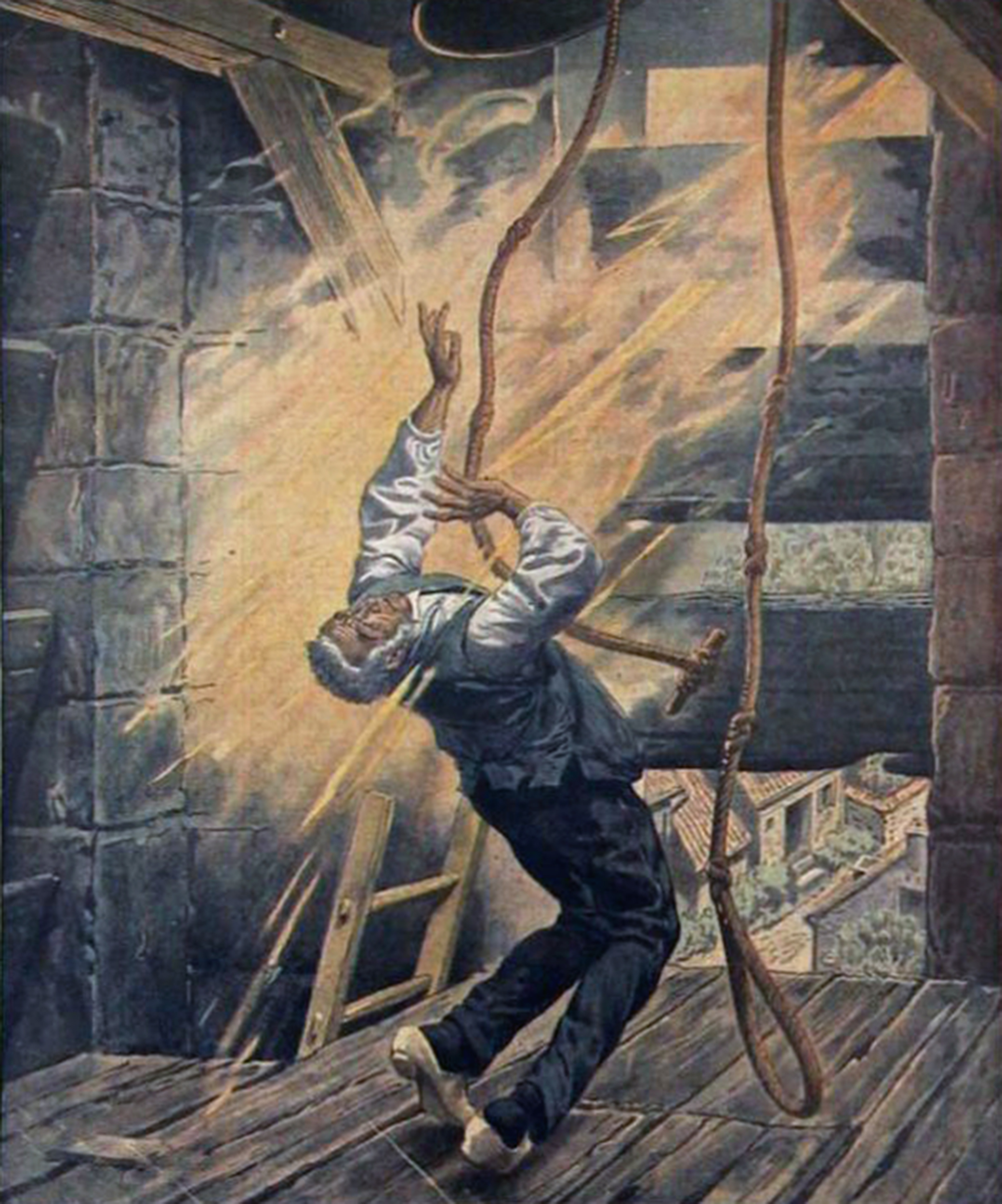
No image of John Smith was available, but Pierre Boudes of Ladepeyre (Aveyron) showed similar imprudence. During a storm, he went up the tower to try to ward off the danger to the harvest by ringing the bells, as was the custom, but had no sooner started than the sound abruptly ceased (Le Petit Journal 1910/09/11).
John Edward Jackson. 1855. The History and Description of St. George’s Church at Doncaster, Destroyed by Fire February 28, 1853. London: J.B. Nichols and Sons. Get it:
.Unedited excerpt
If an excerpt is used in the book, it will be shorter, edited and, where applicable, translated.
SMITH. On two sons of Robert Smith (cordwainer and leader of the ringers): one of whom, John, whilst ringing, was accidentally carried up by a rope to the floor of the bell chamber, and received injuries which caused his death about 1808. The burial of the other was registered Nov. 17, 1812.
These 2 youths was by misfortin serounded,
One died of his wounds, and t’other was drownded.


Comment
Comment
Inscription spelling retained. The dramatic potential of this is pleasing, but I infer from WP that it was not the major threat to (wet) bell-ringers:
In the Middle Ages, it was believed that the sound of a bell could disperse thunder. Many bell-ringers were electrocuted as a result. In France between the years 1753 and 1786, 103 bell-ringers were killed during thunderstorms as a result of holding on to wet bell ropes. The Parlement of Paris enforced an edict in 1786 to prohibit the practice. Deaths likely continued until the 19th century, when the lightning rod came into general use.
Beachcomber: “If Beach was filming this the poor bell ringer would be on an up bounce when it happened and he would come down ash and cinders.”
Something to say? Get in touch
Tags
Tags are assigned inclusively on the basis of an entry’s original text and any comment. You may find this confusing if you only read an entry excerpt.
- Accident (27) W/G ·
- Bell tower (3) W/G ·
- Bell-ringer (6) W/G ·
- Bell (7) W/G ·
- Change ringing (2) W/G ·
- Church bell (6) W/G ·
- Cordwainer (3) W/G ·
- Doncaster Minster (2) W/G ·
- 📌Doncaster (34) W/G ·
- Drowning (24) W/G ·
- Electrocution (1) W/G ·
- France (34) W/G ·
- Lightning rod (1) W/G ·
- Lightning (6) W/G ·
- Paris (5) W/G ·
- West Riding of Yorkshire (150) W/G ·
- Work accident (22) W/G ·
Comment
Comment
Inscription spelling retained. The dramatic potential of this is pleasing, but I infer from WP that it was not the major threat to (wet) bell-ringers:
In the Middle Ages, it was believed that the sound of a bell could disperse thunder. Many bell-ringers were electrocuted as a result. In France between the years 1753 and 1786, 103 bell-ringers were killed during thunderstorms as a result of holding on to wet bell ropes. The Parlement of Paris enforced an edict in 1786 to prohibit the practice. Deaths likely continued until the 19th century, when the lightning rod came into general use.
Beachcomber: “If Beach was filming this the poor bell ringer would be on an up bounce when it happened and he would come down ash and cinders.”
Something to say? Get in touch
Similar
 4 July 1838: 26 girls and boys drown trying to escape via a tunnel from flash flooding in Huskar Colliery, Silkstone, Barnsley, after the steam lifts fail during a rainstorm
Comment
Comment
No-one knows for sure where Sirowsby was – Thoresby is possible but perhaps improbable.
Via The History of Signboards, although I haven’t found an image of any such sign:
The Bell and Horse is an old and still frequent sign; it occurs on trades tokens; as John Harcourt at the Bell and Black Horse in Finsbury, 1668, and on various others; whilst at the present day it may be seen at many a roadside alehouse. Bells were a favourite addition to the trappings of horses in the middle ages. Chaucer’s abbot is described:—
“When he rode men his bridle hear,
Gingling in a whistling wind as clere,
And eke as loud as doth a chapel bell.”In a MS. in the Cottonian Library[238] relating the journey of Margaret of England to Scotland, there to be married to King James, we find constant mention of these bells. The horse of Sir William Ikarguil, companion of Sir William Conyars, sheriff of Yorkshire, is described as “his Hors Harnays full of campanes [bells] of silver and gylt.” Whilst the master of the horse of the Duke of Northumberland was “monted apon a gentyll horse, and campanes[175] of silver and gylt.” And a company of knights is introduced, “some of their hors harnes was full of campanes, sum of gold and sylver, and others of gold.” This led to the custom of giving a golden bell as the reward of a race. In Chester, such a bell was run for yearly on St George’s day; it was “dedicated to the kinge, being double gilt with the Kynges Armes upon it,” and was carried in the procession by a man on horseback “upon a septer in pompe, and before him a noise of trumpets in pompe.”[239] This custom of racing for a bell led to the adoption of the still common phrase, bearing off the BELL.
Something to say? Get in touch
Search
Subscribe/buy
Donate
Music & books
Place-People-Play: Childcare (and the Kazookestra) on the Headingley/Weetwood borders next to Meanwood Park.
Music from and about Yorkshire by Leeds's Singing Organ-Grinder.
 RSS feed
 Bluesky
 Extwitter