11 July 1858: In Whitby, Walter White buys a religious ballad printed at Otley and called ‘The railway to heaven’
Walter White. 1861. A Month in Yorkshire, 4th Ed. London: Chapman and Hall. The best of White’s travel writing, in which, as usual, he encounters and investigates the Plain People. This is the golden age of walking, when there were good roads pretty much everywhere, and they hadn’t yet been made inaccessible to pedestrians by cars. His July is told in 31 chapters, which seem to refer to the days of the month. Get it:
.Unedited excerpt
If an excerpt is used in the book, it will be shorter, edited and, where applicable, translated.
I lingered, contemplating the view, till it was time to look for an inn; I chose the Talbot, and had no reason to repent my choice. On the way thither, I bought two religious ballads at a little shop, the mistress of which told me she sold “hundreds of ’em,” and that they were printed at Otley. As specimens of a class of compositions which are relished and sung as hymns by a numerous section of the community, they are eminently suggestive. Do they supply a real want? Are they harmless? Are they edifying? Can they who find satisfaction therein be led up to something better? To close this chapter, here follows a quotation from The Railway to Heaven:
O! what a deal we hear and read
About Railways and railway speed,
Of lines which are, or may be made;
And selling shares is quite a trade.Allow me, as an old Divine,
To point you to another line,
Which does from earth to heaven extend,
Where real pleasures never end.Of truth divine the rails are made,
And on the Rock of Ages laid;
The rails are fix’d in chairs of love,
Firm as the throne of God above.One grand first-class is used for all,
For Jew and Gentile, great and small,
There’s room for all the world inside,
And kings with beggars here do ride.About a hundred years or so
Wesley and others said they’d go:
A carriage mercy did provide,
That Wesley and his friends might ride.’Tis nine-and-thirty years, they say,
Whoever lives to see next May,
Another coach was added then
Unto this all important train.Jesus is the first engineer,
He does the gospel engine steer;
We’ve guards who ride, while others stand
Close by the way with flag in hand.CHORUS.
“My son,” says God, “give me thy heart;
Make haste, or else the train will start.”

Comment
Comment
Something to say? Get in touch
Tags
Tags are assigned inclusively on the basis of an entry’s original text and any comment. You may find this confusing if you only read an entry excerpt.
- Ballad (18) W/G ·
- Metaphor (2) W/G ·
- Nonconformism (47) W/G ·
- 📌Otley (13) W/G ·
- Rail transport (24) W/G ·
- Railway Mania (5) W/G ·
- Walking (19) W/G ·
- Wesley, John (1703-91) (21), cleric and leader of a evangelical revival movement within the Church of England known as Methodism W/G ·
- 📌Whitby (22), town, port and parish on the east coast of North Yorkshire/the North Riding at the mouth of the River Esk W/G ·
- White, Walter (10), writer W/G ·
Comment
Comment
Something to say? Get in touch
Similar
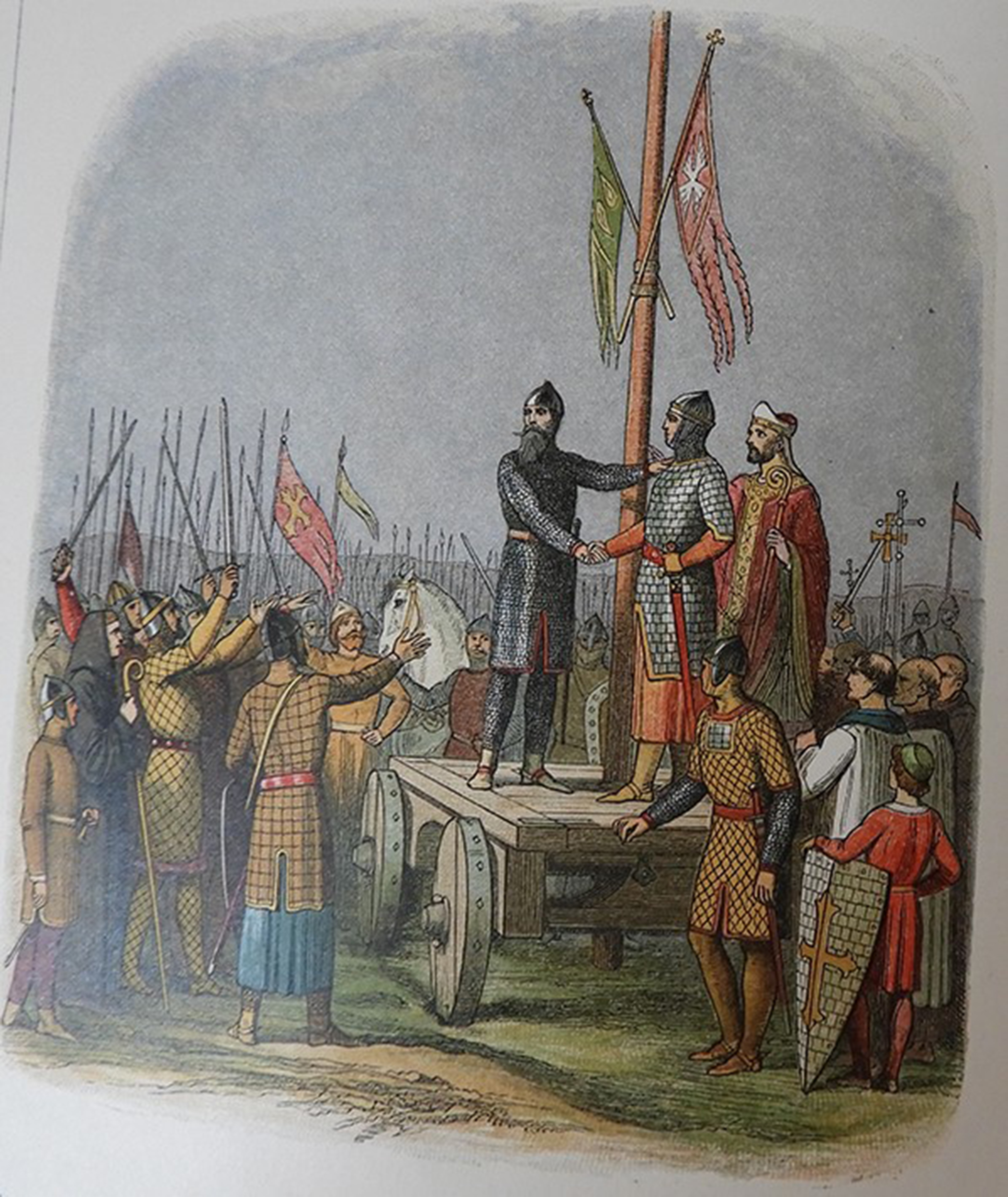 22 August 1138: King David of Scotland is overtaken near Northallerton by a furious local army in possession of a great standard – a Victorian view
Comment
Comment
Shirley is set in 1811 and 1812, and Luddism became a serious threat in the West Riding in early 1812. Easter Sunday was 29 March that year, so Whit Tuesday was 19 May – although Charlotte Brontë’s imagination, perhaps inspired by weather reports in the Leeds Mercury, which she consulted extensively, locates it in the last week of May. John Lock and Canon W.T. Dixon say (p.63) that the scene reworks a confrontation between Patrick Brontë and a drunk when he led the Whitsun procession in Dewsbury in 1810 (Lock 1965), but Herbert Wroot (p.78) has found in the Dewsbury Reporter of 12 December 1896 the report of an interview conducted by P.F. Lee in which the Rev. James Chesterton Bradley, the original of “Mr. Sweeting,” says that Charlotte Brontë reused more or less literally an actual episode:
At the head of the steep main street of Haworth is a narrow lane, which on a certain Whitsuntide was the scene of a similar event to the one related in this seventeenth chapter of ‘Shirley.’ The Church School procession had defiled into the lane, ‘had gained the middle of it,’ when ‘lo and behold! another – an opposition procession’ – was entering the other end of the lane at the same time, ‘headed also by men in black.’
It was interesting, Mr. Lee went on to say, “to hear from Mr. Bradley how Patrick Bronté, seeing the situation, at once assumed the offensive, and charging the enemy with his forces soon cleared the way.”
Wroot also says that “immediately upon the publication of the novel, Briarfield was identified, by all acquainted with the district, as Birstall” (Wroot 1966).
Something to say? Get in touch
Search
Subscribe/buy
Donate
Music & books
Place-People-Play: Childcare (and the Kazookestra) on the Headingley/Weetwood borders next to Meanwood Park.
Music from and about Yorkshire by Leeds's Singing Organ-Grinder.
 RSS feed
 Bluesky
 Extwitter