6 August 1861: Future prime minister H.H. Asquith (8) writes to his mother condemning Fulneck (Pudsey) and its Moravian school
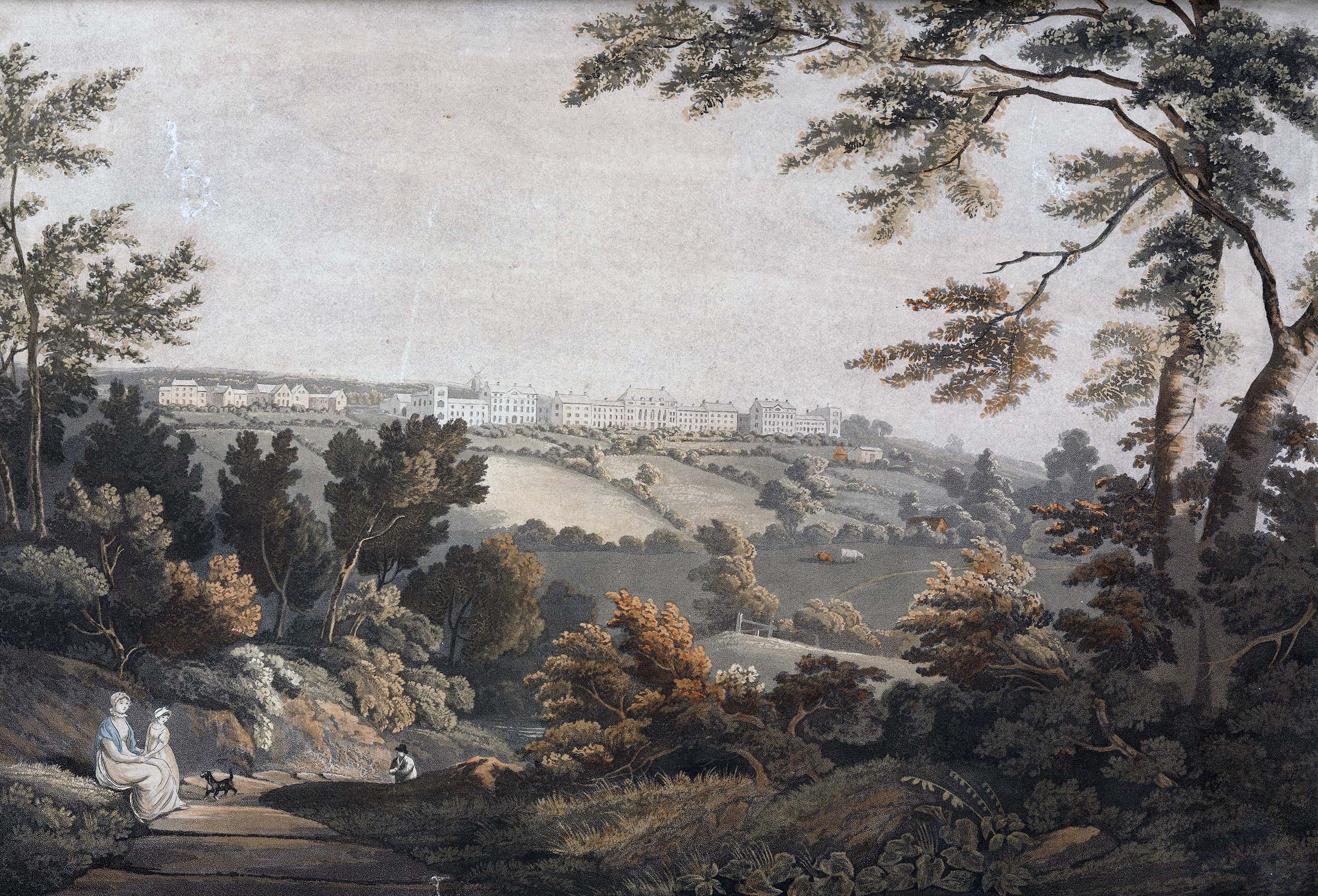
Aquatint by R. Havell from a painting of Fulneck Moravian Settlement by Charles Henry Schwanfelder (Schwanfelder 1814).
J.A. Spender and Cyril Asquith. 1932. Life of Herbert Henry Asquith, Lord Oxford and Asquith, Vol. 1. London: Hutchinson and Co. Get it:
.Unedited excerpt
If an excerpt is used in the book, it will be shorter, edited and, where applicable, translated.
Fulneck,
August 6th, ’61.
My very dear Mamma,
It seems we have an excursion here in the beginning of September and I suppose you know that we can go home on that day of going the excursion and I think that I would rather do so as we do not like the place at all for besides having nothing to do such dreadful smoke comes over from Pudsey that it makes everything quite black. The boys are not allowed to go into the gardens as the girls are and the girls have much more of the terrace than we have. I do not like either masters* or boys and therefore I do not like the place at all. The only amusement we ever have is about an hour in the cricket field when Willie and I make Dandelion chains for Mr. Kramer.
With best love to all believe me ever
to remain,
Your affte. son,
H. H. Asquith.
* With the exception of Mr. Kramer.
P.S. Excuse sending white envelopes as have no black edges.
P.S. Please give my love to Auntie Mardie and tell her I am sorry I could not write to her.

Comment
Comment
Was any particular mill to blame for the smoke?
Another letter two days before:
My very dear Mamma,
I received letters from Elisabeth and Eva this morning. I am sorry to say that very unhappy here and we don’t want to stay much longer we can’t find what to do and it makes us very miserable we often say to each other and Johnny Shaw that we would rather live in the wood than here. I have not time write much more so believe me ever to remain,
Your loving son,
Bertie.
His recollections are more generous:
In the course of a few years we moved our home from Morley to Mirfield, then little more than a village, within a few miles of Huddersfield. It was there that my father, after an illness of only a few hours, died (June, 1860), at the age of thirty-five. He had not been able to accumulate more than a scanty provision for his family, and my grandfather Willans, a well-to-do and large-hearted man, of whom my mother had always been the favourite child, took charge of us, and established us in a house a few doors from his own in the town of Huddersfield. For a short time my brother and I attended Huddersfield College as day-scholars, but we were very soon sent as boarders to a Moravian school at Fulneck, near Leeds, where the ground floor of my education was laid. The life there was homely, and indeed rough, but the Moravians were excellent teachers, and I am gratefully conscious that I owe them much.
In 1864, aged 11, and following the death of his grandfather, the remaining Asquiths moved south, and he became “to all intents and purposes a Londoner.” (Asquith 1928)
Something to say? Get in touch
Tags
Tags are assigned inclusively on the basis of an entry’s original text and any comment. You may find this confusing if you only read an entry excerpt.
- Air pollution (13) W/G ·
- Asquith, Herbert Henry (1852-1928) (4), Morley-born Liberal MP (East Fife, 1886-1916), prime minister (1908-16), home secretary (1892-95) W/G ·
- Boarding school (2) W/G ·
- Cricket (10) W/G ·
- Fulneck Moravian Settlement (4) W/G ·
- Fulneck School (1) W/G ·
- Garland (1) W/G ·
- Huddersfield New College (1) W/G ·
- 📌Huddersfield (32) W/G ·
- Mirfield (3) W/G ·
- 📌Morley, West Yorkshire (5), market town and civil parish 5 miles south-west of Leeds, built on seven hills W/G ·
- Private school (2) W/G ·
- 📌Pudsey (12) W/G ·
- Taraxacum (1) W/G ·
- Textile manufacturing (60) W/G ·
Comment
Comment
Was any particular mill to blame for the smoke?
Another letter two days before:
My very dear Mamma,
I received letters from Elisabeth and Eva this morning. I am sorry to say that very unhappy here and we don’t want to stay much longer we can’t find what to do and it makes us very miserable we often say to each other and Johnny Shaw that we would rather live in the wood than here. I have not time write much more so believe me ever to remain,
Your loving son,
Bertie.
His recollections are more generous:
In the course of a few years we moved our home from Morley to Mirfield, then little more than a village, within a few miles of Huddersfield. It was there that my father, after an illness of only a few hours, died (June, 1860), at the age of thirty-five. He had not been able to accumulate more than a scanty provision for his family, and my grandfather Willans, a well-to-do and large-hearted man, of whom my mother had always been the favourite child, took charge of us, and established us in a house a few doors from his own in the town of Huddersfield. For a short time my brother and I attended Huddersfield College as day-scholars, but we were very soon sent as boarders to a Moravian school at Fulneck, near Leeds, where the ground floor of my education was laid. The life there was homely, and indeed rough, but the Moravians were excellent teachers, and I am gratefully conscious that I owe them much.
In 1864, aged 11, and following the death of his grandfather, the remaining Asquiths moved south, and he became “to all intents and purposes a Londoner.” (Asquith 1928)
Something to say? Get in touch
Similar
28 April 1747: John Wesley visits “the new house of the Germans” (the Moravians) at Pudsey, which is financed by overseas donations
Comment
Comment
Some background to the novel:
D. F. E. Sykes, a Huddersfield solicitor married to the daughter of an Anglican clergyman, focused in Ben o’ Bills, The Luddite, which the author claimed to be based on oral testimony and ‘mostly true’, on a fictional family, the Bamforths, connected with the Particular Baptists at Powle Moor, near Slaithwaite, where the minister, Abraham Webster, was so decidedly against the new machines that old Mrs Bamforth ‘died in the belief that the curse of Scripture was upon them’. George Mellor, a cousin of the Bamforths in the novel, enters the story on Christmas Eve, 1811, intoning the first verse of ‘Christians Awake’. He goes along with the rest of the family to Christmas morning service at Slaithwaite Church, where ‘near all Slaithwaite’ had gathered ‘Methodies and Baptists and all; and even folk that went nowhere, Owenites they called them’, who ‘made a point of going to church that one morning of the year’. Mellor, who occasionally speaks in moderate tones, but elsewhere gives vent to Painite anti-clerical and republican sentiments, is portrayed presiding at a Luddite oath-taking ceremony with a Bible to hand. He refers to Benjamin Walker, the accomplice who betrayed him, whose family Sykes also links with the Baptists at Powle Moor, as a ‘Judas’, He is visited twice in his York prison cell by Abraham Webster, who prays with him on the eve of his execution. According to Sykes, this final pastoral visit inspired Mellor to offer words of forgiveness for his enemies from the scaffold, though Sykes was clearly using dramatic licence in allowing Webster to lead the singing of a Methodist hymn at Mellor’s execution, since all the contemporary accounts record this as a feature of the execution of another group of Luddites. At the end of the novel, Soldier Jack, a former militia-man-turned-Luddite, reflecting on Mellor’s fate, philosophizes: ‘”Yo’re dissenters at th’ Powle … an’ … if there’d been no dissenters there’d been no Luds, ‘an George Mellor ‘d noan ha’ danced out 0′ th’ world on nowt”‘.
Much of the background to Sykes’s novel is authentic, as are several of the key characters, including Abraham Webster, the Baptist minister at Powle Moor, the Reverend Charles Chew, the curate at Slaithwaite and the Luddites George Mellor and Benjamin Walker. A succession of popular evangelical Calvinistic Anglican curates in the Venn tradition at Slaithwaite and the reluctance of the earls of Dartmouth to release land on their estates for the building of Nonconformist places of worship had delayed the local development of both Wesleyanism and Dissent, a factor of which Sykes was clearly aware in his reconstruction of popular religion in the Colne Valley. In fact, no Wesleyan chapel was built at Slaithwaite until 1839, though a chapel had been opened in 1810 at Linthwaite, the first to be built in the Colne Valley, and cottage meetings were begun at Marsden in the same year. The Baptist secession had occurred as recently as 1787 and the Powle Moor Chapel was built· three years later on moorland waste in the neighbouring township of Scammonden, having been denied building land on the Dartmouth estates in the Colne Valley. The most recent historians of the chapel have, however, found no evidence in the chapel records to corroborate the links between Sykes’s characters and the chapel and dismissed Sykes’s account as purely fictional.
(Hargreaves 1990)
See also the official record of the trial (Howell 1823).
Something to say? Get in touch
Search
Subscribe/buy
Donate
Music & books
Place-People-Play: Childcare (and the Kazookestra) on the Headingley/Weetwood borders next to Meanwood Park.
Music from and about Yorkshire by Leeds's Singing Organ-Grinder.
 RSS feed
 Bluesky
 Extwitter