13 October 1863: After a long and acrimonious strike, Henry Briggs, co-owner of Methley Junction Colliery, receives a letter
Leeds Mercury. 1863/10/17. The colliers’ dispute. Threatening letter. Leeds. Get it:
.Unedited excerpt
If an excerpt is used in the book, it will be shorter, edited and, where applicable, translated.
Gentlemen,
Before the publication of your paper of Saturday next you will probably have observed placards posted in the streets by the police, offering a reward for such information as will lead to the apprehension and conviction of the writer of a threatening letter addressed to me, and posted at Leeds, on the 12th instant. The following is a literal copy of the same, the original of which is in the hands of the police:
Mr. Briggs, I will tell you what i think by you about this strougle You are getting an ould man, and besides that you are a tyrant, ould B–r– now sirs, what do you think to that bit– We have stoped 13 weeks All redy, but i have myself sw [sworn] to take your life and your son also–But you shalt not live 13 days–Depend on it my nife is sharp But my bulits is shorer than the nife and if i can under the time i will, by God, if it be at noon day wen i see you shall have the arra [arrow] if it be in your charrit Like ould Abe [Ahab: 1 Kings 21:34-8] Now reade that, and pray to God to for give your sins, to be reddy.
I had previously received an intimation that my life was in danger, but not in such a form as I could communicate to the public. The present diabolical threat, following so soon after the other, renders it necessary for my son and myself to protect ourselves – though we conceive that the object of the letter is only to intimidate, without any serious intention of carrying the threat into full execution. I take this opportunity of publicly announcing that our firm have all along been prepared to employ steady and respectable miners at the Methley Junction colliery, at precisely the same rate of wages, for precisely the same work, and in the same seam of coal, as paid at the adjoining Foxholes colliery. But as the old hands refuse to avail themselves of the offer, we are obtaining colliers from other colliery districts, where work is scarce and wages low.
I remain, gentlemen, your obedient servant,
Henry Briggs
Outwood Hall, near Wakefield, Oct. 15, 1863


Comment
Comment
Why do I think he received it the 13th? Was delivery always next day?
According to Donald Henry Currer Briggs, a descendant, something remarkable then happened:
After this Henry Briggs and his son decided to promote a scheme of co-operative management under which both customers, officials and workmen could share in the profitability of the undertaking. The scheme provided for the division of the profits after proper provision for depreciation etc. and after setting aside a sum to remunerate the invested capital, to be shared equally between shareholders and employees, as a bonus percentage on the money invested in shares, or for non-shareholders as a similar percentage on wages earned during the year.
There was no obligation for workmen or officials to put their share of bonus back to buy shares, but many did so, and therefore they received not only the current bonus on earnings, but also the dividend on shares bought out of past bonuses; in addition it was provided that the employees should elect two members to the board of directors, provided that no strikes took place and that all disputes in the event of dissatisfaction should be settled by arbitration. This scheme proved highly satisfactory for many years and upward of £40,000 in bonus was divided amongst the work people and more than 300 became shareholders (Briggs 1971).
Something to say? Get in touch
Tags
Tags are assigned inclusively on the basis of an entry’s original text and any comment. You may find this confusing if you only read an entry excerpt.
- Coal mining (27) W/G ·
- Death threat (2) W/G ·
- Firearm (15) W/G ·
- Intimidation (1) W/G ·
- Knife (4) W/G ·
- Methley (1) W/G ·
- Strike action (9) W/G ·
Comment
Comment
Why do I think he received it the 13th? Was delivery always next day?
According to Donald Henry Currer Briggs, a descendant, something remarkable then happened:
After this Henry Briggs and his son decided to promote a scheme of co-operative management under which both customers, officials and workmen could share in the profitability of the undertaking. The scheme provided for the division of the profits after proper provision for depreciation etc. and after setting aside a sum to remunerate the invested capital, to be shared equally between shareholders and employees, as a bonus percentage on the money invested in shares, or for non-shareholders as a similar percentage on wages earned during the year.
There was no obligation for workmen or officials to put their share of bonus back to buy shares, but many did so, and therefore they received not only the current bonus on earnings, but also the dividend on shares bought out of past bonuses; in addition it was provided that the employees should elect two members to the board of directors, provided that no strikes took place and that all disputes in the event of dissatisfaction should be settled by arbitration. This scheme proved highly satisfactory for many years and upward of £40,000 in bonus was divided amongst the work people and more than 300 became shareholders (Briggs 1971).
Something to say? Get in touch
Similar
 8 April 1946: Yorkshire miners’ president Joe Hall threatens strike action if Labour starts opencast mining in Lord Fitzwilliam’s gardens at Wentworth Woodhouse (Rotherham)
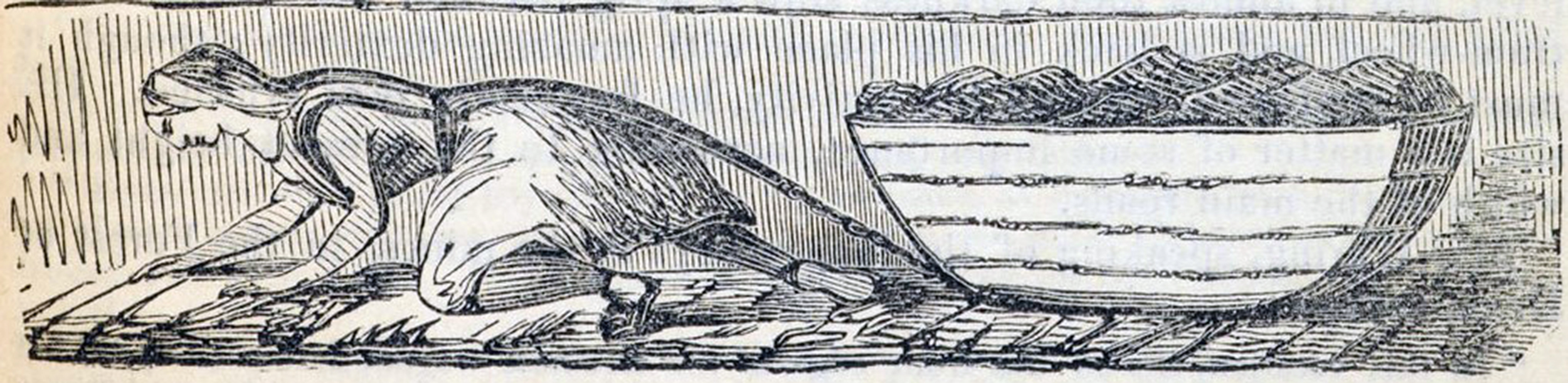 15 May 1841: Patience Kershaw (17) tells the Children’s Employment Commission (Mines) about her work at Joseph Stocks’ Booth Town Pit, Halifax
Comment
Comment
Re this wave of unofficial strikes:
Major-General Sir Noel Holmes, chairman of the north-eastern division of the National Coal Board, in a statement yesterday on the strike at Grimethorpe Colliery, said that 140 coal-face workers, out of 2,682 employed at the pit, were not doing a fair day’s work. A committee representing management and workmen had decided that the stint for the 140 workers should be increased by 2ft., but they refused to accept its findings and came out on strike. The other coal-face workers came out in sympathy. “As much as I dislike mentioning this fact,” said Sir Noel Holmes, “it is only right to recall that at Grimethorpe since January 1, 1947, and before the present strike, there have been 26 sectional unofficial stoppages, which have lost 33,000 tons of coal to the nation. The present stoppage up to date represents a further loss of more than 40,000 tons.” (Times 1947/08/27)
Holmes’s Wikipedia article curiously doesn’t mention this phase of his career.
I’m guessing that the Welsh ex-Puritan authoritarian Communist Arthur Horner is the voice of the NUM in the above – see e.g. the Times for 9 September.
Interesting comments on the wartime coal boards by T.S. Charlton, colliery manager at Cortonwood:
The management of the collieries is in the hands of men trained primarily in management of mines and miners. They have a working knowledge of all the machinery available and how best it can be used, but the details of this side are left to the mechanical and electrical engineer. Labour costs are two-thirds of production costs, and therefore the handling and the best use of men are of the greatest importance to managers. Why it should have been decided that labour leaders should be good labour directors is, apart from the political issue, difficult to understand, unless it is on the old adage of “poacher turned gamekeeper.” Unless and until the production director has control of his labour side, I can see little hope of his schemes proving effective.
The miners have put forward suggestions to improve output, but they appear to do no more than improve the position of the miner. Can it be said that any suggestion already put forward by the men has put up the output figure? Why should it be assumed the men’s side of the pit production committees should be able to improve output in any way? Their training, inclinations, and very job depend upon their obtaining the best for their electors rather than for production.
(Charlton 1943/12/01)
Charlton was clearly a clever and capable man – it would be good to know more about him.
Something to say? Get in touch
Search
Subscribe/buy
Donate
Music & books
Place-People-Play: Childcare (and the Kazookestra) on the Headingley/Weetwood borders next to Meanwood Park.
Music from and about Yorkshire by Leeds's Singing Organ-Grinder.
 RSS feed
 Bluesky
 Extwitter