28 December 1886: James Lonsdale Broderick (45) makes his final journey, from Hawes over Buttertubs Pass to a grave above the family farm near Crackpot (Swaledale)
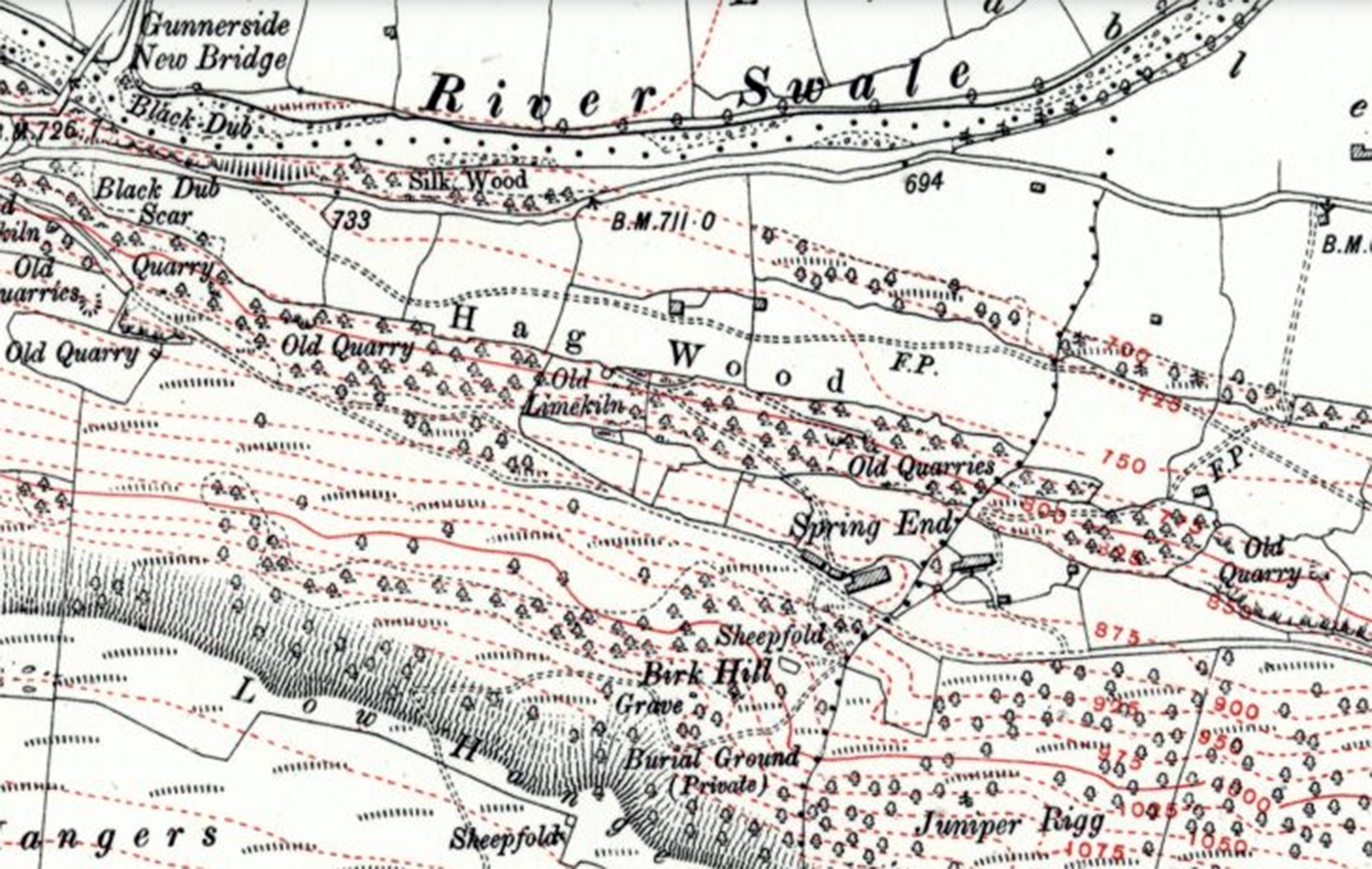
The Broderick farm at Spring End and James Broderick’s resting place at Birk Hill (Ordnance Survey 1914).
Ella Pontefract. 1934. Swaledale. London: J.M. Dent and Sons. Get it:
.Unedited excerpt
If an excerpt is used in the book, it will be shorter, edited and, where applicable, translated.
ACROSS THE VALLEY TO HARKERSIDE
THE road going up the dale from Gunnerside crosses the Swale over a bridge which slants conveniently upwards with the hill. Just below this bridge Gunnerside Beck empties itself into the river. Above it a narrow lane turns to the left to run along the hill on the south side of the river to Summer Lodge and Crackpot.
A large house on the left of the lane is Spring End, a home since Elizabethan days of the Broderick family, one of whom has the peculiar epitaph on his tomb in Muker churchyard. It is still owned by the family, though now only used as a holiday residence, and one end is a farm-house. Resting as it does close under the fells, for six months of the year the sun never reaches the back of the house. The front stands bravely up to the weather. An ancestor of the Brodericks planted two Dutch elms near the house to show his allegiance to the Orange family. Some years ago, when the interior was being altered, one of the dividing walls was found to be double, and a skeleton had been built in between; its story is unknown.
The name of the family shows them to be of Scandinavian descent, their ancestors probably coming into the dale with the Norse chief, Gunnar, who named Gunnerside. They remained for many generations yeomen farmers. Some of their descendants have had unusual ideas about their tombs and burial-places. During the last century one of them expressed a wish to be buried on a ridge of the fells behind Spring End, over which he had roamed, and which he had loved, as a boy. He died in Hawes on 28th December 1886, and from there a few days later, in bitterly cold weather, his funeral procession started out. On the Buttertubs Pass it was overtaken by a blizzard, and snow lay thickly. It was a wild journey, but the mourners struggled on, to be met at Muker by the vicar with the news that the bishop had forbidden him to read the burial service over one who had deliberately planned to be buried in unconsecrated ground. In a hailstorm, relays of bearers carried the coffin to the grave on a level terrace of the hill, and a brother of the dead man read the service. In 1932, another Broderick was buried there, but his remains were first cremated.
It is a peaceful spot, this terrace above the house, sheltered and nearly hidden by a border of birch-trees. It is known as Birk Hill. No rails or inscription mark the grave, simply a mound with a heap of stones at its head.


Comment
Comment
I think Ms Pontefract has confused the dates of death (22 December) and burial (which I’m taking to be her 28 December). Her Elizabethan claim is also interesting – English Heritage thinks Spring End farmhouse and Joe House are both late 18th century. I suspect that the stone memorial (page has more info on JLB) was already there by the time the book went to press. The “peculiar epitaph” in Muker churchyard is not on the gravestone of James’s brother, Luther Broderick (1847-1933), but on the one Luther composed for his parents, Edward (1807-75) and Ann (1819-77):
I want the world to know,
That I know,
That there is no fame,
That all life is co-equal,
That deficiency of intellect is the why
of deficiency in action.That everything is right,
That every atom vibrates
At its proper time, according
to the true results of the forces
that went before.
Hints of Luther’s life and struggles may be found in this index to the Broderick papers at the Richmondshire Museum. I hope someone will tell me more about this remarkable family.
Something to say? Get in touch
Tags
Tags are assigned inclusively on the basis of an entry’s original text and any comment. You may find this confusing if you only read an entry excerpt.
- Blizzard (2) W/G ·
- Burial (12) W/G ·
- Church of England (94) W/G ·
- Ella Pontefract (1) W/G ·
- Epitaph (8) W/G ·
- Gunnerside (2) W/G ·
- Hail (4) W/G ·
- Hawes (1) W/G ·
- Marie Hartley (1) W/G ·
- Muker (2) W/G ·
- Snow (18) W/G ·
- Swaledale (5) W/G ·
- Vikings (6) W/G ·
- Wensleydale (4) W/G ·
- Yorkshire Dales (9) W/G ·
Comment
Comment
I think Ms Pontefract has confused the dates of death (22 December) and burial (which I’m taking to be her 28 December). Her Elizabethan claim is also interesting – English Heritage thinks Spring End farmhouse and Joe House are both late 18th century. I suspect that the stone memorial (page has more info on JLB) was already there by the time the book went to press. The “peculiar epitaph” in Muker churchyard is not on the gravestone of James’s brother, Luther Broderick (1847-1933), but on the one Luther composed for his parents, Edward (1807-75) and Ann (1819-77):
I want the world to know,
That I know,
That there is no fame,
That all life is co-equal,
That deficiency of intellect is the why
of deficiency in action.That everything is right,
That every atom vibrates
At its proper time, according
to the true results of the forces
that went before.
Hints of Luther’s life and struggles may be found in this index to the Broderick papers at the Richmondshire Museum. I hope someone will tell me more about this remarkable family.
Something to say? Get in touch
Similar
 9 April 2021: The Singing Organ-Grinder sees his new home of Leeds from the M62, and a terrible memory surfaces
Comment
Comment
Via Roy Wiles (Wiles 1965).
Events
“Sunday last” is 25 August, but Fawcett managed to get in by 11 September:
On Wednesday last Mr. Fawcett for the first time performed Divine Service in the chapel of Holbeck, but was escorted to and from the chapel by a party of Dragoons, who kept guard at the doors during the service. Notwithstanding this precaution, some evil-disposed people found means to break the windows and throw a brickbat at Mr. Fawcett while he was in the reading- desk. The Sunday following he went through the service unmolested. And on Sunday last he preached a most excellent sermon, 46th verse of 13th chapter of Acts… The same night some prophane sacrilegious villains broke into the chapel and besmeared the seats with human excrements.
On 22 September he was able to conduct a reduced Sunday service in peace:
On Sunday last the Rev. Mr. Fawcett was received and behav’d to by his congregation at Holbeck with great decency… One of Mr. F.’s friends admitted their favourite preacher to his pulpit in the town-by this means the tumultuous part of the people were mostly drawn away from Holbeck, and the curate left at liberty to perform his duty amongst the peaceable and well-disposed inhabitants of the chapelry.
However, on 22 October we read that
In the night between the 16th and 17th inst., the windows of the chapel of Holbeck were again broken. No wonder, when Holbeck contains such a nest of vermin whom neither the laws of God or man can confine within the bounds of decency, etc.
For which John Robinson, a “Houlbecker,” was in November sentenced to be whipped and to pay a fine of £5 (Griffith Wright 1895).
In the summer of the following year he published his first Sunday’s sermon and and his resignation letter. I think that in the following Fawcett is quoting things actually said to him:
A man might oftentimes, by due Care and Watchfulness, perhaps very safely defeat the Schemes, and discourage the Practices of the private Pilferer; and yet, whenever this is done, it is commonly suspected to be done rather for the Preservation of his own Property, than out of a pure Regard to the Public-good: But when he is attack’d in his house, or upon the road by open Plunderers, and requir’d to deliver, or suffer himself to be rifl’d of what he is possess’d of, with some one of these dreadful Alternatives, of having his Brains immediately blown out,” or their hands “wash’d in his hearts Blood,” or “having bis “Entrails pull’d out at his Mouth,” or “being “buried alive,” it will Then surely be accounted highly Romantic in him to reject their demands, out of a Pretence to prevent the bad Influence of their Example; and he will be generally suspected of giving a Proof of his Fool-hardiness or his Avarice, rather than of his public Spirit, by such a Refusal.
In the resignation letter he says that he
perform’d the Duty of the Curacy for near Three Months after he gain’d Admission into the Chapel, and this too, rather to prepare a Say for the peaceable Reception of any other Person whom the Patron shou’d think proper to nominate, that out of any Prospect of reconciling the People to himself.
Fawcett declines to attribute responsibility (“Who the Incendiaries were, the Sufferer neither Pretends to Know, nor Desires to be Inform’d”). He also explicitly excuses the lord of the manor, who at this juncture I take to be Lord Irwin (aka Henry Ingram, 7th Viscount of Irvine) rather than the Whiggish Scholey family, as well as other leading citizens (Fawcett 1755).
Was Fawcett a lousy preacher, or was the mob’s alternative, whoever he was, utterly adorable? Was there a Whiggish or Radical element at work? Was there some element of revenge for Samuel Kirshaw’s victory over James Scott in the struggle from 1745-51 for the vicarage of Leeds (Taylor 1865)? Perhaps you know.
Something to say? Get in touch
Search
Subscribe/buy
Donate
Music & books
Place-People-Play: Childcare (and the Kazookestra) on the Headingley/Weetwood borders next to Meanwood Park.
Music from and about Yorkshire by Leeds's Singing Organ-Grinder.
 RSS feed
 Bluesky
 Extwitter