26 August 1914: From Pontefract to the mines on the Franco-Belgian border: Cpl. Frederick William Holmes wins a VC at Le Cateau
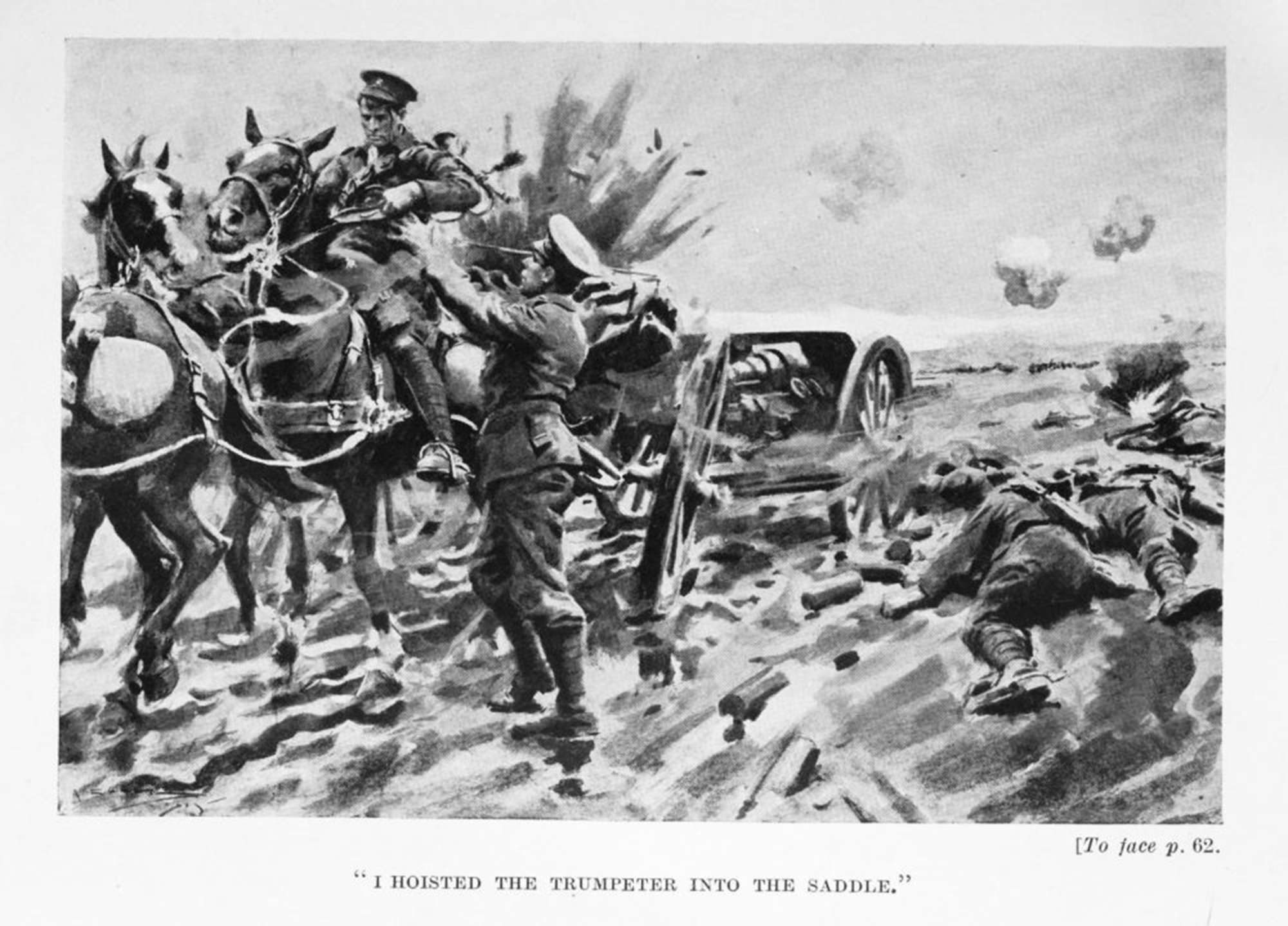
“I hoisted the trumpeter into the saddle,” by A.C. Michael (Michael 1915).
Frederick William Holmes. 1915. The Most Critical Day of All. Soldiers’ Stories of the War. Ed. Walter Wood. London: Chapman and Hall. Get it:
.Unedited excerpt
If an excerpt is used in the book, it will be shorter, edited and, where applicable, translated.
“THE MOST CRITICAL DAY OF ALL”
[Editor’s intro: In the first four months of the war nineteen Victoria Crosses were gazetted for valour in the field, and of these no fewer than five were awarded for the sanguinary fighting at Le Cateau on August 26th, 1914. In his despatch dealing with the retreat from Mons Sir John French described the 26th as “the most critical day of all.” …]
The regimental depôt is at Pontefract, in South Yorkshire, which some unkind people say is the last place that God started and never finished, and in August, having become a soldier again, after marrying and settling down to civil life in Dublin, I found myself in a region which was almost like the South Yorkshire coalfields. There were the same pit-heads and shale-heaps, so that you could almost think you were in England again—but how different from England’s calmness and security! It was around these pit-heads and shale-heaps that some of the fiercest fighting of the earlier days of the war took place…
I know what Mons was and I went through the battles of the Marne and the Aisne; but nothing I had seen could be compared for fury and horror with the stand of the 5th Division on the 26th. It was essentially a fight by the 5th, because that was the only division employed at Le Cateau. The division was composed of three brigades, the 12th, 13th and 14th. My battalion, the 2nd Yorkshire Light Infantry, was in the 13th, the other battalions with us being the West Riding, the King’s Own Scottish Borderers and the West Kent.
There were some coal-pit hills in front of us and the Germans advanced over them in thousands. That was about eleven o’clock in the morning, and the firing began in real earnest again.
The Germans by this time were full of furious hope and reckless courage, because they believed that they had got us on the run and that it was merely a question of hours before we were wiped out of their way. Their blood was properly up, and so was ours, and I think we were a great deal hotter than they were, though we were heavily outnumbered. We hadn’t the same opinion of German soldiers that the Germans had, and as they rushed on towards us we opened a fire from the trenches that simply destroyed them.
Some brave deeds were done and some awful sights were seen on the top of the coal-pits. A company of Germans were on one of the tops and an officer and about a dozen men of the “Koylis” went round one side of the pit and tried to get at them. Just as they reached the back of the pit the German artillery opened fire on the lot, Germans and all—that was one of their tricks. They would rather sacrifice some of their own men themselves than let any of ours escape—and they lost many in settling their account with the handful of Englishmen who had rushed behind the pit at a whole company of Germans.
Hereabouts, at the pits, the machine-gun fire on both sides was particularly deadly. Lieutenant Pepys, who was in charge of the machine-gun of our section, was killed by shots from German machine-guns, and when we went away we picked him up and carried him with us on the machine-gun limber until we buried him outside a little village in a colliery district.
He was a very nice gentleman and the first officer to go down. When he fell Lieutenant N. B. Dennison, the brigade machine-gun officer, took charge. He volunteered to take over the gun, and was either killed or wounded. Then Lieutenant Unett, the well-known gentleman jockey, crawled on his stomach to the first line of the trenches, with some men, dragging a machine-gun behind them. They got this gun into the very front of the line of the trenches, then opened fire on the Germans with disastrous effect. Lieutenant Unett was wounded and lay in the open all the time.
This gallant deed was done between twelve noon and one o’clock, and I was one of the few men who saw it. I am glad to be able to pay my humble tribute to it.
There was a battery of the Royal Field Artillery on our left rear, about 800 yards behind the front line of trenches. Our gunners had such excellent range on the Germans that the German gunners were finding them with high explosive shell. It was mostly those shells that were dropping on them till they got the range and killed the gunners. There were only about five who were not either killed or wounded. The officer was wounded; but in spite of that he carried a wounded man round the bottom of the hill, then went back and fetched another man and repeated the journey until he had taken every one of the five away. After that he returned, picked up a spade and smashed the sights of the gun and made it useless. We heard some time afterwards that he had been killed.
This brave deed was witnessed by most of us who were in the front line of trenches.
When the German guns were got into position in front of us and the Germans tried their hardest to blow us out of our trenches, they searched for our artillery and, failing to discover it, they grew more determined than ever to rout us out of the place from which we were doing deadly damage.
In spite of the heavy losses around us we held on, and all the more stubbornly because we expected every moment that the French would come up and reinforce us. The French were due about four o’clock, but owing to some accident they did not arrive, and it seemed as if nothing could save us.
There was a falling off in our artillery fire, and it was clear that one of our batteries had been put out of action. And no wonder, for the German guns were simply raining shells upon us. The Germans at that time were sticking to the dense formations which had been their practice since the war began—and they hurled themselves forward in clouds towards the 37th Field Battery.
So furiously did they rush, so vast were their numbers, and so certain were they that they had the guns as good as captured, that they actually got within a hundred yards of the battery.
It was at this terrible crisis that Captain Douglas Reynolds and volunteers rushed up with two teams and limbered up two guns, and in spite of all the German batteries and rifles did one gun was saved. This was a wonderful escape, in view of the nearness of the German infantry and their numbers, and for their share in the desperate affair the captain and two of the drivers — Drain and Luke — who had volunteered, got the Victoria Cross.
In a way we had got used to retiring, and we were not at the end of it even now, by a good deal, for on our left the Borderers were withdrawing and on our right the Manchesters were being forced right back; fighting magnificently and leaving the ground littered with their dead and wounded.
The Yorkshire Light Infantry were left in the centre of the very front line of the trenches, where we were heavily pressed. We made every mortal effort to hold our ground, and C Company was ordered up from the second line to reinforce us in the first.
Imagine what it meant for a company of infantry to get from one trench to another at a time like that, to leave shelter, to rush across a space of open ground that was literally riddled with shrapnel and rifle bullets, and in the daytime, too, with the Germans in overwhelming force at point-blank range.
But the order had been given, and C Company obeyed. The men sprang from their trench, they rushed across a fire-swept zone—and the handful of them who were not shot down made a final dash and simply tumbled into our trench and strengthened us. They had just about lost their first wind, but were soon hard at it again with the rifle and did murderous work, if only to get something back on account of the comrades who had fallen.
It was a help, a big help, to have C Company with us in the front trench; but even with this reinforcement we could do nothing, and after we had made a hot stand the order came to retire. That was about half-past four in the afternoon.
Things had been bad before; they were almost hopeless now, for to retire meant to show ourselves in the open and become targets for the German infantry; but our sole chance of salvation was to hurry away—there was no thought of surrender.
When the order was given there was only one thing to do—jump out of the trenches and make a rush, and we did both; but as soon as we were seen a storm of bullets struck down most of the men.
At such a time it is every man for himself, and it is hardly possible to think of anything except your own skin. All I wanted to do was to obey orders and get out of the trench and away from it.
I had rushed about half-a-dozen yards when I felt a curious tug at my boot. I looked to see what was the matter and found that my foot had been clutched by a poor chap who was wounded and was lying on the ground unable to move.
“For God’s sake, save me!” he cried, and before I knew what was happening I had got hold of him and slung him across my back. I can’t pretend to tell you details of how it was all done, because I don’t clearly remember. There was no time to think of much besides the bullets and the fastest way of getting out of their reach. Rain was falling, not heavily, but it was drizzling, and this made the ground greasy and pretty hard going.
I had not gone far before the poor chap complained that my equipment hurt him and begged me to get it out of his way. The only thing to be done was to drop the equipment altogether, so I halted and somehow got the pack and the rest of it off, and I let my rifle go, too, for the weight of the lot, with the weight of a man, was more than I could tackle.
I picked my man up again, and had struggled on for twenty or thirty yards when I had to stop for a rest.
Just then I saw the major of the company, who said, “What’s the matter with him?”
I could not speak, so I pointed to the man’s knees, which were shot with shrapnel; then the major answered, “All right! Take him as far as you can, and I hope you’ll get him safely out of it.”
I picked him up again and off I went, making straight over the hill at the back of the position we had taken, so that he should be safe from the German fire. The point I wanted to reach was about a mile away, and it was a dreadful journey; but I managed to do it, and when I had got there, after many rests, I started to carry my man to the nearest village, which was some distance off.
I got to the village, but the German heavy shells were dropping so fast that I could not stay there, and they told me to carry him into the next village. I was pretty well worn out by this time, but I started again, and at last with a thankful heart I reached the village and got the man into a house where wounded men were being put.
How far did I carry him?
Well, it was calculated that the distance was three miles; but I never felt the weight. Yes, he was quite conscious and kept on moaning and saying, “Oh!” and telling me that if ever he got out of it he would remember me; but I said that he mustn’t talk such nonsense—for I wanted him to stop thanking me and to keep his spirits up.
I don’t know how long I was in getting him over the ground, for I had no idea of time.
Having put my man in safety I left the house and began to go back to the position, expecting to find some of the regiments to rejoin, but when I reached the firing line there were no regiments left. They had been forced to retire, and the ground was covered with the dead and wounded, as it was impossible to bring all the wounded away.
There was a road at this particular point, and on reaching the top of it I saw the Germans advancing, about 500 yards away. Between them and myself there was a field-gun, with the horses hooked in, ready to move off; but I saw that there was only a wounded trumpeter with it.
I rushed up to him and shouted, “What’s wrong?”
“I’m hurt,” he said. “The gun has to be got away; but there’s nobody left to take it.”
I looked all around, and saw that there were no English gunners left—there were only the Germans swarming up, 500 yards away and badly wanting to get at the gun.
There was not a second to lose. “Come on,” I said, and with that I hoisted the trumpeter into the saddle of the near wheel horse, and clambering myself into the saddle of the lead horse we got the gun going and made a dash up the hill.
There was only the one road, and this was so littered up and fenced about with wire entanglements that we could not hope to escape by it. Our only chance was by dashing at the hill, and this we did—and a terrible business it was, because we were forced to gallop the gun over the dead bodies of our own men—mostly artillerymen, they were. Many of the poor chaps had crawled away from their battery and had died on the hillside or on the road.
We carried on over the hill, and when the Germans saw what we were doing they rained shells and bullets on us. One or two of the horses were hit, and a bullet knocked my cap off and took a piece of skin from my head—just here. But that didn’t hurt me much, nor did another bullet which went through my coat. We carried on, and got over the hill, just driving straight ahead, for we couldn’t steer, not even to avoid the dead.
I daresay the bullet that carried off my cap stunned me a bit, at any rate I didn’t remember very much after that, for the time being; all I know is that we galloped madly along, and dashed through two or three villages. There was no one in the first village; but in the second I saw an old lady sitting outside a house, with two buckets of water, from which soldiers were drinking. She was rocking to and fro, with her head between her hands, a pitiful sight. Shells were dropping all around and the place was a wreck.
I carried on at full stretch for about ten miles, tearing along to get to the rear of the column. I don’t remember that I ever looked back; but I took it that the trumpeter was still in the saddle of the wheel horse.
At last I caught up with the column; then I looked round for the trumpeter, but he was not there, and I did not know what had become of him. That was the first I knew of the fact that I had been driving the gun by myself.
Willy-nilly I had become a sort of artilleryman, and from that time until the 28th I attached myself to the guns; but on that day I rejoined what was left of my old regiment.
I had been in charge of twelve men, but when I inquired about them I found that only three were left—nine had been either killed or wounded, and the rest of the battalion had suffered in proportion. That gives some idea of the desperate nature of the fighting and the way in which the little British army suffered during the first three days after Mons.
The officer who had seen me carrying the man off did not see me go back, but a sergeant who knew me noticed me passing through the village with the gun and he was the first man of my battalion that I saw. This was Sergeant Marchant, who, for his gallantry in helping another sergeant, who was wounded, was awarded the Distinguished Conduct Medal. In that fine affair he was helped by Company-Sergeant-Major Bolton, and both of them were mentioned in despatches.
Of course I never thought of saying anything about what I had done; but I was sent for and asked if it was true, and I said I had got the man away and helped to take the gun off, and this was confirmed by the major who had seen me carrying the man.
For the day’s work at Le Cateau two Victoria Crosses were given to my regiment—one to Major C. A. L. Yate, “Cal,” he was called, because of his initials, and one to myself.


Comment
Comment
A splendid account, but probably unjustified here. Holmes was born in Bermondsey, was living at the time in Dublin, and had, as far as I know, no Yorkshire connection. Moreover, I have no idea what the “coal-pit hills in front of us” might be, for, although Holmes will presumably have seen some of the mining districts in getting to the front, Le Cateau is southeast of Cambrai, well to the south of them:

I wonder about the role of the editor in all this. Several of the other accounts feel like they have been through the propaganda mill, and Holmes’ PR value was certainly appreciated:
In July 1915 the Doncaster Chronicle excitedly reported on ‘Stirring Scenes at the Halls’ of Doncaster, as Frederick visited local theatres on a recruitment tour. Frederick had a whirlwind tour of Doncaster, giving two talks at the Palace Theatre and two at the Grand Theatre. The previous day he’d been speaking at a large meeting in Pontefract. Frederick described himself as ‘one of Kitchener’s representatives’ and appeared at these talks on behalf of the Parlimentary Recruiting Committee with the express aim of enlisting men. Frederick was particularly blunt with his delivery and had a lot to say at these recruitment talks about men who had not yet joined the army. He said
Men staying at home between the ages of 18 and 40 who are not doing Government work and have no home ties or responsibilities should be downright ashamed of themselves for not being in khaki.. Many a man claps me at a theatre who ought to go out himself and do his bit.. I told people there would be ‘registration’ three months ago and I have told them there will be conscription.
Frederick took particular issue with men who worked in shops, arguing that they had ‘girlish’ jobs and stating he wasn’t interested in the men making munitions but wanted men ‘from behind the drapers’ counters’ to join the army. The Chronicle stated it was clear that Frederick did not enjoy the work he was doing, but was just following orders. As quickly as he arrived he left to catch the late train back to London.
(Lynseys 2016)Something to say? Get in touch
Tags
Tags are assigned inclusively on the basis of an entry’s original text and any comment. You may find this confusing if you only read an entry excerpt.
- Battle of Le Cateau (1) W/G ·
- British Army (19) W/G ·
- British Expeditionary Force (World War I) (2) W/G ·
- Coal mining (27) W/G ·
- Douglas Reynolds (1) W/G ·
- Dublin (1) W/G ·
- France (34) W/G ·
- Frederick Luke (1) W/G ·
- French Army (1) W/G ·
- Germany (25) W/G ·
- Holmes, Frederick William (1) W/G ·
- II Corps (United Kingdom) (1) W/G ·
- Ireland (24) W/G ·
- Job Henry Charles Drain (1) W/G ·
- King’s Own Yorkshire Light Infantry (2) W/G ·
- Mons (3) W/G ·
- Nord (French department) (1) W/G ·
- Nord-Pas-de-Calais (1) W/G ·
- 📌Pontefract (20) W/G ·
- Victoria Cross (3) W/G ·
- Western Front (World War I) (3) W/G ·
- World War I (1914-19) (21) W/G ·
- Yate, Charles Allix Lavington (1872-1914) (1), Shropshire-born major in the King's Own Yorkshire Light Infantry, VC at Le Cateau W/G ·
Comment
Comment
A splendid account, but probably unjustified here. Holmes was born in Bermondsey, was living at the time in Dublin, and had, as far as I know, no Yorkshire connection. Moreover, I have no idea what the “coal-pit hills in front of us” might be, for, although Holmes will presumably have seen some of the mining districts in getting to the front, Le Cateau is southeast of Cambrai, well to the south of them:
I wonder about the role of the editor in all this. Several of the other accounts feel like they have been through the propaganda mill, and Holmes’ PR value was certainly appreciated:
In July 1915 the Doncaster Chronicle excitedly reported on ‘Stirring Scenes at the Halls’ of Doncaster, as Frederick visited local theatres on a recruitment tour. Frederick had a whirlwind tour of Doncaster, giving two talks at the Palace Theatre and two at the Grand Theatre. The previous day he’d been speaking at a large meeting in Pontefract. Frederick described himself as ‘one of Kitchener’s representatives’ and appeared at these talks on behalf of the Parlimentary Recruiting Committee with the express aim of enlisting men. Frederick was particularly blunt with his delivery and had a lot to say at these recruitment talks about men who had not yet joined the army. He said
Men staying at home between the ages of 18 and 40 who are not doing Government work and have no home ties or responsibilities should be downright ashamed of themselves for not being in khaki.. Many a man claps me at a theatre who ought to go out himself and do his bit.. I told people there would be ‘registration’ three months ago and I have told them there will be conscription.
Frederick took particular issue with men who worked in shops, arguing that they had ‘girlish’ jobs and stating he wasn’t interested in the men making munitions but wanted men ‘from behind the drapers’ counters’ to join the army. The Chronicle stated it was clear that Frederick did not enjoy the work he was doing, but was just following orders. As quickly as he arrived he left to catch the late train back to London.
(Lynseys 2016)Something to say? Get in touch
Similar
Comment
Comment
I suspect Wardell’s real pleasure is in his footnote:
This person was found guilty and executed at York in 1696, for counterfeiting the current coin. The attic story of his dwelling-house in Briggate, was the place he used for this purpose, and was discovered in 1836, by some workmen engaged in repairing the premises. The apparatus used by him, together with a few silver coins were also found at the same time therein.
Something to say? Get in touch
Search
Subscribe/buy
Donate
Music & books
Place-People-Play: Childcare (and the Kazookestra) on the Headingley/Weetwood borders next to Meanwood Park.
Music from and about Yorkshire by Leeds's Singing Organ-Grinder.
 RSS feed
 Bluesky
 Extwitter