4 November 1857: Completion of the White Horse of Kilburn (Hambleton Hills)
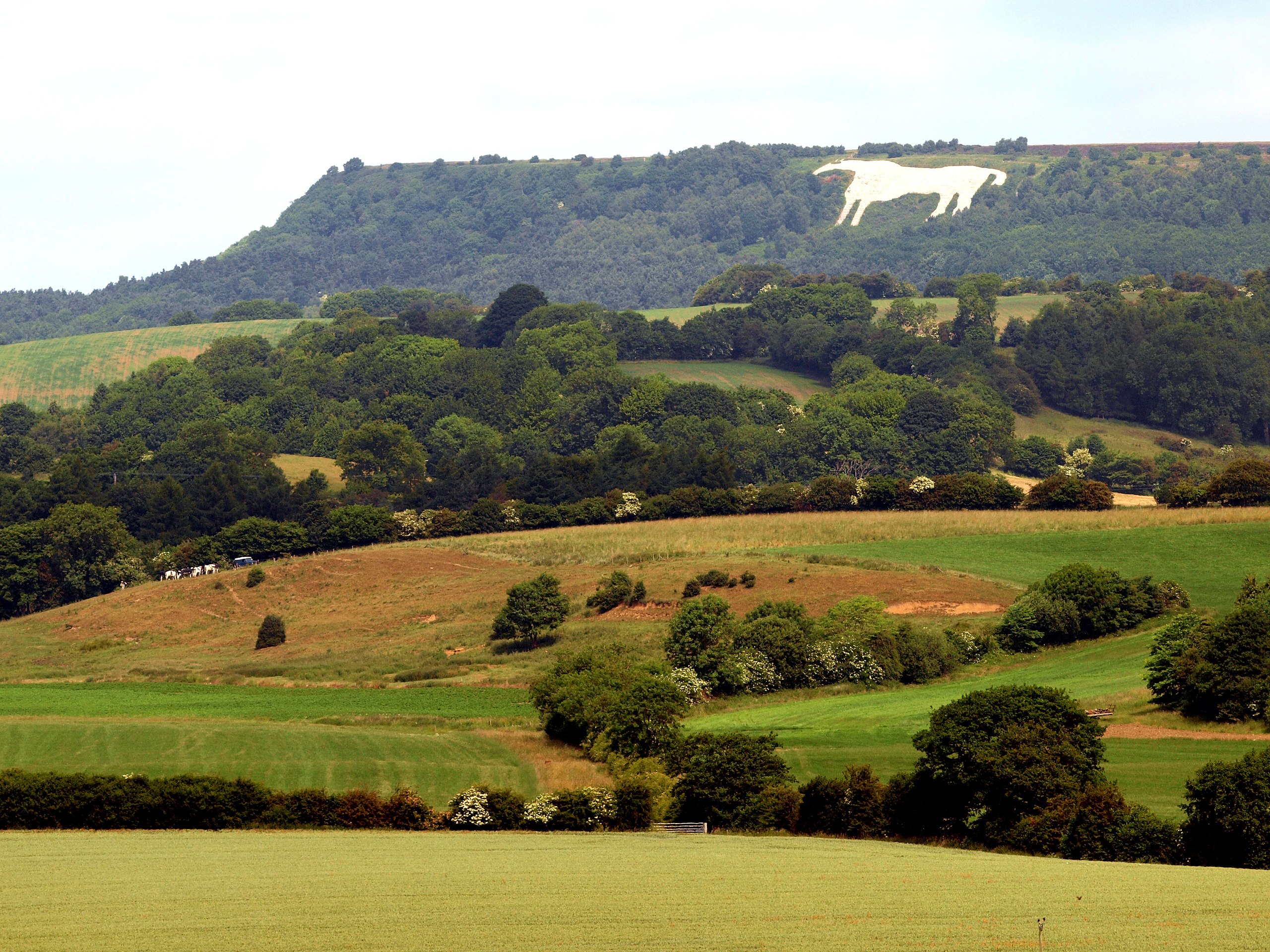
Royston Scar with Kilburn White Horse from near Coxwold (Beecroft 2010).
William Grainger. 1887. The White Horses of the Hambleton Hills. The Monthly Chronicle of North-country Lore and Legend. Ed. Newcastle Weekly Chronicle. Newcastle upon Tyne: Walter Scott. Get it:
.Unedited excerpt
If an excerpt is used in the book, it will be shorter, edited and, where applicable, translated.
In the north-eastern side of the great vale of York are the Hambleton Hills, a long mountain range, presenting a bold elevation to the valley at its foot. On the face of this range of hills are two remarkable objects, severally named The White Horse of Kilburn, and The White Mare of Whitstonecliff, the first being the figure of a horse cut on the steep hill side, the second a rocky precipice, so named, on the face of the hill. These two objects can be seen at a great distance from the plain below, from the higher country towards the west and south-west, and from the North-Eastern Railway for several miles of its course…
The Kilburn White Horse is situate only a few hundred yards south-east of Roulston Scar, the most south-western part of the Hambleton range. Here the precipice has become a steep slope, covered with turf, and on this slope the figure of an equine monster, whose profile can be seen at a distance of thirty miles, is cut. The length of the horse is 180 feet, and the height 80 feet; his one great green eye is three yards in diameter; the quantity of land he covers is three roods; and to make a fence around him would enclose two acres. This figure was first formed in November, 1857, by Mr. Thomas Taylor, a native of the village of Kilburn. The land on which the horse stands is, or was, the property of Mr. Dresser, of Kilburn Hall. Six tons of lime were used to give his skin the requisite whiteness, and thirty-three men at work upon him on the 4th of November, the day on which he was completed. The figure was cut merely to gratify the whim of the projector, not to commemorate any remarkable event. The ground covered by the horse requires to be carefully cleared of bracken at least once a year, or all traces of his existence would soon be obliterated.

Comment
Comment
WP:
Morris Marples in his 1949 book[2] gives Thomas Taylor the credit for being the prime mover: a native of Kilburn, he was a buyer for a London provision merchant. He seems to have attended celebrations at the Uffington White Horse in 1857, and he was inspired to give his home village a similar example.
Something to say? Get in touch
Tags
Tags are assigned inclusively on the basis of an entry’s original text and any comment. You may find this confusing if you only read an entry excerpt.
- Hambleton District (5) W/G ·
- Hambleton Hills (5) W/G ·
- Hill figure (2) W/G ·
- Horse (72) W/G ·
- Kilburn White Horse (2) W/G ·
- Kilburn, North Yorkshire (2) W/G ·
- Limestone (11), a common type of carbonate sedimentary rock, generally formed from the accumulation of corals and shells in the sea, often containing fossils; unsuited for textile manufacturing because of the hardness of the water and the relative lack of springs and brooks on its fells and in its gills W/G ·
- North Eastern Railway (United Kingdom) (3) W/G ·
- North Riding of Yorkshire (51) W/G ·
- Sutton Bank (1) W/G ·
- Uffington White Horse (1) W/G ·
- White horse (3) W/G ·
- White horses in mythology (3) W/G ·
Comment
Comment
WP:
Morris Marples in his 1949 book[2] gives Thomas Taylor the credit for being the prime mover: a native of Kilburn, he was a buyer for a London provision merchant. He seems to have attended celebrations at the Uffington White Horse in 1857, and he was inspired to give his home village a similar example.
Something to say? Get in touch
Similar
 23 January 1643: Thomas Fairfax, the Rider of the White Horse, captures Leeds from the Beast with the help of Psalm 68
 8 February 1745: Pioneering but pennyless philologist Eugene Aram murders a wealthy Knaresborough wastrel
Comment
Comment
Although a brief search didn’t throw up the date for 1874, other mentions in the period suggest that the Pateley races were held on the penultimate Monday of September – the 21st in 1874 – and in corroboration the first (rugby) football match in Nidderdale was held on this day at Pateley Bridge between Harrogate and Pateley and district. Re the 1877 feast:
The weather was fine, and though threatening clouds hung about during the morning, the country people turned out in strong force. There was a large contingent of pleasure seekers from Harrogate and other towns within easy reach of Pateley Bridge, which is approached by a single line from Harrogate, and the trains were crowded to excess. Hence the one narrow street which gives the appellation of Town to Pateley Bridge was thronged long before the sports were to commence, but the people who flocked in from the surrounding villages found plenty of amusement. Bands of music paraded the town, and an itinerant nigger band excited the greatest admiration of their rural audience. The races, which were the chief item in the afternoon’s programme, were held in a field on the side of the river Nidd, and close to the town, and there was a very large company present. The entries for the various events were larger than on any previous occasion. Each event was run in heats, and though the proceedings can hardly be dignified by the name of sport, yet the contests produced much amusement. There were several gentlemen who might by way of compliment be called bookmakers present, but their offers were of the most illiberal description. The betting is, of course, not quotable, though there was a good deal of wagering for small money on the various races.
(York Herald 1877/09/25)
Something to say? Get in touch
Search
Subscribe/buy
Donate
Music & books
Place-People-Play: Childcare (and the Kazookestra) on the Headingley/Weetwood borders next to Meanwood Park.
Music from and about Yorkshire by Leeds's Singing Organ-Grinder.
 RSS feed
 Bluesky
 Extwitter